


If you are in the midst of a house renovation, or are planning on doing one, LINQSTAT Volume-Conductive Film, a 3M Velostat alternative material is the perfect, cost-effective way to shield your entire house from unwanted radiation, radio frequency (RF) and electromagnetic interference (EMI).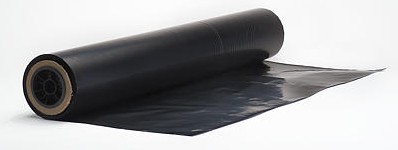 The most often heard downside to using the LINQSTAT material is that it should be used behind the drywall in a house. This means removing the existing drywall if the room is already finished; an understandably unwanted chore. If the room is not yet finished however, or there is a planned remodeling or renovation, LINQSTAT Volume-Conductive Film is a conductive plastic for RF shielding and can serve a dual purpose of a vapor barrier and EMI/RFI and radiation shield.
LINQSTAT VCF as a Vapor Barrier
The purpose of a vapor barrier is to stop the warm moist air from condensing on the cool concrete walls. This is accomplished by installing the vapor barrier to the warm (inside) side of the insulation. Without a vapor barrier, water vapor flows through the insulation and if the concrete wall is cold enough, the water vapor condenses on the concrete, drips down the wall and causes mildew, mold, rot, and water stains. 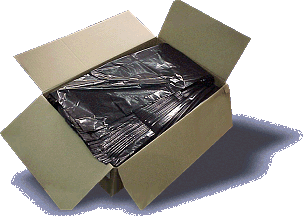
 In a basement, a continuous vapor barrier – minimum 4mil thick sheeting over unfaced insulation is recommended. LINQSTAT Volume-Conductive Film is a carbon-filled polyolefin. To the layman, this means that it is a plastic that is filled with carbon powder. If you didn’t know any better, the plastic looks like black, garbage-bag plastic. Our standard LINQSTAT VCF 200,000 Ohms/sq 4 mil Antistatic Film is thicker than a garbage bag (1mil (0.025mm) thick for the garbage bag vs. 4mil (0.1mm) thick for the VCF-40036S/2) and feels more like heavy-duty plastic sheeting. Even thicker plastic (which provides no more vapor protection but doubles the EMI/RFI shielding capabilities) is available in our 8-mil (0.2mm) grade (LINQSTAT VCF 200,000 Ohms/sq 8 mil Antistatic Film). A good guide on when/if or whether to install a vapor barrier in your house can be found on the natural handyman site.
LINQSTAT as an EMI/RFI Radiation Shield
Both 4mil (0.1mm) and 8mil (0.2mm) thick LINQSTAT VCF Film provide adequate vapor barrier protection, but the latter is twice as thick and therefore provides nearly 2 times the shielding strength. A minimum of 4mil (0.1mm) thickness is recommended, and 8mil (0.2mm) thick VCF plastic is optional depending on the level of EMI/RF Radiation shielding desired.
LINQSTAT is a cost-effective solution
With the LINQSTAT VCF-40036S/2 (the 4mil version) at $100.80 per 36in. x 150ft roll (minus discounts for multiple rolls) this works out to less than $2.50 per square meter (less than $0.25/sq.ft). The LINQSTAT VCF-80036S/2 (the 8 mil version) is $187.50 per 36in. x 150ft roll (minus discounts for multiple rolls) and works out to less than $4.50 per square meter (less than $0.42/sq.ft). Compare these to other solutions and you will find that they quickly climb from $7/sq.ft. to over $45/sq.ft.
CAPLINQ is a specialty plastics supplier offering a range of conductive materials including our broad range of electrically conductive plastics and antistatic tapes and films. If you have any questions, please don’t hesitate to contact us to find out how we can help you further to find a conductive plastic for your RF shielding application.


is there a more clothlike version of linqstat?
CAPLINQ does indeed manufacture anti-static fabrics, though they are not yet posted on the website. We manufacture:
a) Polyester & cotton with carbon conductive yarn. Resistance: 10^5 ? 1×10^7 to 1×10^7?1×10^11?. Metal conductive yarn is also possible.
b) Carbon Fibrous conductive yarn. Resistance: approximately 200?
c) Anti-electromagnetic Fabric
d) Conductive Sheet for electrode. Resistance: approximately 200?
Please contact us for your specific requirements.
Other products are listed with a chart (or whatever else) that states the level of blocking the material will block. Usually in the range of decibels:Hertz.
Do you have any such tests completed to know the level of protection you claim? Some materials, (which I am considering), claim to block up to 10GHz frequency; far surpassing the 2.6GHz +/- available in mobile tech and getting into microwave technology.
I’d like further Information on this fabric If I could get that emailed to me that would be pretty cool..
Can this be used as shielding for am MRI room
Can this be used as shielding for am MRI room
Hi Terry, though we believe you could use it for these purposes, we recommend that you test a small amount of material yourself to be sure it meets all your application requirements.