


When customers look at the technical datasheet (TDS) for LINQSTAT Volume Conductive Film, they often are confused by the electrical properties. The 3M Velostat material lists only Volume Resistivity as less than 500 ohm-cm, yet the LINQSTAT material lists Volume Resistivity, Volume Conductivity and Surface Resistivity. The fact of the matter is that they are all related, and if you know the Volume Resistivity of the material and the thickness of the sheeting, then you can calculate the other values.
Surface Resistance (also called Sheet Resistance) multiplied times the thickness of the material in centimeters, equals the Volume Resistivity.
Resistance vs. Resistivity vs. Conductivity vs. Conductance
There is such a confusing mixture of resistance and resistivity across the various literature source available both online and offline that one might start to get the idea that these are two different things. Very simply, a non-electrically conductive material is said to have a certain resistance, and if you are measuring this, you are measuring the material’s resistivity. If, on the other hand, the material is has a very low resistance, then it is said to be conductive, it can have a certain conductance, and you can measure the material’s conductivity.
Is conductance the opposite of resistance?
Yes. Conductance is the opposite of resistance, conductivity is the opposite of resistivity and conductive is the opposite of resistive. A low-resistance material can also be said to be conductive. Since the LINQSTAT Volume Conductive Film (VCF) materials are carbon-filled plastics, where the polyethylene is resistive, but the carbon is conductive, the films are said to be volume conductive films.
What is volume conductive?
What is different in both value and test method is the type of resistivity being measured. Since the films have a uniform thickness, a property that is often measured is the sheet resistance. This property is also called sheet resistivity, surface resistivity or surface resistance. All of these are the same, but are distinctly different from a material’s volume resistivity (also called volume resistance, bulk resistance or bulk resistivity).
Before we move on to the next section, let us be sure that we are clear on the following:
Volume Resistivity = Volume Resistance = Bulk Resistivity = Bulk Resistance
AND
Sheet Resistivity = Sheet Resistance = Surface Resistivity = Surface Resistance
Still with me? Ok, let’s go on to explain the difference between these two properties.
Surface (or Sheet) Resistivity vs. Volume Resistivity
Surface Resistivity is a measurement of the resistivity of a material along the plane or surface of the sheet. It is a useful measurement when measuring a thin film of material with a uniform thickness such as LINQSTAT VCF because it is independent of the material thickness, and can be measured across a range of (thin) thicknesses, such as our 2mil, 4mil or 8 mil LINQSTAT VCF films. Sheet resistance is expressed as ohms/sq, spoken as “ohms-per-square”. This unit is only used for sheet resistance because it is dimensionally the same as an ohm, but leaves no room for misinterpretation as one might mistake it for the bulk resistance otherwise.
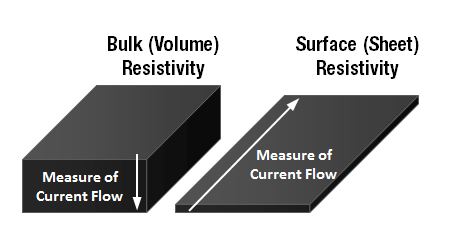
Volume Resistivity, therefore is a measurement of the resistivity of a material perpendicular to the plane. As such, we can multiply the sheet resistance by the thickness of the material (in centimeters) to give us a volume resistivity in “ohms-cm” or ohms-centimeters. Likewise, the Volume Resistivity divided by the thickness in centimeters equals the surface resistivity.
Volume Resistivity vs. Volume Conductivity
Volume resistivity is also called bulk resistivity because it is a measure of the resistivity across a defined thickness. As mentioned earlier, resistivity is the inverse of conductivity. Since volume resistivity is measured in Ohms-cm, or spoken as “ohms-centimeter”, volume conductivity is one-over-ohm-cm (1/Ω-cm) and is measured in S/cm, or spoken as “Siemen per centimeter”. Therefore, a Volume Resistivity of 500 ohm-cm is equal to a Volume Conductivity of 1/500 or 0.002 S/cm.
Therefore, looking at the LINQSTAT VCF materials, this is our “medium-level” volume conductive film and has a the surface resistivity of 10,000 ohm-cm (10^4 Ω-cm). If you are interested in a more conductive plastic, check out of XVCF-Series which has a higher carbon-loading making it more conductive.
- VCF-2xxxxS-Series: 10,000 ohms/square (Surface Resistance) x 2mil (0.00508cm) = ~50 ohms-cm (Volume Resistance)
- VCF-4xxxxS-Series: 10,000 ohms/square (Surface Resistance) x 4mil (0.01016cm) = ~100 ohms-cm (Volume Resistance)
- VCF-8xxxxS-Series: 10,000 ohms/square (Surface Resistance) x 8mil (0.02032cm) = ~200 ohms-cm (Volume Resistance)
Why does CAPLINQ give “less than” values (ie. <200,000 ohms per square) instead of Typical Values?
LINQSTAT Volume Conductive Film is a carbon-loaded polyethylene. As such, there are necessarily some differences in the conductivity over the entire surface. The data that CAPLINQ provides is meant to be a minimum, repeatable value that can be used in the design of the final product.
Watch this video to see how we measure Surface Resistivity vs Volume Resistivity
This video explains the way we measure Volume and Surface Resistivity of our LINQSTAT electrically conductive plastics.
Watch this video to learn the Difference between Surface Resistivity vs Volume Resistivity
This video explains the difference between Volume and Surface Resistivity of our LINQSTAT electrically conductive plastics.
CAPLINQ is a specialty plastics supplier offering a range of conductive materials including our broad range of electrically conductive plastics and antistatic tapes and films. If you have any questions, please don’t hesitate to contact us to find out how we can help you further.


2 thoughts on “Volume Resistivity vs. Volume Conductivity vs. Surface Resistivity”