
-
Home

-
Products
-
Thermal Interface Materials
-
One Part Hybrid
- HT 10000-R | One part Hybrid Thermal Gel
HT 10000-R | One part Hybrid Thermal Gel
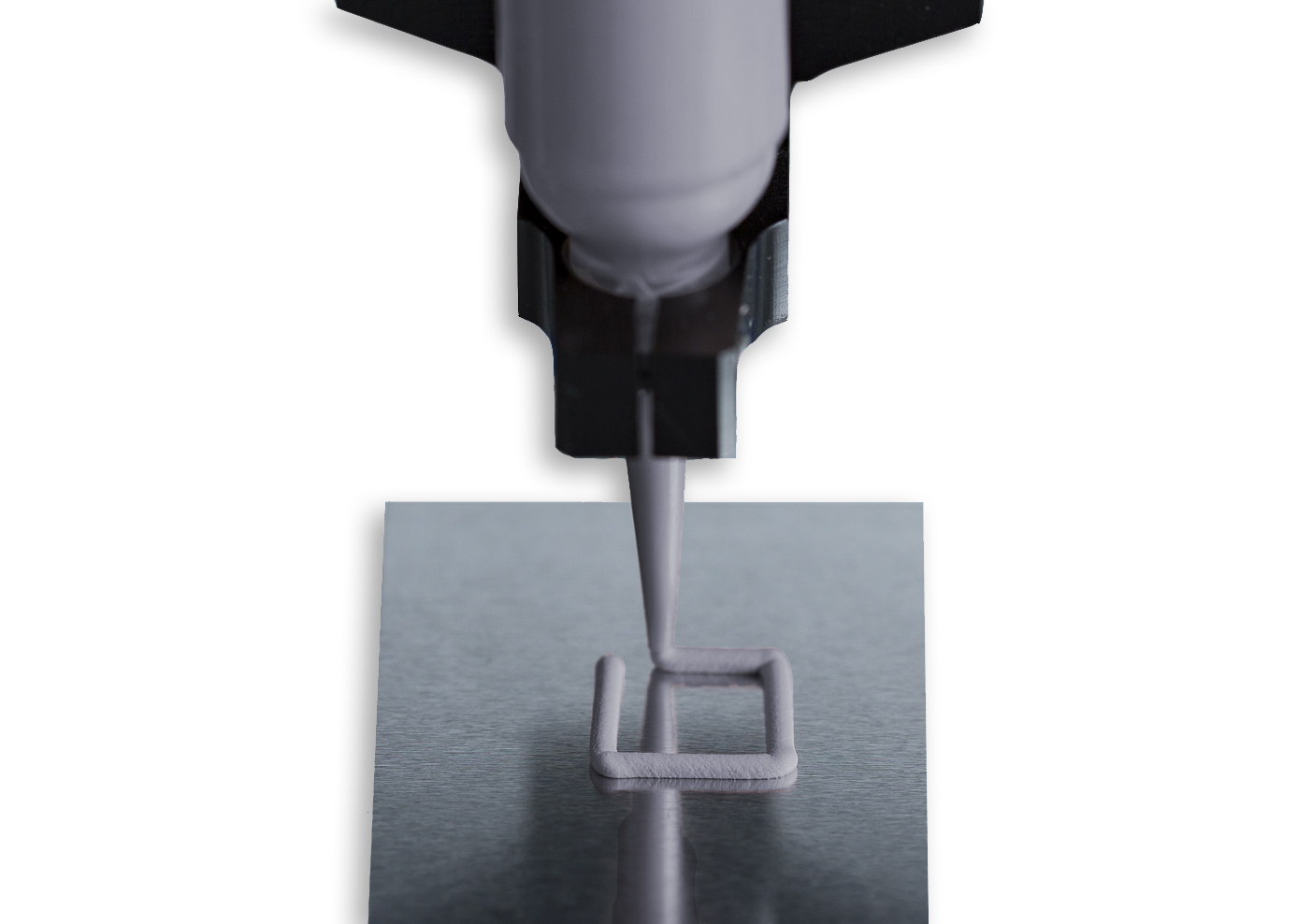

- Dark Gray
- 10 Thermal Conductivity
- Good dispense rate
Product Description
HT10000-R silicone based one-part hybrid thermal gel, provides top of the line thermal conductivity of 10.0 W/m·K along with high conformability and high compressibility, only to be challenged by HT11000 (11 W/mK) which is still rolling out of development. It is a max performance product, formulated to deliver high dispense rates for improved productivity, long-term reliability and easy reworkability.
HT10000-R is designed to minimize thermal resistance at interfaces, maintain excellent performance through reliability testing, and provide scalable applications at a competitive cost. Additionally it performs great in oil,crack and slump testing and it exhibits no pump out and cracking risk.
Technical Specifications
| General Properties | |||||
|
Color
Color
The color |
Light Gray | ||||
|
Specific Gravity
Specific Gravity
Specific gravity (SG) is the ratio of the density of a substance to the density of a reference substance; equivalently, it is the ratio of the mass of a substance to the mass of a reference substance for the same given volume. For liquids, the reference substance is almost always water (1), while for gases, it is air (1.18) at room temperature. Specific gravity is unitless. |
3.2 | ||||
|
|||||
| Thermal Properties | |||||
|
Thermal Conductivity
Thermal Conductivity
Thermal conductivity describes the ability of a material to conduct heat. It is required by power packages in order to dissipate heat and maintain stable electrical performance. Thermal conductivity units are [W/(m K)] in the SI system and [Btu/(hr ft °F)] in the Imperial system. |
10 W/m.K | ||||
Additional Information
To evaluate the reliability of HT10000-R under extreme conditions, a series of reliability tests were conducted, including high temperature baking, high temperature and high humidity testing, and thermal shock testing.
The thermal impedance results remained nearly constant throughout all tests, indicating that no material degradation occurred during exposure. The slight decrease in thermal resistance from the initial 𝑇0 is a positive indication, suggesting that the phase change material progressively filled microscopic air gaps at the interface, thereby enhancing the overall surface thermal contact.
High Temperature Baking
This test aims to evaluate the material’s thermal stability and resistance to degradation when exposed to elevated temperatures over an extended period. It helps assess whether prolonged heat exposure affects the material’s thermal performance, integrity, or reliability.
Test Method Specifications:
Test Condition: Samples together with the fixtures are maintained at 150℃ thermal baking chamber
Test Duration: 1000 hours
Samples Frequency: 3 batches with 3 samples per batch were tested

| Time | Thickness | |||||
| 0.5 mm | 1.5 mm | |||||
| #1 | #2 | #3 | #1 | #2 | #3 | |
| 0 hr | 0.10 | 0.10 | 0.10 | 0.25 | 0.25 | 0.26 |
| 250 hrs | 0.08 | 0.09 | 0.09 | 0.24 | 0.24 | 0.25 |
| 500 hrs | 0.08 | 0.08 | 0.08 | 0.24 | 0.24 | 0.24 |
| 750 hrs | 0.08 | 0.08 | 0.07 | 0.24 | 0.24 | 0.24 |
| 1000 hrs | 0.08 | 0.08 | 0.07 | 0.23 | 0.24 | 0.23 |
High Temperature & High Humidity Testing
This test aims to evaluate the material’s stability and reliability when exposed to prolonged high temperature and humidity conditions. It helps determine whether any physical, chemical, or performance degradation occurs under accelerated environmental stress.
Test Method Specifications:
Test Condition: Samples together with the fixtures are maintained at 85℃ temperature and 85% high humidity environment
Test Duration: 1000 hours
Samples Frequency: 3 batches with 3 samples per batch were tested

| Time | Thickness | |||||
| 0.5 mm | 1.5 mm | |||||
| #1 | #2 | #3 | #1 | #2 | #3 | |
| 0 hr | 0.10 | 0.10 | 0.10 | 0.25 | 0.25 | 0.24 |
| 250 hrs | 0.09 | 0.09 | 0.09 | 0.24 | 0.24 | 0.24 |
| 500 hrs | 0.09 | 0.08 | 0.08 | 0.23 | 0.23 | 0.23 |
| 750 hrs | 0.08 | 0.08 | 0.08 | 0.24 | 0.24 | 0.23 |
| 1000 hrs | 0.08 | 0.07 | 0.08 | 0.23 | 0.23 | 0.23 |
Thermal Shock Testing
This test aims to evaluate the material’s durability and reliability when subjected to rapid temperature changes between high and low extremes. It assesses the material’s ability to withstand thermal stress and maintain consistent performance without cracking, delamination, or degradation of thermal properties.
Test Method Specifications:
Test Condition: Samples together with the fixtures are transitioned between -40℃ and 150 ℃ with 1hr for one cycle, the transfer time is less than 10 seconds
Number of cycles: 1000 cycles
Samples Frequency: 3 batches with 3 samples per batch were tested

| Time | Thickness | |||||
| 0.5 mm | 1.5 mm | |||||
| #1 | #2 | #3 | #1 | #2 | #3 | |
| 0 hr | 0.10 | 0.10 | 0.10 | 0.25 | 0.26 | 0.26 |
| 250 hrs | 0.09 | 0.09 | 0.08 | 0.25 | 0.25 | 0.26 |
| 500 hrs | 0.08 | 0.08 | 0.07 | 0.24 | 0.24 | 0.25 |
| 750 hrs | 0.08 | 0.08 | 0.07 | 0.24 | 0.25 | 0.25 |
| 1000 hrs | 0.08 | 0.07 | 0.07 | 0.24 | 0.25 | 0.24 |
How to keep HT10000 from separating?
During the initial launch of the newest version HT10000-R, some customers encountered flow rate and separation issues.
The flow rate issue may have been caused by improper application, specifically:
(1) Continued high pressure applied after dispensing, causing silicone oil to be pushed out;
(2) We recommend using compressed air to push the plunger, air remains between the plunger next time. Material can not be pushed out well due to the low real pushing pressure.