Battery packs
Potting, gasketing and assembling

EV Batteries
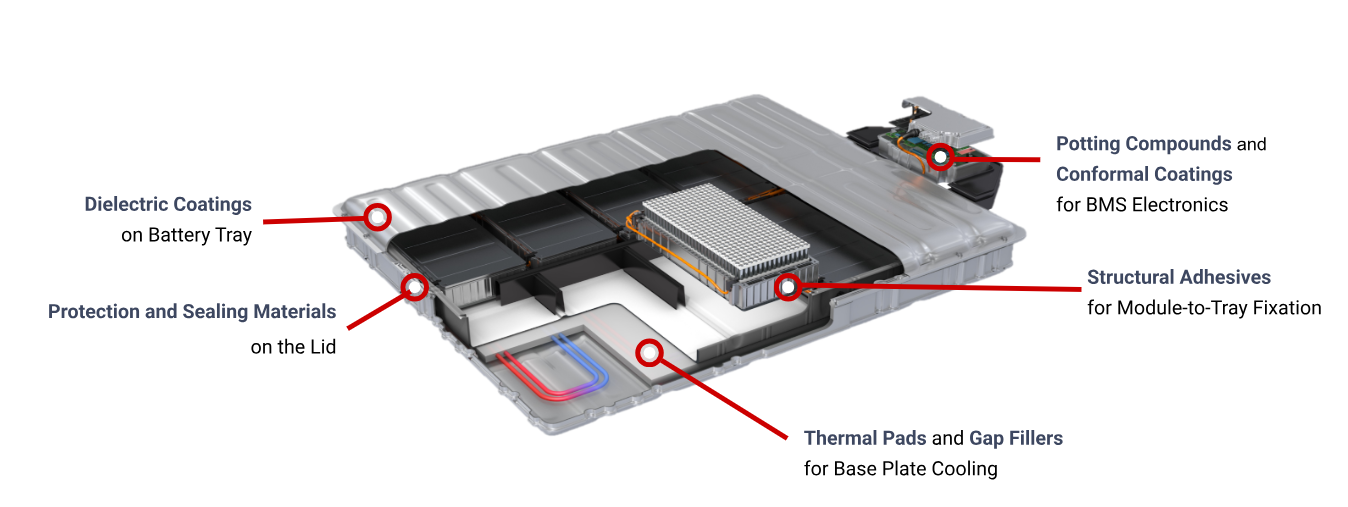
EV Battery System Overview
Electrochemical Energy Storage, Thermal Control, and High-Voltage Safety
An EV battery system stores electrical energy in rechargeable cells and delivers power to the electric drivetrain. The system includes individual cells, modules, pack-level structures, busbars, high-voltage connectors, cooling systems, battery management electronics, and enclosure protection.
Because battery systems operate under high voltage, repeated charge-discharge cycling, thermal gradients, and mechanical vibration, material selection is critical. Thermal interface materials, structural adhesives, dielectric insulation, conformal coatings, potting compounds, fire barriers, sealants, and protective films help improve safety, durability, and long-term battery performance.
EV Battery Architecture: Cell, Module, and Pack Level
EV battery systems are built in a layered architecture. Each level introduces different performance requirements and material interfaces. At the cell level, materials must support electrochemical performance and swelling control. At the module level, cells are grouped, interconnected, cooled, and mechanically supported. At the pack level, the complete system is integrated with cooling plates, safety electronics, structural housings, sealing systems, and high-voltage protection.
Cell Level
The cell is the smallest energy storage unit and contains the anode, cathode, separator, electrolyte, and current collectors.
Key concerns: heat generation, swelling, electrical isolation, compression, and cycling stability
Module Level
Cells are connected in series and parallel to increase voltage and capacity while being mechanically supported and thermally managed.
Key concerns: busbar bonding, cell spacing, module cooling, dielectric protection, and vibration resistance
Pack Level
The full battery pack integrates multiple modules with cooling systems, BMS electronics, high-voltage wiring, safety devices, and enclosure structures.
Key concerns: enclosure sealing, crash protection, thermal runaway mitigation, high-voltage safety, and environmental durability
EV Battery Chemistries and Design Considerations
Lithium-ion batteries are widely used in electric vehicles because of their high energy density, power capability, and rechargeability. Different cathode chemistries are selected depending on cost, energy density, thermal stability, cycle life, and safety requirements.
NMC Batteries
Nickel manganese cobalt chemistry provides high energy density and is commonly used in EV platforms requiring long driving range.
Material focus: thermal management, module cooling, insulation, and safety protection
LFP Batteries
Lithium iron phosphate chemistry offers strong thermal stability, long cycle life, and cost advantages for many EV and energy storage applications.
Material focus: pack integration, thermal uniformity, structural bonding, and high-volume manufacturability
High-Nickel Chemistries
High-nickel chemistries improve energy density but require careful thermal control, safety management, and long-term reliability design.
Material focus: heat dissipation, thermal runaway mitigation, dielectric protection, and sealing
Technical Challenges in EV Battery Systems
Thermal Management
Battery cells generate heat during charge and discharge. Uneven temperature distribution can accelerate degradation, reduce performance, and increase safety risk.
Material need
Gap fillers, thermal pads, thermal gels, thermally conductive adhesives, phase change materials, and heat spreading materials
Cell Expansion and Compression
Cells can expand during cycling, especially pouch and prismatic formats. Mechanical compression must be controlled to maintain performance without overstressing the cell.
Material need
Compression pads, elastomeric materials, structural adhesives, spacers, and compliant thermal materials
High-Voltage Electrical Safety
Battery packs require reliable dielectric separation between cells, busbars, module frames, cooling plates, and high-voltage conductors.
Material need
Dielectric coatings, insulating films, conformal coatings, potting compounds, and encapsulants
Thermal Runaway Mitigation
Battery packs must be designed to slow heat propagation, protect neighboring cells, and maintain safety during abnormal thermal events.
Material need
Fire barriers, thermal insulation materials, mica sheets, ceramic papers, encapsulation foams, and protective coatings
Functional Materials Used in EV Batteries
EV batteries require materials that support thermal performance, mechanical bonding, electrical safety, environmental protection, and system-level durability. These materials are used across cells, modules, cooling interfaces, busbars, BMS electronics, and pack enclosures.
Thermal Management Materials
Thermal materials improve heat transfer from cells, modules, busbars, and BMS electronics to cooling plates or heat spreading structures.
Typical materials
Thermal gap fillers, thermal pads, thermal gels, phase change materials, greases, and thermally conductive adhesives
Where they are used
Cell-to-pack interfaces, module-to-cold plate interfaces, BMS electronics, busbars, and power electronics
Structural Bonding Materials
Structural materials secure cells, modules, trays, and pack components while supporting vibration resistance and mechanical load distribution.
Typical materials
Epoxy adhesives, polyurethane adhesives, acrylic adhesives, structural tapes, and bonding films
Where they are used
Cell-to-cell bonding, cell-to-pack bonding, module-to-pack bonding, tray bonding, and enclosure assembly
Electrical Insulation Materials
Insulation materials prevent unintended current paths and help maintain high-voltage safety across cells, busbars, cooling plates, and electronics.
Typical materials
Dielectric coatings, PET films, polyimide films, insulating tapes, conformal coatings, potting compounds, and encapsulants
Where they are used
Busbars, interconnects, high-voltage electronics, cell interfaces, BMS boards, and module frames
Protection and Sealing Materials
Protection materials shield the battery system from moisture, dust, corrosion, vibration, and abnormal thermal events.
Typical materials
Sealants, gaskets, potting compounds, encapsulation foams, conformal coatings, fire barriers, and thermal insulation materials
Where they are used
Pack enclosures, connectors, BMS electronics, module barriers, cell spacing, and high-voltage safety areas
EV Battery Application Areas
Support Safer and More Reliable EV Battery Systems
Selecting the right thermal interface materials, structural adhesives, dielectric insulation, conformal coatings, potting compounds, fire barriers, and sealing materials helps improve battery safety, durability, and long-term performance.
```