


Structural Bonding for eMobility
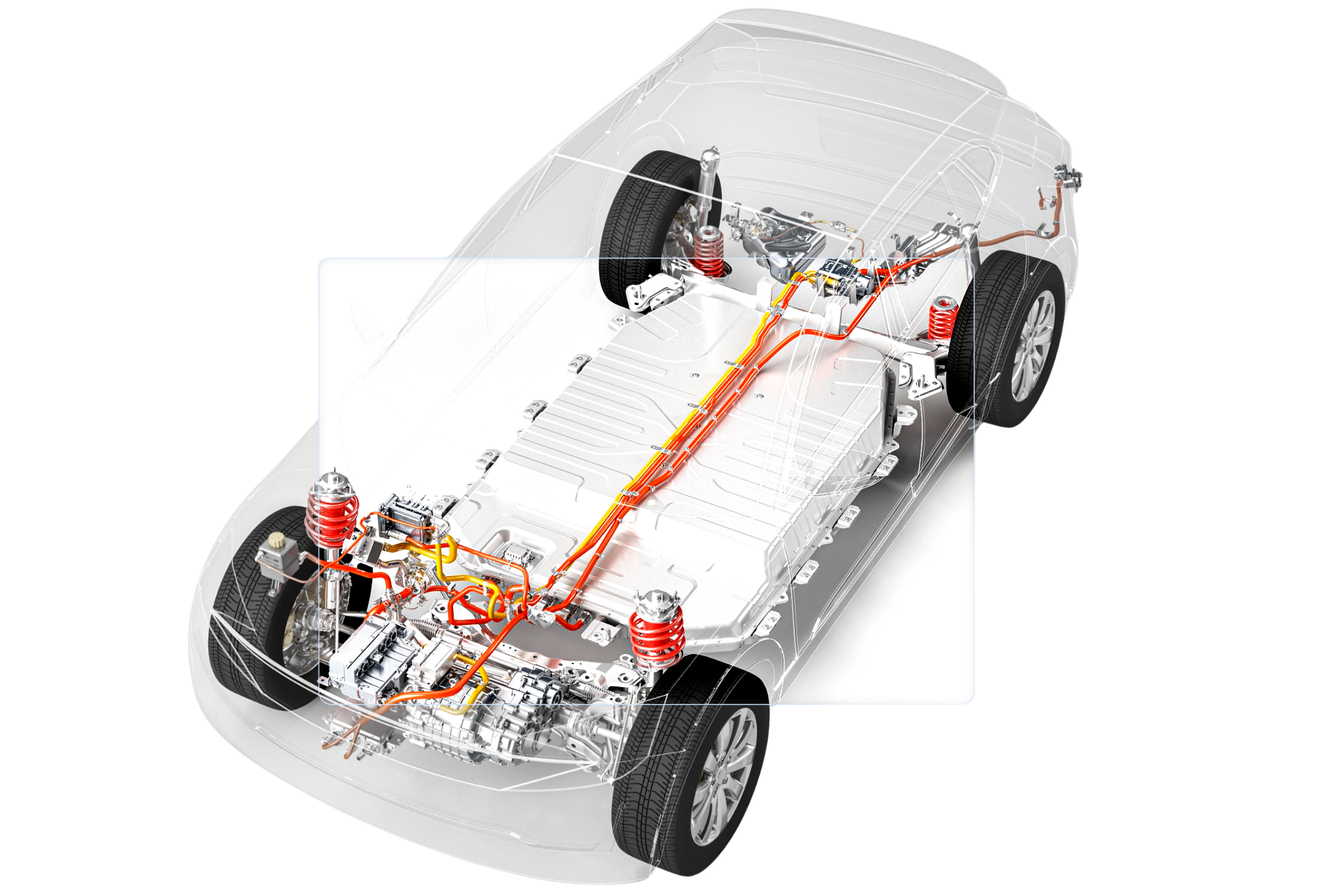
As electric vehicle (EV) design evolves, manufacturers are replacing traditional mechanical fasteners with advanced structural adhesives to reduce weight, improve durability, and enable multi-material assemblies. Structural bonding plays a critical role in enhancing performance, reliability, and design flexibility across EV systems.
This page focuses specifically on high-performance structural bonding solutions for eMobility, supporting applications where lightweighting, strength, and substrate compatibility are key drivers.
Structural Adhesives & Sealants in EV Battery Systems
Global EV battery adhesives & sealants market.
Driven by EV adoption and battery scale-up.
Strong double-digit growth across regions.
Larger packs and higher energy density designs.
The global market for structural adhesives and sealants in EV battery systems is expanding rapidly as electrification accelerates across passenger and commercial vehicle segments. Growth is closely tied to increasing battery production volumes, rising energy density requirements, and the shift toward more integrated battery architectures such as cell-to-pack (CTP) and cell-to-body (CTB) designs. These evolving configurations rely heavily on advanced bonding solutions to replace traditional mechanical fasteners, enabling weight reduction, improved structural integrity, and enhanced thermal management.
Adhesives and sealants are no longer secondary materials—they are critical enablers of battery performance, safety, and manufacturability. Structural adhesives provide mechanical strength and crash durability, while sealants ensure environmental protection against moisture, dust ingress, and chemical exposure. As OEMs push for higher efficiency and longer driving range, material requirements are becoming more stringent, demanding multifunctional solutions that combine bonding strength, thermal conductivity, flame resistance, and process efficiency.
Shift Toward Integrated Battery Architectures
Next-generation EV platforms are increasingly adopting cell-to-pack and cell-to-body designs, eliminating intermediate modules to reduce weight and improve volumetric efficiency.
These designs significantly increase reliance on structural adhesives for load distribution and mechanical reinforcement, while sealants play a critical role in maintaining enclosure integrity and long-term durability.
Asia-Pacific dominates the market due to its leadership in EV manufacturing and battery production, particularly in China, South Korea, and Japan. Meanwhile, Europe and North America are experiencing accelerated growth driven by regulatory pressure, localized battery manufacturing investments, and expanding EV adoption.
Across all regions, the outlook remains strongly upward, with adhesives and sealants positioned as foundational materials supporting the next generation of high-performance, safe, and scalable EV battery systems.
Structural Adhesive Selection for eMobility Assembly
Structural adhesives are increasingly replacing traditional welding and mechanical fasteners in electric vehicle manufacturing as OEMs move toward lightweight, multi-material vehicle architectures. Modern EV systems combine aluminum, coated steels, composites, engineered plastics, and low surface energy polymers within a single assembly, creating significant challenges in structural integration, thermal expansion management, and long-term durability.
Selecting the correct adhesive chemistry depends on the substrate combination, mechanical loading conditions, flexibility requirements, manufacturing process, and environmental exposure. Different adhesive systems are optimized for different bonding challenges, from rigid metal-to-metal structural reinforcement to flexible bonding of plastics and composite assemblies.
Metal-to-Metal Structural Bonding
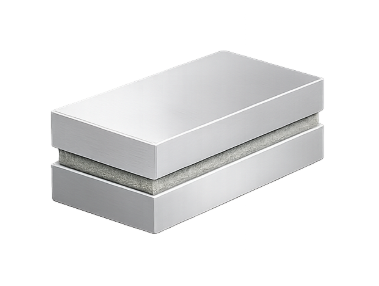
Metal bonding applications are among the most demanding structural interfaces in EV manufacturing. Battery enclosures, cross members, structural reinforcements, and body structures experience continuous vibration, thermal cycling, torsional loading, and impact stress throughout vehicle operation.
Structural epoxy adhesives are commonly used to distribute loads more evenly across bonded surfaces while reducing localized stress concentrations associated with spot welds and mechanical fasteners. Adhesive bonding also helps isolate dissimilar metals, reducing galvanic corrosion risks in mixed-material assemblies.
- Battery enclosures
- Crash structures
- Body-in-white assemblies
- Cross members and reinforcements
- Chassis structural bonding
- High shear strength
- Fatigue resistance
- Impact durability
- Corrosion resistance
- Long-term thermal cycling stability
Toughened epoxy structural adhesives are commonly used where maximum structural strength and rigidity are required.
Composite-to-Metal Bonding
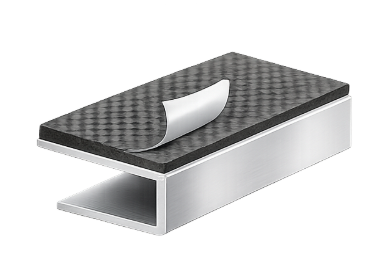
Composite materials are increasingly used throughout EV platforms to reduce weight while maintaining structural performance. Carbon fiber composites, sheet molding compounds (SMC), and fiberglass-reinforced plastics are commonly integrated with aluminum and steel structures.
Unlike welded joints, adhesive bonding enables stress distribution across large surface areas without introducing thermal distortion or localized stress cracking in brittle composite materials. Adhesives also accommodate differences in coefficient of thermal expansion between metals and composites.
- Battery covers
- Lightweight body panels
- Roof assemblies
- Composite underbody shields
- Structural reinforcement panels
- Differential thermal expansion management
- Impact resistance
- Low shrinkage during cure
- Fatigue resistance
- Bondline flexibility
Flexible toughened acrylic and epoxy systems help absorb movement between dissimilar materials during thermal cycling.
Bonding Low Surface Energy (LSE) Plastics

Low surface energy plastics such as polypropylene (PP), polyethylene (PE), and thermoplastic olefins (TPO) are widely used in EVs due to their lightweight properties, chemical resistance, and cost efficiency. However, these materials are traditionally difficult to bond because adhesives struggle to wet and adhere to their non-polar surfaces.
Conventional bonding often requires plasma treatment, flame treatment, or primers to improve adhesion. Specialized acrylic adhesive chemistries are designed to bond directly to many LSE plastics with minimal surface preparation, simplifying manufacturing and reducing process complexity.
- Battery venting components
- Plastic covers and trims
- Air duct assemblies
- Fluid management systems
- Interior and underbody components
- Thermal expansion compensation
- Vibration durability
- Impact resistance
- Adhesion to engineered plastics
- Environmental resistance
Flexible acrylic and urethane-modified structural adhesives are commonly used to accommodate movement between plastics and metals.
Plastic-to-Metal Bonding
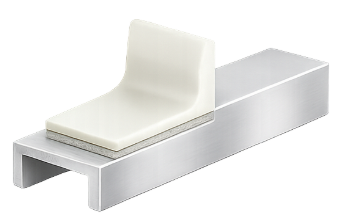
Plastic-to-metal bonding is increasingly common across EV battery systems, power electronics, sensor assemblies, and lightweight structural components. Engineers frequently combine metals with engineering plastics to reduce weight, improve corrosion resistance, and simplify manufacturing.
However, plastics and metals exhibit significantly different surface energies, stiffness, and thermal expansion behavior. Structural adhesive systems must therefore maintain adhesion despite vibration, temperature cycling, and differential movement between substrates.
- Battery covers and housings
- Power electronics enclosures
- Sensor and connector assemblies
- Interior structural components
- Lightweight brackets and supports
- Thermal expansion compensation
- Vibration durability
- Impact resistance
- Adhesion to engineered plastics
- Environmental resistance
Flexible acrylic and urethane-modified structural adhesives are commonly used to accommodate movement between plastics and metals.
Substrate combination and joint geometry—not just chemistry—determine how each interface is bonded, sealed, and mechanically supported, making adhesive selection a key driver in EV assembly design.
The Science Behind Structural Adhesive Selection in eMobility
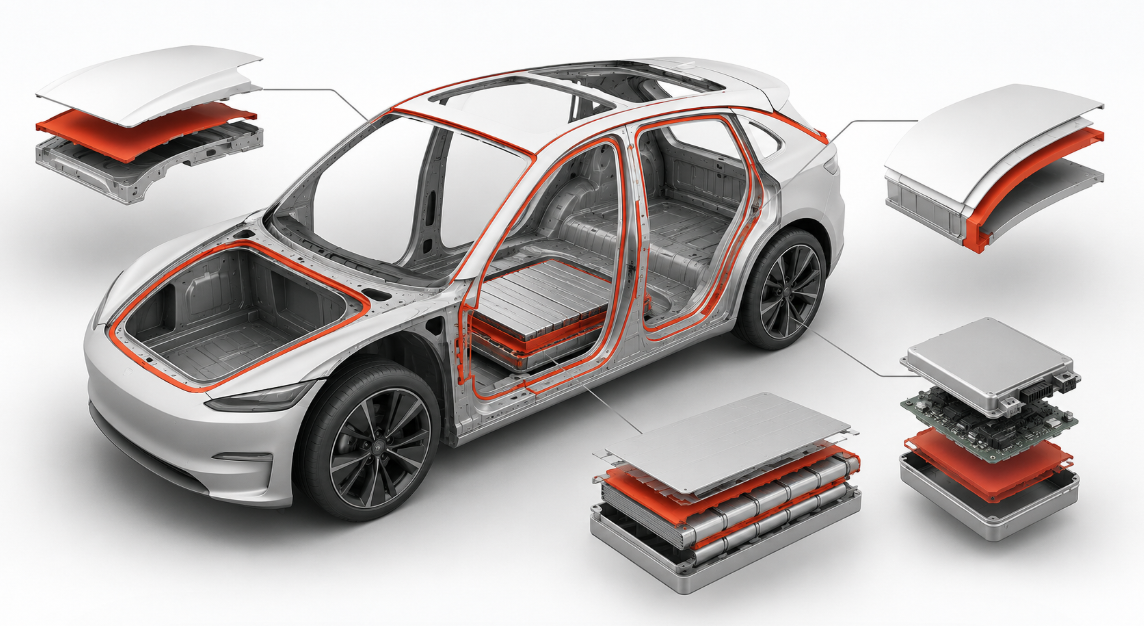
Structural adhesives in eMobility applications are engineered to replace or complement traditional mechanical fastening methods such as welds, rivets, and bolts. In modern EV architectures, they are widely used across body structures, battery-adjacent assemblies, and multi-material interfaces where lightweighting, vibration damping, and load distribution are critical. The performance of these adhesives is primarily governed by two key engineering principles: rigidity versus flexibility and thermal expansion mismatch between bonded substrates.
Key Engineering Drivers in Structural Bonding
Rigid Structural Bonding (High Modulus Systems)
Rigid structural adhesives are designed to maximize stiffness and load transfer between bonded components. In EV applications, they are commonly used to replace spot welds and rivets in structural assemblies where dimensional stability and high strength are required.
- Primary role: Structural reinforcement and load-bearing joints
- Typical use cases: Body-in-white structures, aluminum frames, battery trays
- Material preference: Toughened epoxy systems
- Engineering benefit: Uniform stress distribution across bonded surfaces
Flexible Structural Bonding (Elastomeric Systems)
Flexible adhesives are engineered to absorb mechanical stress caused by vibration, impact, and differential thermal expansion. They are essential in multi-material EV assemblies where rigid bonding would lead to stress cracking or fatigue failure.
- Primary role: Stress absorption and durability enhancement
- Typical use cases: Plastic-to-metal bonding, interior assemblies, electronic housings
- Material preference: Urethane-based structural adhesives
- Engineering benefit: Improved fatigue resistance under dynamic loading
Thermal Expansion Differences Between EV Materials
In EV systems, bonded materials such as aluminum, steel, carbon fiber composites, and thermoplastics expand at different rates when exposed to temperature changes. This phenomenon, known as coefficient of thermal expansion (CTE) mismatch, introduces internal stress at the adhesive interface during heating and cooling cycles.
Engineering Challenge
- Aluminum expands significantly more than carbon fiber composites
- Plastics exhibit high thermal movement compared to metals
- Battery systems experience repeated thermal cycling during charging/discharging
Bonding Implications
- Stress concentration at rigid adhesive interfaces
- Risk of fatigue cracking in brittle joints
- Need for controlled flexibility in multi-material designs
Selecting the appropriate adhesive system allows engineers to balance rigidity and compliance, ensuring long-term durability in battery-adjacent assemblies, structural EV frames, and lightweight composite structures.
Structural Bonding for eMobility Solutions
Material selection in EV battery packs depends on the specific interface, performance requirements, and system design. 3M provides a broad portfolio of materials for EV battery pack assembly, covering thermal interface materials, structural adhesives, sealing systems, and fire protection materials, applied across multiple interfaces within the battery system.
Material focus
Silicone-based gap fillers and thermal gels, polyurethane structural adhesives, RTV sealants, and silicone foams.
3M toughened epoxy adhesives are designed for high-strength structural bonding where durability, stiffness, and long-term mechanical performance are critical. These adhesives provide excellent adhesion to metals and composites while maintaining strong resistance to vibration, fatigue, impact, and environmental exposure. Toughened epoxies are commonly selected for metal-to-metal and composite-to-metal bonding applications that require high load-bearing capability and dimensional stability.
Typical applications
Automotive structural bonding, bus panels, honeycomb structures, panel bonding, electronics assemblies, general industrial bonding
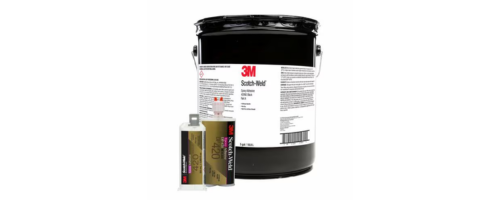

3M urethane structural adhesives are formulated to provide a balance of structural strength and flexibility. Compared to epoxies, urethanes accommodate greater movement between bonded substrates, making them ideal for assemblies exposed to vibration, impact, and differing thermal expansion rates. Their flexibility helps reduce stress concentrations in lightweight EV structures and is best suited to mixed-material and composite-to-metal assemblies.
Typical applications
Automotive component bonding, bonding composite or plastic panels to metal frames, structural assemblies, replacing rivets and screws, multi-material bonding


3M structural plastic adhesives are specifically engineered to bond low surface energy (LSE) plastics and engineered polymers that are traditionally difficult to bond. These adhesives enable strong structural adhesion without extensive surface preparation, supporting lightweight plastic integration in modern EV designs.
Typical applications
Automotive component bonding, bonding composite or plastic panels to metal frames, structural assemblies, replacing rivets and screws, multi-material bonding


Further Reading on EV Battery Materials and Assembly


Support reliable eMobility assembly and performance.
From thermal interface materials and structural adhesives to encapsulants and protective coatings, selecting the right materials is critical for eMobility safety, reliability, and manufacturability. Contact us to discuss your application requirements, material compatibility, and system-level considerations.