
-
Home

-
Products
-
Adhesives
-
Acrylic Adhesives
- 3M™ Scotch-Weld™ Structural Acrylic Adhesive DP8005
3M™ Scotch-Weld™ Structural Acrylic Adhesive DP8005
Harmonization Code : 3506.91.90.99 | Prepared glues and other prepared adhesives, not elsewhere specified or included; products suitable for use as glues or adhesives, put up for retail sale as glues or adhesives, not exceeding a net weight of 1 kg ; Adhesives based on polymers of headings 3901 to 3913 or on rubber; Other ; Other
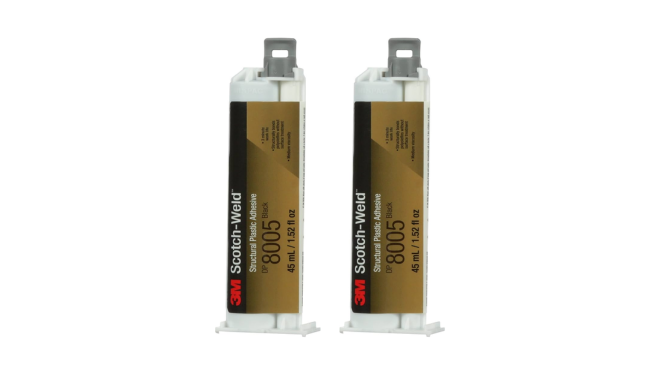

Main features
- Room Temperature Cure
- Excellent Water and Humidity Resistance
- Very Good Chemical Resistance
Product Description
3M™ Scotch-Weld™ Structural Plastic Adhesive DP8005 is a two-part acrylic-based adhesive (10:1 ratio by volume) that can bond many low surface energy plastics, including many grades of polypropylene, polyethylene, and TPO’s without special surface preparation.
3M™ Scotch-Weld Adhesive DP8005 can replace screws, rivets, plastic welding, and two-step processes which include chemical etchants, priming or surface treatments in many applications.
Product Key Features
- Ability to Bond Dissimilar Substrates
- Ability to Structurally Bond Polyolefins
- Room Temperature Cure
- Excellent Water and Humidity Resistance
- Very Good Chemical Resistance
- One Step Process - No Pre-Treatment of the Substrates Needed
- Solvent-free Adhesive System
- Convenient Hand-Held Applicator System
- Contains 0.008” glass beads for bondline thickness control
Technical Specifications
| General Properties | |||||
| Chemistry Type | Methacrylate/Amine | ||||
|
Color
Color
The color |
Black/White | ||||
|
Mix Ratio
Mix Ratio
The amount of a constituent divided by the total amount of all other constituents in a mixture |
10:1 | ||||
|
Work life @25°C
Work life @25°C
Work life is the amount of time we have to work with a material until it is no longer able to be easily worked and applied on a substrate. It is based on the change in viscosity and it can rely on the application requirements. |
0.05 hours | ||||
| Physical Properties | |||||
|
Viscosity
Viscosity
Viscosity is a measurement of a fluid’s resistance to flow. Viscosity is commonly measured in centiPoise (cP). One cP is defined as the viscosity of water and all other viscosities are derived from this base. MPa is another common unit with a 1:1 conversion to cP. A product like honey would have a much higher viscosity -around 10,000 cPs- compared to water. As a result, honey would flow much slower out of a tipped glass than water would. The viscosity of a material can be decreased with an increase in temperature in order to better suit an application |
15,000 - 55,000 mPa.s | ||||
| Curing Conditions | |||||
|
|||||