

Epoxy Adhesives
1K & 2K Structural Adhesives

Epoxy Adhesives
High-Performance Structural Epoxy Adhesives
Engineered for load-bearing assemblies and extreme operating environments, epoxy adhesives are thermosetting polymers that form high-modulus, crosslinked networks upon curing. Unlike solvent-based adhesives that dry via evaporation, epoxies cure through a stoichiometric chemical reaction. This results in a 100% solid bond line with virtually zero shrinkage, offering exceptional tensile strength, chemical resistance, and dimensional stability.
Whether bonding dissimilar substrates like carbon fiber reinforced polymers (CFRP) to aluminum, or requiring a high glass transition temperature (Tg) for aerospace applications, industrial epoxy formulations deliver permanent, reliable mechanical fastening alternatives.
Looking for electronic protection? While epoxies excel as adhesives, low-viscosity formulations are also heavily used to protect circuitry. If your primary goal is dielectric insulation, thermal management, or protecting components from shock and moisture, view the dedicated Potting & Encapsulants category.
-

LINQBOND ED-416CM | Two-component Epoxy Adhesive
- No surface treatment required
- Excellent chemical resistance
- Zero solvent formulation
- 8 weeks
-
LINQBOND EO-322PL
- High adhesion
- Medium-high temperature cure
- Ideal for sensitive components
- 12 weeks
-

ED-490CM | Two-part Epoxy Adhesive for Casting & Bonding
- Excellent toughness
- Reliable in humid conditions
- Low thermal stress
- 12 weeks
-

ED-645CM | Two-Part Epoxy Adhesive for General Applications
- Excellent electrical insulation
- Reliable in humid conditions
- High Viscosity
- 12 weeks
-

ED-425PL | One-Part Epoxy Adhesive for Rubber & Plastics
- Strong adhesion to electronic components
- Excellent toughness
- Low outgassing
- 12 weeks
-

EO-830MT | One-part Epoxy Adhesive for Metal Bonding
- High crack & fatigue resistance
- Excellent adhesion on metals
- RoHS compliant
- 12 weeks
-

ED-845CM | Fast-curing Epoxy Adhesive for Electronics Bonding
- Fast-curing
- Excellent adhesion
- High insulation, chemical resistance and anti-vibration
- 12 weeks
-

3M Adhesive Mix Monitor
- Real-Time In-Line Monitoring for Two-Part Adhesive Dispensing
- Reduce Bond Failure Risk from Improperly Mixed Two-Part Adhesives
- Minimize Adhesive Waste from Unnecessary Purging
- 8 weeks
-


-

3M™ Scotch-Weld™ 420
- Bonds metals, composites, glass, ceramics, plastics, and wood
- 20-minute work life at 72°F (22°C) for positioning and alignment before cure
- Handling strength in approximately 2 hours; full cure in 24 hours at room temperature
- 2 weeks
-

-

3M™ Scotch-Weld™ Epoxy Adhesive DP490
- 90-minute work life supports complex assembly positioning and alignment
- Maintains bond strength across high- and low-temperature operating conditions
- Bonds metals, composites, glass, ceramics, plastics, and wood
- 2 weeks
-

-

3M™ Scotch-Weld™ Epoxy Adhesive DP125
- 25-minute worklife
- Flexible
- High peel and shear strength
- 2 weeks
-

3M™ Scotch-Weld™ Epoxy Adhesive 7240 FR
- Long open time for large surface application
- Non-sag properties
- Contains glass beads for thickness control
- 2 weeks
-

3M™ Scotch-Weld™ Epoxy Adhesive DP110
- Controlled flow
- 20-minute handling strength
- Good adhesion to many plastics and metals
- 2 weeks
-

3M™ Scotch-Weld™ Epoxy Adhesive DP190
- 90-minute work life
- 1:1 mix ratio
- High shear and peel strength
- 2 weeks
-

3M™ Scotch-Weld™ Epoxy Adhesive 7260FC NS
- Toughened formulation
- Cures at room temperature or accelerated at up to 65 °C
- Working time of 90 minutes
- 2 weeks
-

3M™ Scotch-Weld™ Epoxy Adhesive 7288
- Two-part A/B epoxy system
- High durability
- Strong adhesion to metals and thermoset plastics
- 2 weeks
-

3M™ Scotch-Weld™ Epoxy Adhesive DP760
- 2:1 mix ratio
- Non sagging paste
- High temperature resistance
- 2 weeks
-

3M™ Static Mixing Nozzle
- Available for 50 mL and 200 mL / 400 mL cartridge formats
- Doubles as a cartridge storage cap between uses
- Automatic ratio metering through passive cascade mixing
- 2 weeks
-

3M™ Scotch-Weld™ EPX Mixing Nozzle
- Simultaneous metering, mixing, and application in one step
- Used nozzle doubles as a cartridge storage seal between uses
- Compatible with 3M EPX manual and pneumatic applicators
- 2 weeks
-

3M™ Scotch-Weld™ EPX™ Standard Mixing Nozzle
- Genuine 3M accessory engineered for compatibility with EPX applicators and Duo-Pak cartridges
- Available in configurations for both small-format and larger cartridge systems
- Disposable design eliminates cleanup associated with manual mixing tools
- 2 weeks
-

3M™ Scotch-Weld™ EPX Manual Applicator
- No power source required for portable and in-field operation
- Conversion kits allow support for multiple mix ratios using a single applicator body
- Dual-drive mechanism maintains a consistent mix ratio throughout the dispensing stroke
- 2 weeks


Frequently Asked Questions
Frequently Asked Questions about Structural Epoxy Adhesives
Why is exact stoichiometric mixing so critical for 2K epoxies?
Unlike polyester resins where the catalyst simply acts as a trigger, epoxy hardeners react chemically with the resin on a molecular level. If the mix ratio is off by even a few percent, unreacted resin or hardener remains in the polymer matrix. This drastically reduces the cured adhesive's mechanical strength, chemical resistance, and Tg.
Can the cure time of a room-temperature epoxy be accelerated?
Yes. Adding heat accelerates the crosslinking reaction. As a general rule of thumb, based on the Arrhenius equation, every 10°C increase in ambient temperature cuts the curing time roughly in half. Heat curing also often yields a tighter polymer network, resulting in higher ultimate strength.
What causes an exothermic reaction when mixing large batches?
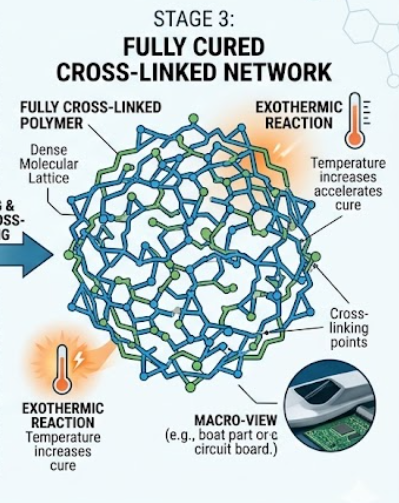
The chemical reaction between the resin and hardener releases heat. In a large, confined mass, such as a mixing cup, that heat cannot dissipate, which accelerates the reaction further and generates even more heat. This runaway thermal event can cause the adhesive to flash-cure, smoke, or even melt plastic containers. Mix only what can be applied within the pot life, or pour it into a shallow tray to help dissipate heat.
What is the difference between work life and cure time?
Work life, often called pot life, is the amount of time available to mix, apply, and position the parts before the epoxy begins to thicken and gel. Cure time is the total time required for the adhesive to reach its absolute maximum structural strength.
Learn More
Types of Structural Epoxies
Four primary epoxy systems engineered for distinct cure mechanisms, processing methods, and performance profiles
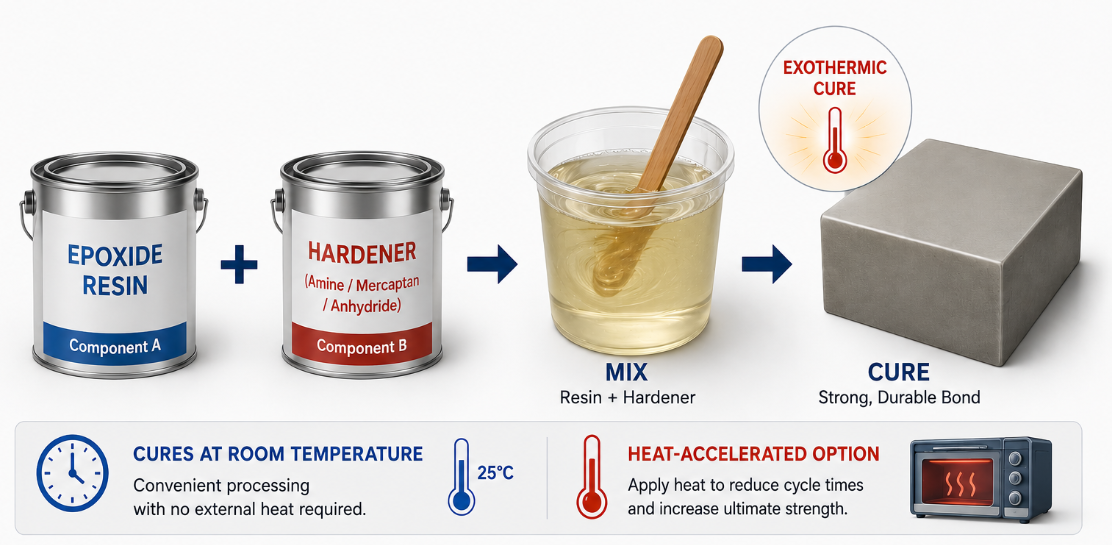
1. Two-Component (2K) Epoxies
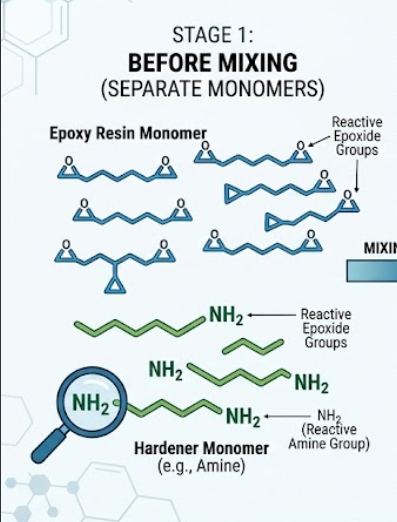
The most versatile and widely used structural adhesives worldwide. The curing mechanism relies on the physical mixing of two distinct chemicals at the point of application. A 2K system consists of an epoxide resin (Part A) and a hardener (Part B).
The Resin: Typically a bisphenol-A or bisphenol-F derivative, containing highly reactive epoxide rings. The Hardener: Most commonly an amine, mercaptan, polyamide, or anhydride.
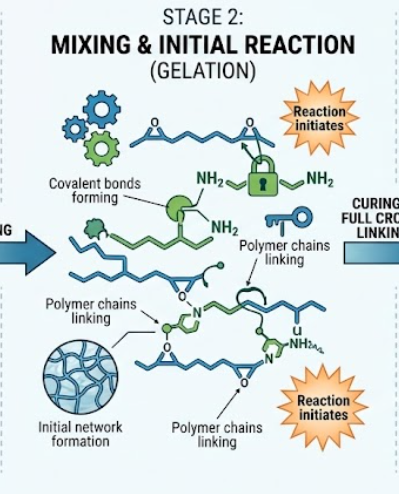
When mixed, the hardener acts as a nucleophile, attacking and opening the epoxide rings. This triggers a chain reaction, linking short polymer chains into a dense, infinite 3D network.
Requires a mathematically exact ratio of resin to hardener (e.g. 1:1, 2:1, 10:1). An off-ratio mix leaves unreacted molecules in the matrix, drastically lowering Tg and structural integrity.
Most amine-cured 2K epoxies crosslink immediately at approximately 22°C (72°F). Heat (60–80°C) accelerates curing from days to hours while often improving ultimate lap shear strength.
Crosslinking releases heat. Mixing a large mass accelerates heat buildup, which speeds curing further and may result in thermal runaway (flash cure) if not properly managed.
2. One-Component (1K) Epoxies
One-component epoxies eliminate the need for metering and mixing equipment on the assembly line. Pre-mixed by the manufacturer, they rely entirely on thermal energy to trigger crosslinking. The epoxide resin is pre-blended with a latent curing agent, often a solid, microscopic powder such as dicyandiamide (dicy).
At room temperature, this latent hardener is completely insoluble and unreactive. When exposed to elevated temperatures, typically 120°C to 150°C (250°F to 300°F), the hardener melts or chemically unlocks, dissolving into the resin and initiating crosslinking.
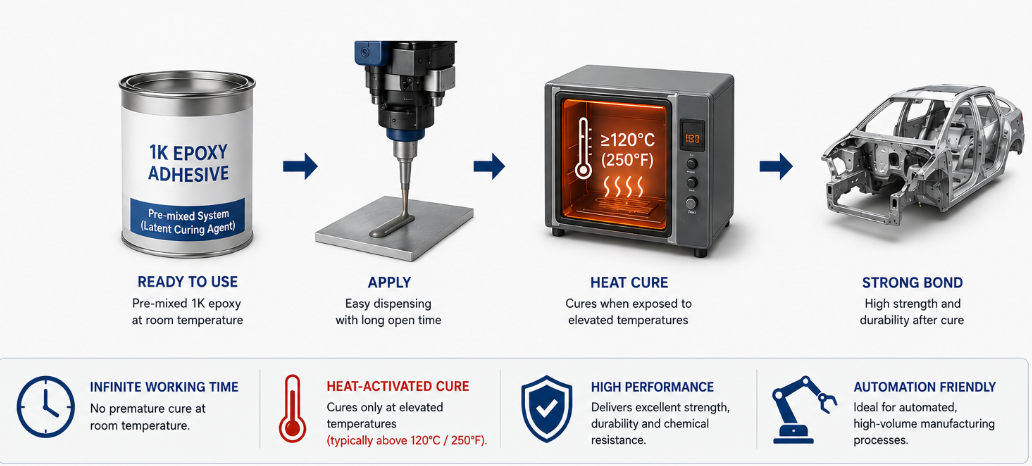
1K Systems – Key Processing Characteristics
| Characteristic | Detail |
|---|---|
| Infinite Working Time | Reaction won't start without extreme heat, giving unlimited pot life at room temperature for complex assembly. |
| No Mixing Variables | Eliminates off-ratio mixing and entrapped air bubbles, producing consistent, void-free structural joints. |
| High Ultimate Strength & Tg | High-temperature cure produces tightly crosslinked networks, among the highest shear strength and thermal stability available. |
| Storage Requirements | Often requires cold storage (refrigeration/freezing) to prevent premature reaction of the latent hardener. |
Favored in automated, high-volume manufacturing environments like automotive assembly.
Epoxy Curing Mechanism
The molecular journey from unreacted monomers to a fully crosslinked structural bond
Epoxy Curing Timeline
Exact times vary by formulation and ambient temperature, but the chemical journey always follows four distinct stages
| Curing Stage | Typical Timeframe* | Physical State | What Is Happening | Actionable Phase |
|---|---|---|---|---|
| 1. Working Time (Open Time / Pot Life) | Minutes to hours | Liquid or spreadable paste | Resin and hardener just mixed; chains short enough to allow free flow. | Apply & Position: mix, apply, and position parts exactly as needed. |
| 2. Gelation (Initial Cure) | Minutes to hours (begins as working time ends) | Rubbery, tacky gel | Polymer matrix grows large enough to stop flowing; exothermic heat peaks. | Do Not Disturb: unworkable but lacks holding strength, moving parts now breaks forming bonds. |
| 3. Fixture Time (Handling Strength) | 15 minutes to 24 hours | Solid, hard to the touch | Crosslinking network mostly established; supports its own weight. | Remove Clamps: jigs can be removed; handle gently, no heavy loads yet. |
| 4. Full Cure (Maximum Strength) | 24 hours to 7 days | Fully hardened thermoset plastic | Polyaddition reaction 100% complete; every bond locked into the 3D lattice. | Active Service: bears full structural loads, machining, and chemical exposure. |
*Timeframes are highly dependent on the specific adhesive formulation and ambient temperature. Heat drastically accelerates this timeline; cold temperatures extend it.
Key Performance Benefits
Why structural epoxies remain the benchmark for permanent, load-bearing bonds
Core Industrial Applications
Structural epoxies across the industries where permanent, load-bearing bonds are non-negotiable
| Industry | Application |
|---|---|
| Aerospace & Aviation | Structural bonding of fuselages, honeycomb assemblies, and interior components, for weight reduction, high-temp resistance, and altitude tolerance. |
| Electronics & Telecom | Potting and encapsulating circuit boards and microelectronics, for insulation and shielding from moisture, thermal cycling, and shock. |
| Automotive & Transportation | Bonding composite panels, metal body parts, and EV battery housings, replacing welding while improving efficiency and rigidity. |
| Construction & Civil Engineering | Infrastructure repair, crack injection, structural beam bonding, and anchoring rebar or bolts into concrete. |
| Marine & Shipbuilding | Assembling, waterproofing, and repairing hulls, decks, and underwater components, with high saltwater resistance. |
| Wind Energy | Primary adhesive for bonding massive, load-bearing wind turbine blades together. |
| Tooling & Prototyping | Casting master models, jigs, fixtures, and vacuum-forming molds requiring dimensional stability and heat resistance. |
.png)
Need Help Selecting the Right Structural Epoxy?
Chemistry selection depends on your substrate combination, required cure speed, service temperature, and processing equipment. Our technical team provides product selection support, trial quantity sourcing, and application guidance across 2K, 1K, toughened, and conductive epoxy systems.
Structural Epoxy – Quick Reference