

Lubricants
Oils, greases & anti-friction coatings

Lubricants
Industrial lubricants reduce friction and manage wear between moving surfaces by introducing a separating layer, liquid, semi-solid, or dry film, that has lower shear strength than the surfaces it protects. Rather than the mating surfaces grinding directly against each other, the lubricant's internal layers shear instead, cutting friction, heat, and wear while helping to dissipate heat, resist corrosion, and manage contamination.
The right lubricant depends on operating speed, load, temperature, and environment. Liquid oils and dispersions suit high-speed systems needing active cooling and debris flushing. Greases, pastes, and compounds suit slower or open mechanisms where liquid can't be retained, or where the lubricant must also seal out contamination. Anti-friction coatings serve extreme environments where liquids and semi-solids fail entirely, such as vacuum, radiation, or inaccessible mechanisms.
Frequently Asked Questions
Frequently Asked Questions about Lubricants
How do I choose between a liquid oil, a grease, and an anti-friction coating (AFC)?
Selection is governed by operating speed, cooling requirements, and environmental exposure. Liquid oils suit high-speed dynamic systems (high DN factors) where active convective cooling and debris flushing are required. Greases suit low-to-moderate speeds, unsealed bearings, and environments where water and dirt need to be sealed out. AFCs (dry films) are used in extreme environments where liquids fail: ultra-high vacuums (10⁻⁹ Torr), extreme temperatures above 350°C, heavy abrasive dust, or mechanisms that can't be accessed for re-lubrication.
What is the difference between hydrodynamic and boundary lubrication?
Hydrodynamic lubrication occurs when a liquid fluid film is thick enough to fully separate two moving surfaces (film thickness ratio Λ > 3), resulting in zero metal-to-metal contact and near-zero wear. Boundary lubrication occurs under heavy shock loads or slow speeds when the liquid film collapses (Λ < 1). Under boundary conditions, system survival relies entirely on chemical anti-wear additives, such as ZDDP, or solid lubricants, such as MoS2, to physically prevent surface asperities from cold-welding together.
Are synthetic base oils always superior to mineral oils?
Not always. Synthetics, such as polyalphaolefins (PAO) or esters, provide better extreme-temperature stability, lower pour points (below -50°C), and extended oxidation life. Mineral oils, however, offer strong natural solvency, meaning they dissolve additives more easily and safely swell legacy elastomer seals to prevent leaks. Synthetics are required when the operating environment exceeds the thermal and oxidative thresholds of a high-quality Group II mineral oil, not as a universal upgrade.
Can polyalkylene glycol (PAG) synthetic oils be mixed with PAO or mineral oils?
No. Standard polyalkylene glycols are chemically immiscible with mineral oils and PAOs. Mixing them causes immediate phase separation, additive precipitation, severe sludge formation, and filter plugging. When transitioning a gearbox from mineral oil to PAG, the system must be thoroughly flushed first.
What is a colloidal dispersion, and when should it be used instead of a pure oil?
A colloidal dispersion is a liquid base oil containing homogeneously suspended sub-micron solid lubricant particles, such as MoS2 or graphite. Pure oils rely on dissolved chemicals to protect surfaces, which can fail under massive shock impacts. Dispersions are used in heavy-duty gearboxes, forging presses, and chain drives, where extreme loads demand the physical, mechanical barrier that only solid particles can provide.
What is the fundamental structural difference between a grease and a paste?
The difference lies in solid lubricant concentration. Greases typically contain 0% to 5% solid additives and function by bleeding liquid base oil into a hydrodynamic contact zone. Pastes contain much higher concentrations, 15% to 60% or more, of solid lubricants such as MoS2, copper, or nickel, and function as a physical barrier under boundary conditions, such as high-tonnage mechanical press-fits and high-temperature threaded anti-seize applications.
Can greases with different thickeners, such as lithium complex and polyurea, be mixed?
Generally, no. Polyurea and lithium complex thickeners are chemically incompatible. Mixing them disrupts the structural fiber matrix, resulting in rapid oil separation, severe softening that can cause the grease to run out of the bearing, or extreme hardening. Old grease should always be fully purged before introducing a new thickener chemistry.
Is it normal for oil to separate and pool on top of grease during storage?
Yes, a minor amount of static oil separation, or bleeding, is normal and engineered into the grease; it's how the thickener releases oil to lubricate the bearing. Excessive pooling, more than a few millimeters, indicates poor storage conditions, such as high ambient heat, or thickener degradation. Separated oil can often be safely stirred back into the bulk grease before application.
What does the NLGI consistency number represent?
The National Lubricating Grease Institute (NLGI) scale measures the physical stiffness of a grease, ranging from 000 (fluid-like) to 6 (solid block). NLGI 2, roughly a peanut-butter consistency, is the standard used in most industrial bearings. Softer greases (NLGI 00) suit centralized pumping systems, while firmer greases (NLGI 3) suit vertical shafts and high-vibration equipment where slump resistance matters.
How does an anti-friction coating differ from a standard fluoropolymer paint?
Standard decorative fluoropolymer paints prioritize corrosion resistance or non-stick properties with minimal mechanical load-bearing capability. Engineering AFCs are formulated with specific ratios of solid lubricants bound within high-performance structural resins, such as polyamide-imide, epoxy, or silicates, engineered to withstand extreme localized contact pressures, up to roughly 2,500 MPa, without flaking or cohesively shearing.
Learn More
The Primary Mechanism of Lubrication
Tribology, the science of interacting surfaces in relative motion, starts from a simple fact: no two surfaces are perfectly smooth. On a microscopic level, even highly polished metal surfaces contain tiny irregularities, or asperities, that under magnification resemble a rugged mountain landscape rather than a flat plane.
When two unlubricated surfaces move against each other, these asperities come into direct contact, leading to friction, wear, and heat generation. The fundamental engineering objective of any lubricant is to introduce a separating medium, whether liquid, semi-solid, or dry film, that has lower shear strength than the mating substrates. Beyond friction reduction, industrial lubricants also help dissipate heat, protect against corrosion, manage contamination, and extend equipment service life under demanding operating conditions.

Key engineering functions of lubricants: friction reduction, thermal management, surface protection, wear mitigation, and contaminant removal.
This interaction between unlubricated surfaces can result in several damaging wear mechanisms:


The primary function of a lubricant is to reduce direct solid-to-solid contact by introducing a protective layer between moving surfaces. Depending on the lubricant type, this layer may take the form of an oil film, grease layer, lubricant paste, lubricating compound, dispersion, or bonded anti-friction coating. Whether liquid, semi-solid, or solid, the lubricant acts as a sacrificial shear layer: instead of metal asperities shearing against each other, the internal molecular layers of the lubricant shear instead, drastically reducing the coefficient of friction.
Understanding the differences between oil lubricants, greases, lubricant pastes, lubricating compounds, dispersions, and anti-friction coatings is essential for selecting the right lubrication strategy for industrial applications.
The Governing Model: The Film Thickness Ratio (Λ)
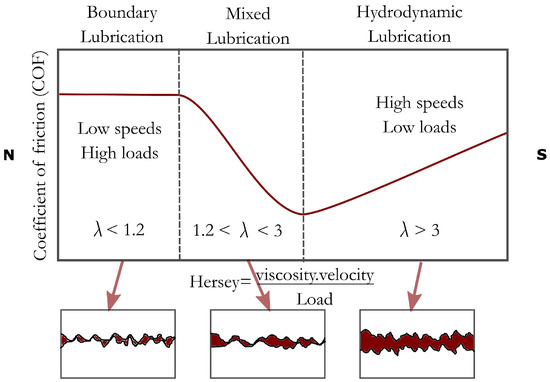
Engineers quantify the effectiveness of surface separation using the Film Thickness Ratio, often called the Lambda Ratio (Λ), which calculates the thickness of the lubricant film relative to the combined surface roughness of the mating components:
Λ = hmin / √(σ1² + σ2²)
Where hmin is the minimum fluid film thickness, and σ1 and σ2 are the root-mean-square surface roughness values of the two components.
Based on this ratio, the primary mechanism of lubrication shifts dynamically through distinct regimes, visually mapped by the Stribeck Curve:
Hydrodynamic Lubrication (HL)
Mechanism: Full fluid-film separation.
How it works: As components move at high speed, they drag viscous oil into a converging clearance space, creating a high-pressure dynamic fluid wedge that completely lifts and separates the metal surfaces.
Result: Zero asperity contact. Friction is determined entirely by the internal viscous drag of the oil; wear is theoretically zero.
Mixed Lubrication
Mechanism: Partial fluid support combined with mild asperity contact.
How it works: As speeds drop, loads increase, or oil viscosity drops due to heat, the hydrodynamic fluid wedge thins. The fluid film still supports most of the load, but the tallest asperities begin to intermittently contact.
Result: Friction increases significantly. Wear begins to occur, requiring chemical additives to prevent severe damage.
Boundary Lubrication
Mechanism: Physical solid-film or chemical-film protection.
How it works: The hydrodynamic film has fully collapsed due to heavy shock loads, ultra-low speeds, or extreme temperatures, and the metal surfaces are in direct contact. Protection shifts from fluid dynamics to chemistry and solid mechanics.
Result: System survival relies on anti-wear (AW) or extreme pressure (EP) additives, which react chemically with the metal to form sacrificial polyphosphate or iron-sulfide layers, or on solid lubricants like MoS2 or PTFE, which physically plate the asperities and provide low-shear slip planes.
The Lubrication Regimes in a Bearing

a. At Rest (Boundary Lubrication)
When the machinery is off, rotational speed is zero. Gravity and static load squeeze lubricating oil out of the load zone, forcing the shaft to rest directly on the bottom of the bearing, a state of boundary lubrication with direct metal-to-metal asperity contact. This phase represents the highest risk for mechanical wear, since starting a heavy machine from this dead-stop position produces high initial friction.
b. Starting (Mixed Lubrication)
As the shaft begins to rotate, it doesn't immediately float; dry friction causes it to climb slightly up the bearing wall. As it turns, surface drag pulls viscous oil into the microscopic converging gap between the surfaces, entering mixed lubrication, where the load is supported partially by surface contact and partially by building fluid pressure.
c. Stable Fluid Film (Hydrodynamic Lubrication)
Once the shaft reaches sufficient speed, it continuously drags viscous oil into the narrowing, wedge-shaped clearance, acting as a high-pressure fluid pump. The resulting hydrodynamic pressure is strong enough to fully lift the shaft off the bearing wall into a stable, off-center position. With the surfaces fully separated by a wedge of oil, mechanical wear drops to near zero.
Explore Our Tribological Solutions
1. Lubricating Oils & Dispersions
Primary Function: Liquid fluids engineered for high-speed dynamic systems requiring continuous hydrodynamic and elastohydrodynamic (EHL) film separation, active thermal dissipation, and continuous flushing of wear debris and micro-contaminants away from the contact zone.
Technical Composition: Formulated using high-performance synthetic base stocks, including polyalphaolefins (PAO) for extreme temperature stability, polyol esters for high polarity and clean evaporation, and polyalkylene glycols (PAG) for ultra-low sliding friction. To survive severe boundary conditions where liquid films collapse (Λ < 1), colloidal solid dispersions suspend sub-micron solid lubricants, such as MoS2, synthetic graphite, or PTFE, directly within the fluid matrix to provide mechanical shock-load protection.
Key Industrial Applications
- High-Speed CNC Spindles (DN > 500,000): Ultra-low viscosity synthetic PAO/ester oils (ISO VG 2 to 22) maintain micro-thin hydrodynamic separation while minimizing viscous fluid drag, preventing thermal distortion of precision machining components.
- Industrial Gearboxes & Hydraulics: Heavily additized fluids (ISO VG 32–68 for hydraulics; ISO VG 150–460 for gears) transmit hydraulic power efficiently and protect heavy gear tooth flanks against micro-pitting under continuous torque.
- High-Temperature Conveyor Chains (>250°C): Polyol ester carriers blended with colloidal graphite evaporate cleanly at extreme temperatures without leaving tacky carbon sludge, depositing a dry, lubricating graphite film effective up to 550°C.
2. Greases, Pastes & Compounds
Primary Function: Semi-solid thixotropic materials for applications where liquid oils can't be retained due to open mechanical architectures, vertical shaft orientations, slow rotational speeds, or severe external contamination. They act as both a lubricant and a physical environmental seal.
Technical Composition: Engineered using complex thickener matrices, such as lithium complex, calcium sulfonate, or polyurea, that act as a microscopic sponge, holding liquid base oil in suspension and releasing it into the bearing track under mechanical shear (controlled bleeding), then re-absorbing it at rest. Greases contain low solids for rolling bearings; pastes contain much higher concentrations of solid lubricants (15% to over 60%) for heavy boundary sliding; and compounds use inert silica and silicone fluids purely for sealing and dielectric insulation.
Key Industrial Applications
- Electric Motor & Crusher Bearings: Polyurea greases (NLGI 2) provide sealed-for-life stability in high-speed motors without thickener hardening. For heavy mining crushers, calcium sulfonate greases enriched with 5% MoS2 absorb shock loads and resist water wash-out.
- High-Temp Threaded Anti-Seize: Assembly pastes heavily loaded with metallic solids (copper, nickel, aluminum) prevent thread galling, cold-welding, and stress-corrosion cracking on turbine flanges and exhaust bolts exposed to extreme thermal cycling (>650°C).
- O-Ring Assembly & Dielectric Sealing: Non-melting silicone compounds provide strong dielectric strength (>30 kV/mm) to help prevent electrical arcing in high-voltage switchgear, while safely lubricating EPDM and nitrile elastomer seals without chemical swelling or shrinkage.
3. Anti-Friction Coatings (AFCs)
Primary Function: Thermally cured, dry-film bonded coatings that act as lubricating paints. AFCs provide permanent, maintenance-free dry lubrication in extreme tribological environments where wet fluids fail, migrate, attract abrasive dust, or chemically decompose.
Technical Composition: These engineered micro-films (applied at a precise 10–20 µm dry film thickness) bind ultra-pure solid lubricants, such as MoS2 for extreme contact pressure and PTFE for ultra-low sliding friction, within structural crosslinking resins like polyamide-imide, epoxy, or inorganic silicates. Once cured, they chemically and mechanically lock onto the grit-blasted metal substrate, withstanding localized pressures up to roughly 2,500 MPa.
Key Industrial Applications
- Spacecraft & Ultra-High Vacuum Mechanisms: Silicate-bound MoS2 coatings operate in deep-space environments (10⁻⁹ Torr) and extreme radiation zones. Because they are fully solid, they exhibit minimal outgassing, helping prevent contamination of sensitive satellite optics.
- Automotive Engine Piston Skirts: Polyamide-imide (PAI) resins loaded with MoS2 are screen-printed onto piston skirts to reduce hydrodynamic drag and help prevent aluminum-on-steel scuffing during cold engine starts, supporting fuel economy.
- Semiconductor Cleanroom Slides: PTFE-based AFCs provide smooth, stick-slip-free linear motion for wafer-handling robots. The non-tacky, dry surface generates minimal particulate shedding and emits no hydrocarbon vapors, supporting strict cleanroom integrity.
Master Engineering Selection Criteria
Selecting the optimum tribological state relies on evaluating the boundaries of the operating environment against the physical limitations of the lubricant.
Specify Liquid Oils When
Kinematic speeds are high (DN > 300,000), active thermal cooling is required, the housing is fully sealed, and in-line filtration is available to remove debris.
Specify Greases When
Speeds are low to moderate, housing sealing is poor or non-existent, the component must be protected against water or dust ingress, and stop-start operation requires the lubricant to stay in place without dripping.
Specify Assembly Pastes When
Performing interference press-fits of metallic hubs to shafts, or securing threaded fasteners subject to heavy thermal cycling where future destructive galling must be prevented.
Specify Anti-Friction Coatings When
The environment is an ultra-high vacuum, exposed to radiation, ambient dust is severe, parts are inaccessible for maintenance, or temperatures exceed the carbonization limits of synthetic base oils.