

Greases, Pastes & Compounds
Stay-in-place lubrication
-
Home

-
Products
-
Lubricants
- Greases, Pastes & Compounds
Greases, Pastes & Compounds
Greases, pastes, and compounds are semi-solid lubricants used when liquid oils can't be effectively retained within an assembly, due to open structural designs, low operational speeds, intermittent motion, or sealing constraints. Rather than circulating like an oil, they stay in place, sealing out contamination while releasing lubrication as needed.
Grease is not simply thick oil. A thickener creates a structured three-dimensional matrix that holds base oil in suspension, responds to mechanical shear, and controls how oil is released and replenished at the contact zone. Pastes and compounds carry the same idea further with much higher solid content, providing high load capacity, anti-seize behavior, and resistance to squeeze-out, though this can also make them unsuitable for high-speed rolling bearings, fine centralized systems, or small clearances. Selection depends on operating speed, temperature, load, contamination exposure, and whether the application needs anti-wear protection, dielectric insulation, or assembly anti-seize behavior.
Frequently Asked Questions
Frequently Asked Questions about Greases, Pastes & Compounds
What is the main structural difference between a grease and a paste?
The primary distinction lies in solid lubricant content. Greases contain 0% to 5% solid additives and function through controlled base oil release (bleeding) inside hydrodynamic/EHL contact zones. Pastes contain 15% to over 60% solid lubricants, such as MoS2, metallic powders, or white solids, and act as a physical boundary barrier under heavy loads where liquid oil films collapse entirely.
Can lithium complex grease be mixed with polyurea grease during routine maintenance?
Generally, no. Polyurea and lithium complex thickeners are often incompatible. Mixing them can break down the thickener matrix, resulting in rapid oil separation, severe softening (grease run-out), or hardening, which can lead to bearing failure. Old grease should always be fully purged before applying a new thickener chemistry.
What does the NLGI consistency grade signify?
The National Lubricating Grease Institute (NLGI) scale measures grease firmness, ranging from 000 (fluid/semi-liquid) to 6 (solid, block-like). It's measured using the ASTM D217 cone penetration test, which records the depth a standard cone penetrates a worked grease sample at 25°C in tenths of a millimeter (10⁻¹ mm).
What causes grease bleeding, and is it acceptable?
Grease bleeding, or oil separation, is the gradual release of base oil from the thickener network. Controlled static bleeding, typically 1% to 3% per ASTM D1742, is necessary, since the released oil lubricates rolling contact tracks. Excessive bleeding, however, indicates mechanical over-shearing, thermal breakdown, or thickener degradation.
Can different greases be mixed if both are lithium-based?
Compatibility is not guaranteed by thickener family alone. Base fluids, additive packages, complexing agents, and polymer modifiers can all interact. NLGI recommends avoiding mixing and treating compatibility charts only as rough guidance. If a changeover is necessary, supplier guidance should be obtained, the system purged or cleaned as appropriate, mixtures tested at expected ratios, and consistency, oil separation, and bearing temperature monitored afterward.
What happens when too much grease is added to a bearing?
Excess grease increases churning and heat, can force lubricant past seals, and may accelerate oxidation or damage shields. The correct initial fill depends on bearing type, speed, free space, and housing design. Relubrication quantity and interval should be based on the OEM method and the actual purge path; filling "until grease comes out" is not a safe universal rule.
Why does grease bleed oil, and is that a defect?
Controlled oil release is part of how grease supplies a contact, and a small amount of bleed during storage or service can be normal. Excessive separation can leave a hardened, oil-depleted residue, while too little release can starve the contact. ASTM D6184 is useful for specification and quality control, but its result isn't intended to predict dynamic service performance on its own.
How is base-oil viscosity selected for a grease?
The same contact logic used for oil applies: speed, load, geometry, and operating temperature determine the required viscosity at the contact inlet. The NLGI grade describes the bulk consistency of the grease and is a separate choice. High speed generally pushes toward lower base-oil viscosity, while slow, heavily loaded sliding pushes toward higher viscosity and stronger boundary protection, subject to start-up and delivery limits.
When should an anti-seize paste be used instead of grease?
A validated anti-seize should be used when the main need is controlled assembly, dismantling after heat or corrosion exposure, or preventing galling on slow or static threaded and fitted joints, not as a rolling-bearing grease. Torque values must be adjusted using product-specific torque-tension data, since lubrication can substantially increase bolt load at a given torque.
Learn More
Stay-in-Place Lubrication for Bearings, Assembly & Severe Contact
When liquid oils can't be effectively retained within a mechanical assembly, due to open structural designs, low operational speeds, intermittent motion, or sealing constraints, semi-solid tribological materials are required. This product group includes three distinct formulations: greases, pastes, and compounds.
Lubricating Greases
Structured semi-solid suspensions composed of a base oil immobilized within a 3D thickener matrix, formulated to bleed controlled amounts of lubricating oil into rolling elements and sliding interfaces over long service lives.
Lubricating Pastes
High-solid-content semi-solids, typically 15% to over 60% solid lubricants such as MoS2, copper, aluminum, or graphite, engineered for boundary lubrication under extreme press-fits, threaded connections, and slow sliding speeds.
Silicone / Dielectric Compounds
Non-melting formulations combining synthetic silicone fluids with inert thickeners, such as silica gel, designed primarily for moisture sealing, dielectric insulation, vacuum sealing, and valve lubrication rather than heavy anti-wear protection.
Grease is not simply thick oil. The thickener creates a structured matrix that retains base oil, responds to shear, and controls oil release and replenishment. In a rolling bearing, an initial churning phase redistributes grease away from the raceway. Pastes and compounds can contain far more solid material than a grease, providing high load capacity, anti-seize behavior, controlled assembly friction, and resistance to squeeze-out, but this can also make the product unsuitable for high-speed rolling bearings, fine centralized systems, or small clearances.
Compositional Architecture
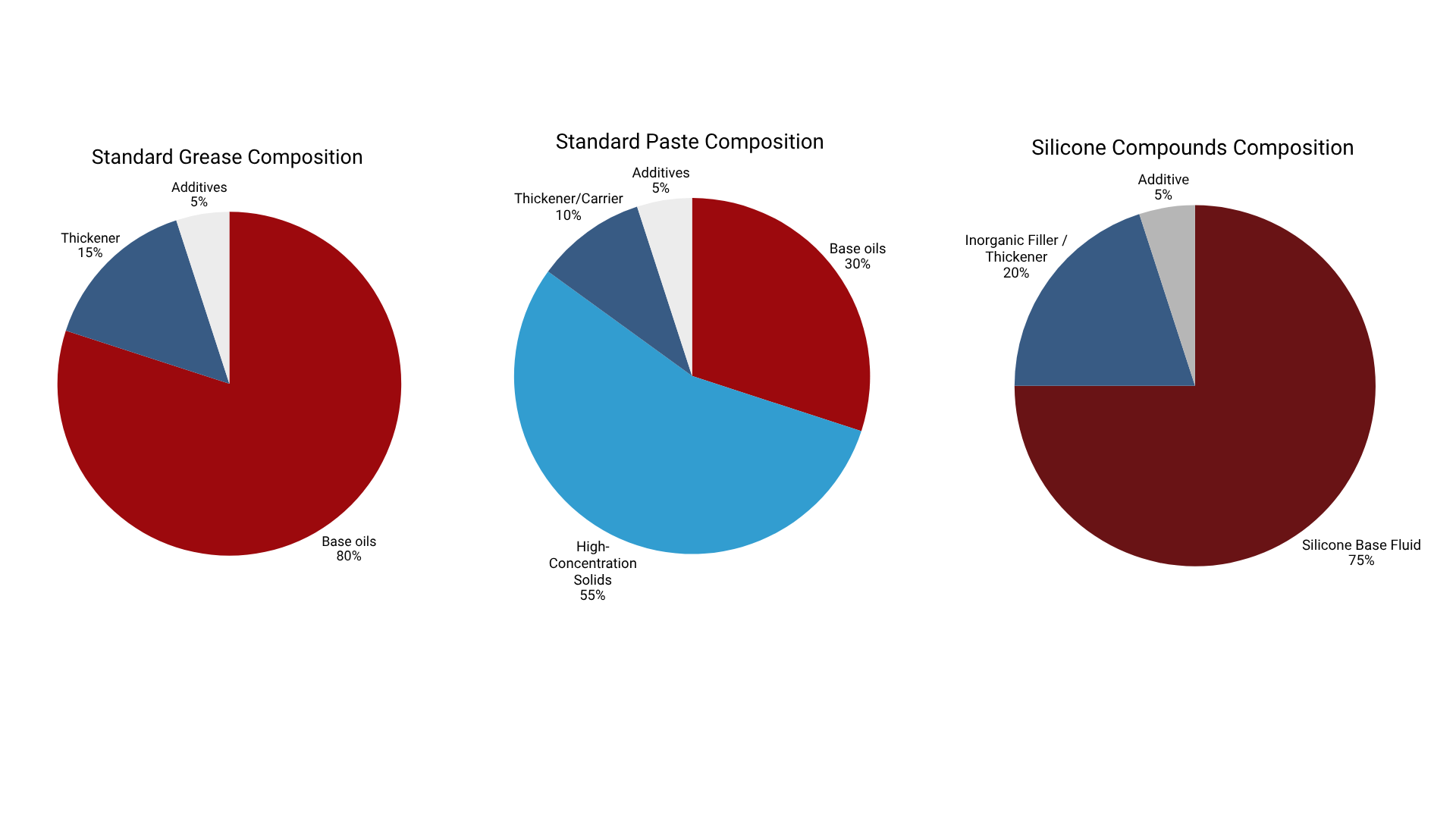
Standard Grease Composition
Base Oil (70–90%)
Mineral oils or synthetic fluids (like PAO or esters) that provide primary fluid lubrication.
Thickener (5–25%)
Metallic soaps, such as lithium, calcium, aluminum, or sodium complex soaps, that act like a sponge to hold the oil.
Additives (0–10%)
Rust inhibitors, anti-wear agents, and extreme-pressure (EP) additives.
Lubricating Paste Composition
Base Fluid (20–40%)
Mineral or synthetic lubricating oils.
High-Concentration Solids (40–60%)
Heavy loads of solid lubricants like graphite, molybdenum disulfide (MoS2), or PTFE.
Thickener/Carrier (10–20%)
Non-melting thickeners and dispersing agents designed to prevent the high volume of solids from settling out.
Additives (1–5%)
Surface adhesion promoters and extreme-pressure (EP) additives.
Silicone Compound / Grease Composition
Silicone Base Fluid (70–90%)
Polydimethylsiloxane (PDMS) or fluorosilicone oils providing strong thermal stability and water resistance.
Inorganic Filler / Thickener (5–20%)
Amorphous fumed silica creating a thixotropic, non-melting gel structure.
Performance Additives (0–5%)
Rust inhibitors, oxidation stabilizers, or extreme-pressure sulfur compounds added for enhanced metal protection.
Key Thickener Chemistries
Lithium 12-Hydroxystearate
The legacy standard. Max continuous temperature 120°C, with moderate water resistance.
Lithium Complex
High dropping point (>260°C) with strong high-temperature shear stability. The standard for automotive wheel bearings and general industrial motors.
Calcium Sulfonate Complex
Strong inherent extreme-pressure (EP) capacity and rust protection without additional chemical additives, and largely resistant to water wash-out. Common in mining, marine, and steel continuous-caster applications.
Polyurea (Non-Soap)
An organic polymer thickener containing zero metallic ash, with strong oxidation resistance and long life. A common choice for sealed-for-life, high-speed electric motor bearings.
PTFE (Fluorocarbon)
Used to thicken PFPE base oils. Resistant to most chemicals, solvents, and oxygen, and non-melting. Used in semiconductor vacuum pumps and extreme oven cart bearings above 280°C.
Thickener Compatibility Warning: Polyurea is strictly incompatible with lithium complex thickeners; mixing them causes matrix collapse and oil run-out. Old grease should always be fully purged before switching thickener chemistry.
NLGI Consistency Grades & ASTM D217
NLGI consistency grades classify the relative stiffness or hardness of lubricating greases, which determines fluid flow, pumpability, and sealability under operating conditions. The NLGI grading system uses a scale from 000 (fluid/semi-fluid) to 6 (very hard block grease). These grades are determined by measuring how far a standardized weighted cone penetrates the grease under the ASTM D217 test method.
.png)
Lubricating Mechanism
Rheological Behavior & Thixotropic Shear Dynamics
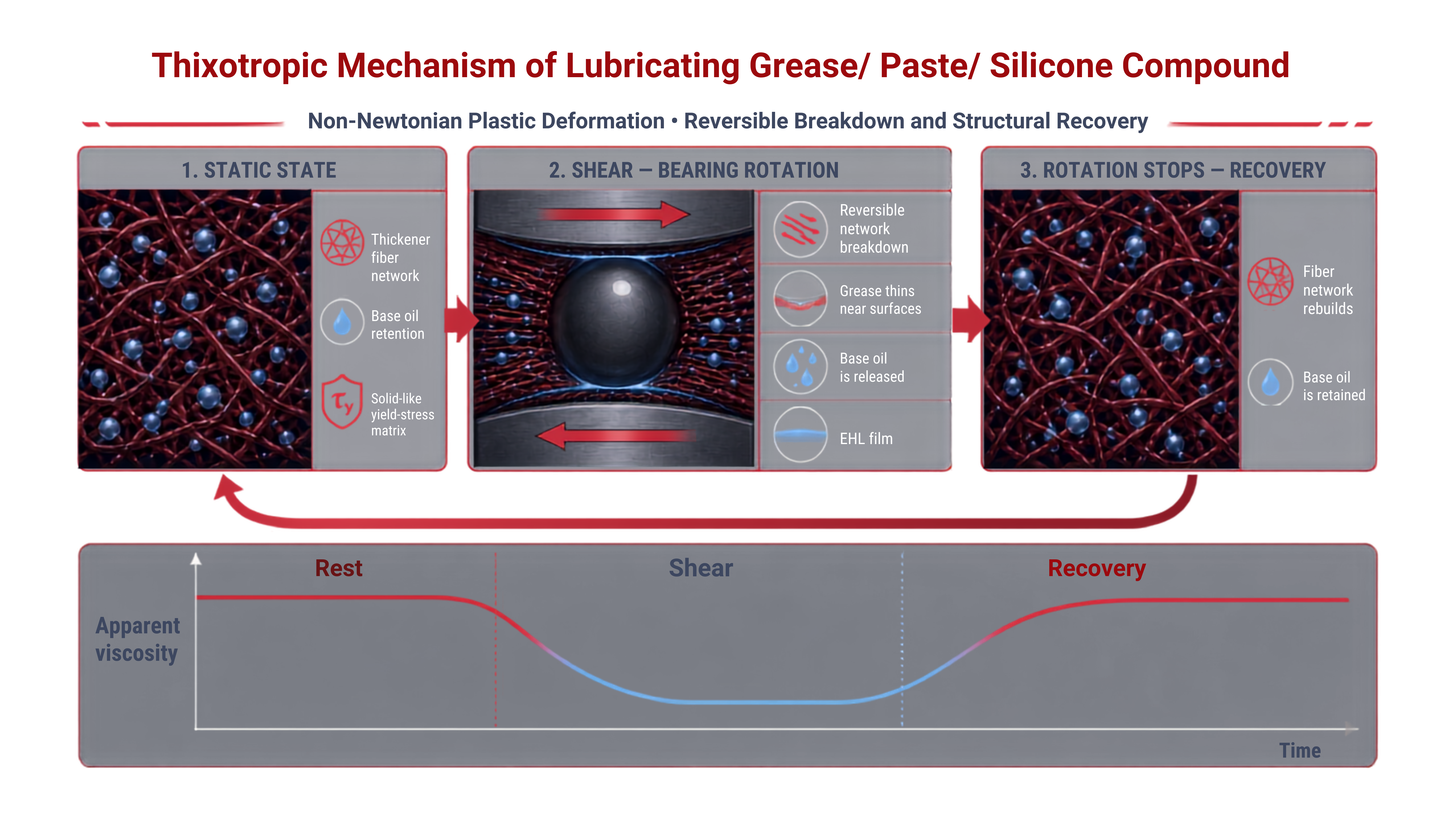
Greases operate as non-Newtonian, thixotropic plastic materials. At rest, the soap or polymer thickener fiber network forms a solid-like matrix defined by a specific yield stress that holds the base oil in suspension.
Upon application of mechanical shear from rotating bearing elements, this structural network breaks down reversibly in the contact zone. This localized shear-thinning action reduces fluid viscosity, releasing free base oil into the rolling track to form a protective elastohydrodynamic (EHL) film. Once mechanical shear forces cease, the thickener fiber network recombines, re-immobilizing the remaining base oil within the matrix.
The Bearing Lubrication Lifecycle
Initial Churning Phase
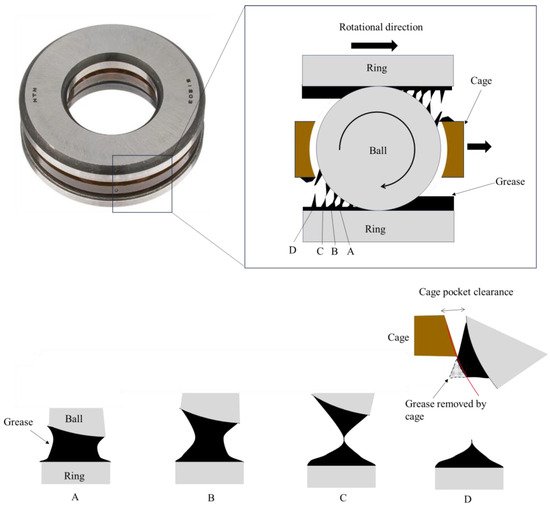
In a newly greased rolling bearing, the rolling elements push and shear the bulk grease. This phase produces high internal friction and redistributes excess grease into side housing reservoirs.
Channeling & Bleeding
Once the bearing settles, the contact operates with a limited lubricant supply. Continuous film maintenance relies on controlled bleeding of base oil from the adjacent side reservoir grease.
Film Formation
The released oil forms a separating film within the contact area. If the film is incomplete (Film Thickness Ratio Λ < 1), anti-wear (AW) additives and dispersed solids protect the surface through tribochemical layers. When rotation stops, the thickener network recombines.
Pros and Cons of Semi-Solid Lubrication
Product Selection Decision Tree
Key Application Sectors & Machinery Components
Electric Motor & Industrial Pump Bearings (Greases)
Mechanism: High speeds and moderate-to-high temperatures (80°C–150°C), requiring long-term operational life without oil leakage into motor windings.
Role: Polyurea-thickened NLGI 2 greases with synthetic PAO base oils offer long shear stability, low thickener hardening, and low noise, extending relubrication intervals to over 15,000 operating hours in many applications.
Heavy Mining, Cement, & Construction Equipment (High-Load Greases)
Mechanism: Extreme shock loading, heavy vibration, dust contamination, and water wash-off in jaw crushers, excavator bucket pins, vibrating screens, and slewing rings.
Role: Heavy-duty calcium sulfonate complex or lithium complex greases enriched with 3% to 5% solid MoS2 (NLGI 1 or 2, ISO VG 460 base oil). The thickener provides inherent rust protection and water resistance, while MoS2 helps prevent pin galling during high shock impacts.
Threaded Connections, Flanges, & Turbines (Anti-Seize Pastes)
Mechanism: Extreme thermal exposure (roughly 300°C to 1,000°C), aggressive atmospheric corrosion, and high torque loading leading to thread galling and cold welding.
Role: Metallic pastes containing high solid concentrations (copper, nickel, aluminum, or calcium fluoride powder in a low-viscosity carrier). When the carrier oil evaporates at high temperatures, the metal powders form a mechanical barrier, supporting predictable break-away torque during maintenance turnarounds.
Assembly Press-Fits, Splines, & Keyways (Assembly Pastes)
Mechanism: High contact pressures during mechanical press-fitting of bearings, gears, and bushings onto shafts, causing stick-slip, fretting corrosion, and surface scoring.
Role: High-concentration molybdenum disulfide pastes (>50% MoS2). The solid particles burnish into metal micro-roughness, helping prevent galling during press assembly and reducing fretting corrosion during operational micro-oscillations.
Electrical Switchgear, Spark Plug Boots, & Seals (Silicone/Dielectric Compounds)
Mechanism: Electrical arcing, moisture intrusion, corona discharge, and rubber elastomer hardening or swelling.
Role: Inert polydimethylsiloxane (PDMS) silicone fluids thickened with amorphous silica. These compounds don't melt, offer strong dielectric strength (>30 kV/mm), seal out moisture, and lubricate O-rings and plastic components without causing elastomer swelling.