
-
Home

-
Products
-
Adhesives
-
Polyurethane Adhesives
- 3M™ Scotch-Weld™ Urethane Adhesive DP6330NS
3M™ Scotch-Weld™ Urethane Adhesive DP6330NS
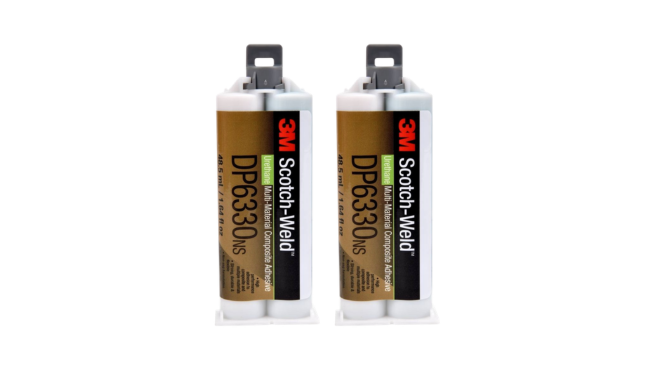

- 1:1 mix ratio
- 15-minute work life
- Non-sag rheology
Product Description
3M™ Scotch-Weld™ Multi-Material & Composite Urethane Adhesive DP6330NS is a multi-purpose urethane adhesive for bonding a variety of composites, plastics, metals and wood. It combines a 1:1 mix ratio by volume, a solvent-free adhesive system, and a 30-minute open time, while reaching handling strength in 2 hours at 73°F (23°C). Its non-sag paste formulation, high-strength structural bond profile with some flexibility, and excellent water, humidity, and chemical resistance make it suitable for replacing rivets and screws in attaching composites to other substrates.
Product Key Features
- Equal-Mix Processing - uses a 1:1 mix ratio by volume (1:1.09 by weight) to simplify dispensing.
- Open Time and Handling - offers a 15-minute worklife, a 30-minute open time, and reaches handling strength in 2 hours.
- Non-Sag Rheology - resists running and slumping of adhesive, operating as a non-sag paste for accurate application.
- Structural Bond Profile - delivers a Shore D hardness of 70 and strong overlap shear performance.
- OEM Compliance & Environmental Resistance - meets Freightliner and PACCAR specifications, while providing excellent water, humidity, and chemical resistance.
Applications
This adhesive fits composite and mixed-material assemblies that require structural bonding, flexibility to accommodate thermal expansion, and primerless adhesion to many substrates.
- Composite and Plastic Bonding: Bonds a variety of composites and plastics, serving as an alternative to rivets and screws to provide an aesthetically-pleasing, fatigue-resistant bond line.
- Metal Assemblies: Bonds well to most metals without requiring priming.
- Dissimilar Material Bonding: Provides a high-strength bond with some flexibility to accommodate thermal expansion and contraction differences when bonding dissimilar materials.
Technical Specifications
| General Properties | |||||
|
Appearance
Appearance
Appearance at room temperature. |
Green/Off-White | ||||
| Density (g) | part A: 1.2 — 1.32/ part B: 1.26 — 1.38 g/cm3 | ||||
|
Mix Ratio
Mix Ratio
The amount of a constituent divided by the total amount of all other constituents in a mixture |
1:1 | ||||
| Solids | 100 % | ||||
|
Work life @25°C
Work life @25°C
Work life is the amount of time we have to work with a material until it is no longer able to be easily worked and applied on a substrate. It is based on the change in viscosity and it can rely on the application requirements. |
0.25 hours | ||||
| Physical Properties | |||||
|
Viscosity
Viscosity
Viscosity is a measurement of a fluid’s resistance to flow. Viscosity is commonly measured in centiPoise (cP). One cP is defined as the viscosity of water and all other viscosities are derived from this base. MPa is another common unit with a 1:1 conversion to cP. A product like honey would have a much higher viscosity -around 10,000 cPs- compared to water. As a result, honey would flow much slower out of a tipped glass than water would. The viscosity of a material can be decreased with an increase in temperature in order to better suit an application |
part A: part A 9,000-25,000/ part B: 15,000-35,000 mPa.s | ||||
| Thermal Properties | |||||
|
Glass Transition Temperature (Tg)
Glass Transition Temperature (Tg)
The glass transition temperature for organic adhesives is a temperature region where the polymers change from glassy and brittle to soft and rubbery. Increasing the temperature further continues the softening process as the viscosity drops too. Temperatures between the glass transition temperature and below the decomposition point of the adhesive are the best region for bonding. The glass-transition temperature Tg of a material characterizes the range of temperatures over which this glass transition occurs. |
41 °C | ||||
| Mechanical Properties | |||||
|
|||||
|
|||||
| Curing Conditions | |||||
|
|||||
Additional Information
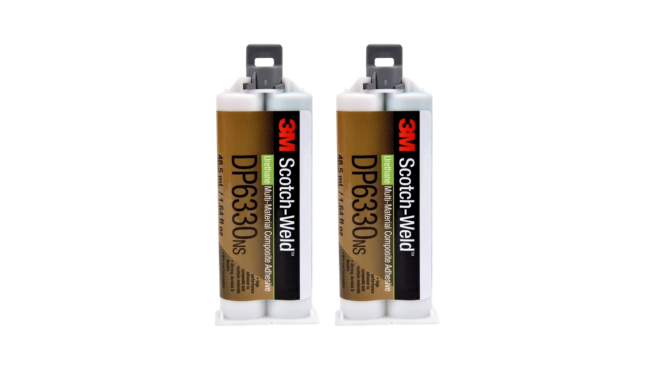
3M™ Scotch-Weld™ DP6330NS
3M™ Scotch-Weld™ Multi-Material & Composite Urethane Adhesive DP6330NS is a multi-purpose, two-component urethane adhesive system engineered for high-strength structural bonding of a variety of composites, plastics, metals, and wood. As a high-strength bonder with deliberate flexibility, it easily accommodates differences in thermal expansion and contraction during dissimilar material bonding. DP6330NS serves as an ideal replacement for rivets and screws, providing an aesthetically pleasing, fatigue-resistant, and impact-resistant bond line. It also establishes excellent primerless adhesion to most bare metals.
Typical engineering data measured at standard conditions of 72°F (22°C) unless otherwise indicated.
Key Features
- Outstanding capability to bond most composites and highly challenging dissimilar substrates.
- Primerless-to-surface adhesion performance across most bare metal variants.
- Non-sag thixotropic paste rheology prevents running, slumping, or migration on vertical seams.
- Meets specific OEM structural strength criteria including Freightliner No. 49-00093 Rev C and PACCAR CMT0038.
- Excellent resistance profiles against water and environmental humidity alongside very good chemical resistance.
- 100% solid, solvent-free adhesive framework supporting a cleaner factory workflow.
- Room temperature structural cure mechanism that can be further accelerated through targeted heat.
Processing Summary
Process Notes
- Store under normal temperature conditions between 16° to 27°C (60° to 80°F).
- Keep material contained within its original product packaging out of direct sunlight.
- Maintain ambient relative humidity levels between 40% and 60% to realize the 12-month shelf life.
- Steel: Wipe with pure solvent (acetone/IPA), sandblast or abrade with clean fine grit mending mediums, and wipe clean. Apply an epoxy primer or 3M™ Adhesion Promoter 111 for best results.
- Aluminum: Clean dust and structural oils away with pure acetone or IPA, sandblast/abrade with fine abrasives, and wipe clean.
- Plastics/Rubbers/Coatings: Perform an initial wipe using isopropyl alcohol (IPA), abrade thoroughly with fine grit media, and wipe clean with IPA again.
- Glass: Clean the bond area with acetone or MEK, apply a thin uniform coating of a silane adhesion promoter, and let dry completely.
- Duo-Pak Cartridges: Store with the cap end up to let micro air bubbles escape toward the tip. Place into the EPX applicator, balance the plungers by expelling a fraction of material, attach the mixing nozzle, and dispense.
- Hand Mixing: Expel the targeted amount of Part B and Part A, blend thoroughly, and continue mixing for 15 seconds after achieving a single uniform color streak.
- Bulk Configurations: Combine material precisely by weight or volume to match label criteria, and agitate for 15 seconds past the point of visual color uniformity.
- Mate and close all part assemblies within the explicit open time. Large scale volumes or high floor temperatures will shorten working time.
- Ensure parts remain completely undisturbed during early curing stages; employ light contact pressure or custom fixtures.
- Allow adhesive to cure at 60°F (16°C) or above until completely firm. Cure processing speeds up significantly when heat up to 200°F (93°C) is introduced.
- Clean up any excess uncured material instantly using standard ketone-type solvent lines.
Engineering Data for 3M™ DP6330NS
Uncured Physical Properties (at 22°C / 72°F)
| Property | Base (B) | Accelerator (A) | Condition / Test Method |
|---|---|---|---|
| Color | Green | Off-White | Visual inspection |
| Density | 1.2 - 1.32 g/cm³ (10 — 11 lb/gal) |
1.26 - 1.38 g/cm³ (10.5 — 11.5 lb/gal) |
- |
| Viscosity | 15,000 - 35,000 cP | 9,000 - 25,000 cP | Brookfield RTV, spindle #7, 20 RPM at 27°C (80°F) |
| Mixed Viscosity Profile | Non-sag paste | - | |
Typical Cured Characteristics (at 23°C / 73°F)
| Attribute Name | Typical Value | Test Method Details |
|---|---|---|
| Shore D Hardness | 70 | ASTM D2240 |
| Glass Transition Temperature (Tg) | 41°C (106°F) | Measured at six weeks via DMA |
Overlap Shear Strength Performance
Tested at 23°C (73°F) after a 7-day dwell period. Evaluated under ASTM D1002, ISO 4587 standards using 5-8 mil bondlines.
| Substrate Matrix | Surface Prep Protocol | Overlap Shear Value | Failure Mode Result |
|---|---|---|---|
| Glass Filled Epoxy LW | IPA Wipe / Abrade / IPA Wipe | 20.7 MPa (3000 lb/in²) | Substrate Failure (SF) |
| Stainless Steel | MEK / Abrade / MEK | 20.3 MPa (2946 lb/in²) | Cohesive Failure (CF) |
| Aluminum | MEK / Abrade / MEK | 18 MPa (2612 lb/in²) | Cohesive Failure (CF) |
| Cold Rolled Steel | MEK / Abrade / MEK | 14.3 MPa (2068 lb/in²) | Adhesive Failure (AF) |
| Galvanized Steel | MEK / Abrade / MEK | 11.7 MPa (1700 lb/in²) | Adhesive Failure (AF) |
| Glass Filled Polyester | IPA Wipe / Abrade / IPA Wipe | 8.3 MPa (1200 lb/in²) | Substrate Failure (SF) |
| Polycarbonate (PC) | MEK / Abrade / MEK | 7.6 MPa (1100 lb/in²) | Substrate Failure (SF) |
| Fiber-Reinforced Plastic (FRP) | IPA Wipe / Abrade / IPA Wipe | 6.9 MPa (1000 lb/in²) | Substrate Failure (SF) |
| ABS | MEK / Abrade / MEK | 4.5 MPa (650 lb/in²) | Adhesive Failure (AF) |
- Cohesive Failure (CF): Structural breakdown within the internal adhesive layer body.
- Adhesive Failure (AF): Separation occurring cleanly at the exact contact plane between the adhesive film and substrate surface.
- Substrate Failure (SF): Material breakdown occurs within the bonded part substrate layers before the adhesive interface yields.
Peel Strength Performance
Tested at 23°C (73°F) after a 24-hour dwell period. 25 mm (1 in) wide samples; 0.4 mm (0.017 in) bond line thickness. The jaw separation rate during testing was 15 cm/min (6 in/min). The bonds are made with 1.6 mm (0.064 in) bonded to 0.64 mm (0.025 in) thick adherends.
| Substrate Matrix | Bell Peel Value | Test method |
|---|---|---|
| Etched Aluminum | 53 N/cm (30 lb/in) | ASTM D3167 |
Where 3M™ DP6330NS Fits
(2).png)
Panel-to-Frame Assembly
- Replaces traditional physical rivets and sheet screws.
- Eliminates localized mechanical fastening spot distortion.
- Delivers premium aesthetic, fatigue-resistant line joints.
(1).png)
Composite-to-Composite Assembly
- Provides superior impact and micro-shock absorption.
- Maintains high elongation stress-strain resilience.
- Protects assemblies against harsh environmental degradation.
.png)
- Certified to Freightliner Standard No. 49-00093 Rev C.
- Fully compliant with rigid PACCAR CMT0038 parameters.
- Extended 15-minute worklife accommodates large manual alignments.
See 3M™ Scotch-Weld™ EPX Application System in Use
Review the explicit operation of structural adhesive application utilizing 3M™ EPX™ Applicator static mixing nozzle systems. This visual guide walks through auto-plunger balancing, consistent ribbon bead tracking, and essential closing methods within the target open time limits.
Standard Packaging & Technical Help
- Duo-Pak Cartridges built for manual handheld dispensing gear.
- High-capacity bulk container configurations optimized for automated lines.
- Fully compatible with authentic 3M™ EPX™ static mixing nozzle arrays.
- Assists with target surface prep configurations for unique or complex substrates.
- Provides custom risk assessments evaluating specialized structural assembly plans.
- Advises on exact nozzle configurations, fluid pressure limits, and staging plans.
- Offers support for regulatory matching, including European EN 45545 fire test data.
Tips and Troubleshooting
| Issue | Recommended Action |
|---|---|
| Adhesive cures inside nozzle or forces excessive trigger resistance |
|
| Premature bond failure or reduced shear profile values |
|
| Accelerating slow cure cycles during high-throughput schedules |
|