
-
Home

-
Products
-
Soldering Materials
-
Solder Pastes
- KESTER EP256 Solder Paste
KESTER EP256 Solder Paste
- Stable wetting behavior
- Excellent printing characteristics
- High activity on all substrates
Product Description
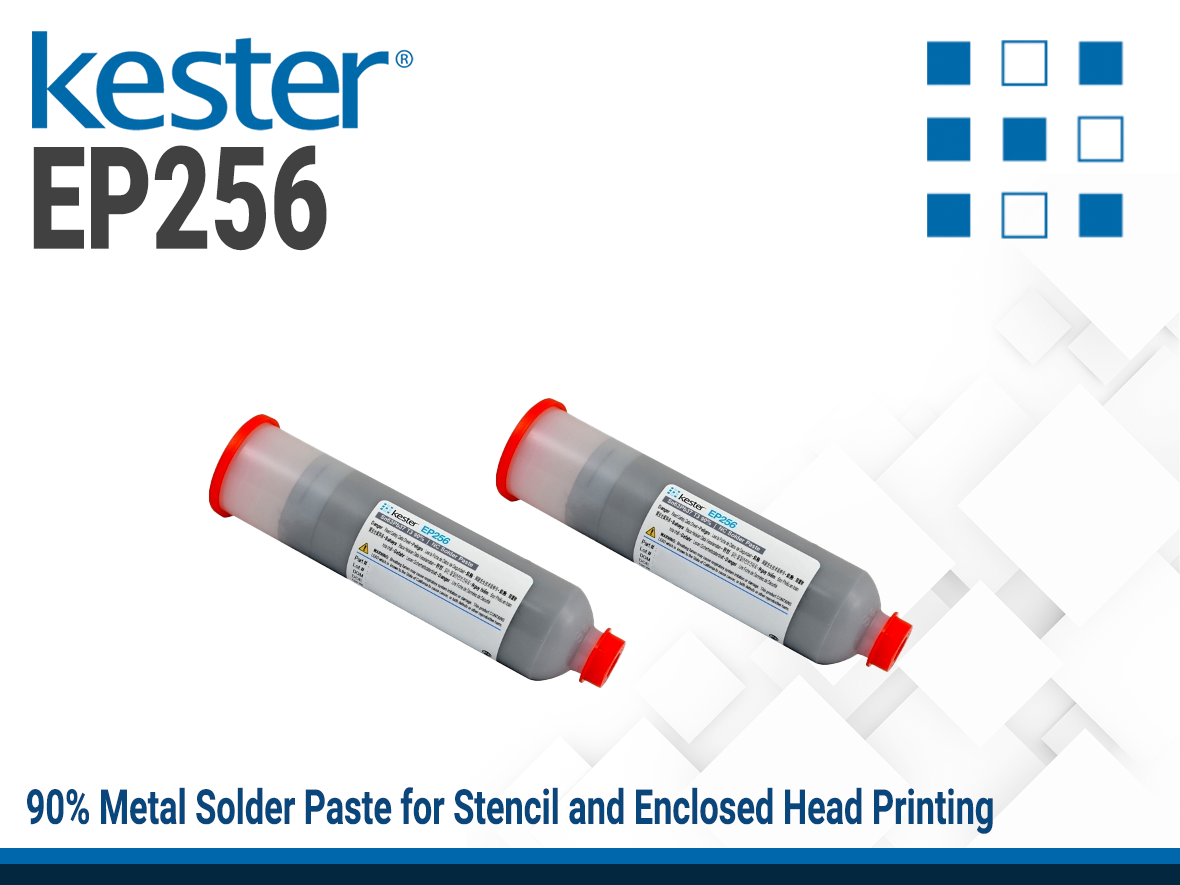
KESTER EP256 is a no-clean, air or nitrogen reflowable solder paste specifically designed for maximum robustness in reflow profiling and stencil printing. EP256 has the widest possible reflow processing window and it is also capable of stencil printing downtimes of up to 90 minutes with an effective first print down to 20 mils. EP256 is a solder paste formula that maintains its activity and printing characteristics for up to 8 hours without any shear thinning.
Product Key Features
- Stable wetting behavior over a wide range of profiles
- Capable of 90-minute break times in printing
- High print speeds to 200+ mm/sec (8+ in/sec)
- Compatible with enclosed print head systems
- Excellent printing characteristics to 0.4mm (16 mil) pitch with Type 3 powder.
Applications
- Stencil printing and enclosed head printing (90% metal)
Technical Specifications
| Chemical Properties | |||||
|
|||||
| Physical Properties | |||||
|
|||||
| General Properties | |||||
|
Alloy Type
Alloy Type
A metallic element type |
Sn63Pb37, Sn62Pb36Ag2 and Sn43Pb43Bi14 | ||||
|
|||||
Additional Information
Reflow Profile
The recommended reflow profile for EP256 made with either the Sn63Pb37 or Sn62Pb36Ag02 is shown here. This profile is simply a guideline. Since EP256 is a highly active solder paste, it can solder effectively over a wide range of profiles, including lead-free profiles in some cases.
EP256 is capable of reflowing at the 235 °C peak temperatures required for fully collapsing lead-free SAC BGAs for maximum reliability and remains easy to clean after these high temperature profiles. Your optimal profile may be different from the one shown based on your oven, board and mix of components.
Contact us if you need additional profiling advice.
| Sn63Pb37 or Sn62Pb36Ag02 Alloys | SnAgCu Alloys |
|
Preheat Zone:
Reflow Zone:
Cooling Zone:
|
Preheat Zone:
Reflow Zone:
Cooling Zone:
|