-
Home

-
Products
-
Soldering Materials
-
Solder Flux
- KESTER RF771 Rework Flux
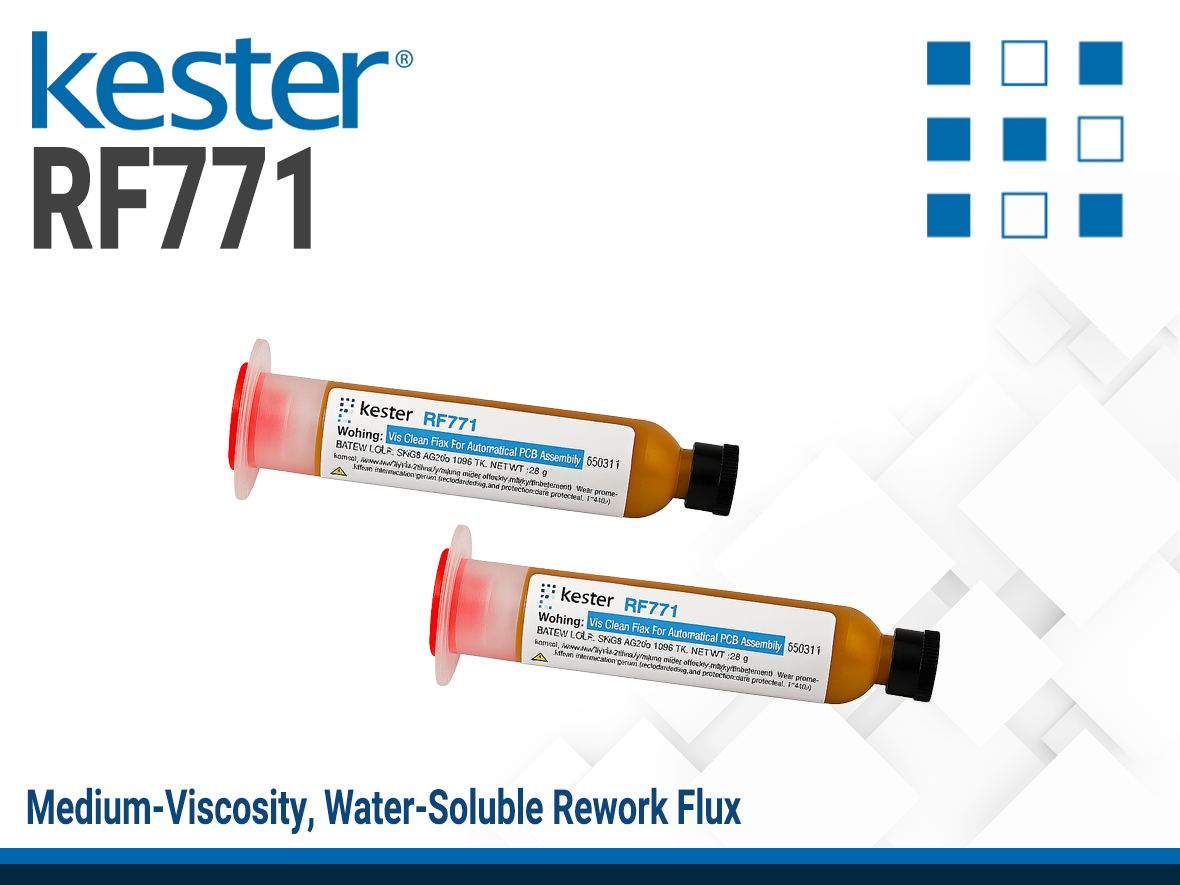
KESTER RF771 Rework Flux
- High thermal stability
- Leaves bright & shiny solder joints post-reflow
- Classified as ORM0 per J-STD-004
Product Description
KESTER RF771 is a medium-viscosity, water-soluble flux designed for electronic component rework and repair applications. RF771 has a gel-like consistency and is easily applied by syringe dispensing. RF771 can be precisely dispensed onto a specific area that needs flux. After being dispensed, RF771 stays in place until soldering occurs. Traditional problems experienced with controlling the application of water-soluble liquid fluxes are eliminated. RF771 has excellent performance in applications that require a flux having good thermal stability such as surface mount component repair. RF771 is the ideal choice for QFP or BGA semi-automated rework operations. In addition, RF771 is well suited for use with through-hole repair operations where solder fountain or controlled solder reservoir is being used for selective component removal and repair. Residues that remain on surfaces after soldering are easily removed with hot water. KESTER RF771 can be used in combination with Kester water-soluble cored wire solders and water-soluble solder pastes, as well as water-soluble liquid fluxes, to provide the complete water-soluble soldering connection.
Product Key Features
- Compatible with HM351 solder paste
- High thermal stability
- Leaves bright & shiny solder joints after reflow
Applications
- Electronic component reflow and repair applications
Technical Specifications
| Physical Properties | |
|
Viscosity
Viscosity
Viscosity is a measurement of a fluid’s resistance to flow. Viscosity is commonly measured in centiPoise (cP). One cP is defined as the viscosity of water and all other viscosities are derived from this base. MPa is another common unit with a 1:1 conversion to cP. A product like honey would have a much higher viscosity -around 10,000 cPs- compared to water. As a result, honey would flow much slower out of a tipped glass than water would. The viscosity of a material can be decreased with an increase in temperature in order to better suit an application |
285000 mPa.s |