
-
Home

-
Products
-
Encapsulants & Underfills
-
Underfills
- LOCTITE 3515
LOCTITE 3515
Harmonization Code : 3907.30.00.85 | Polyacetals, other polyethers and epoxide resins, in primary forms; polycarbonates, alkyd resins, polyallyl esters and other polyesters, in primary forms : Epoxide resins : Other
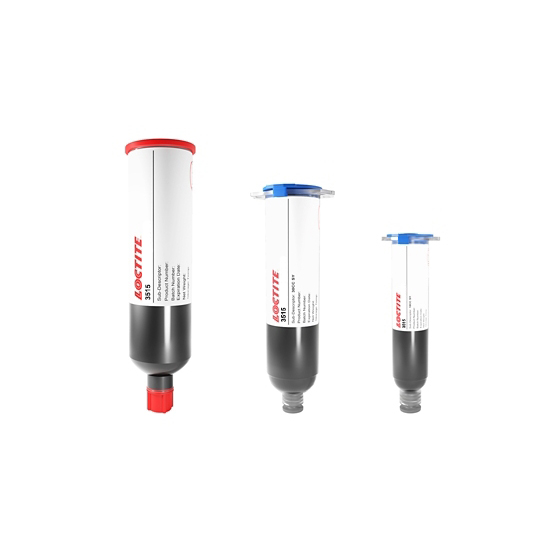

Main features
- Cornerbond
- Fast cure
- Self alignment of SMT components
Product Description
LOCTITE 3515 is a one component epoxy adhesive, designed to allow self-alignment of SMT components during the reflow operation. The adhesive is pre-applied to the board at the corners of the CSP pad site using a standard SMA dispenser, a process that speeds assembly by eliminating post-reflow underfill dispense and cure steps.
LOCTITE 3515 cures during the solder reflow phase to form a reliable bond, and contributes to improvements in handheld device reliability. LOCTITE 3515 cornerbond has excellent dispensing characteristics, good dot profile, and good on-board electrical characteristics. Reinforcement of CSPs with interposers or comerless arrays in portable electronic devices.
Cure Schedule
- 30 minutes @ 150 °C
- 5 minutes @ 180 °C
- 30 seconds @ 200 °C
- 15 seconds @ 220 °C
Technical Specifications
| General Properties | |||||||||
|
Specific Gravity
Specific Gravity
Specific gravity (SG) is the ratio of the density of a substance to the density of a reference substance; equivalently, it is the ratio of the mass of a substance to the mass of a reference substance for the same given volume. For liquids, the reference substance is almost always water (1), while for gases, it is air (1.18) at room temperature. Specific gravity is unitless. |
1.23 | ||||||||
| Thermal Properties | |||||||||
|
Glass Transition Temperature (Tg)
Glass Transition Temperature (Tg)
The glass transition temperature for organic adhesives is a temperature region where the polymers change from glassy and brittle to soft and rubbery. Increasing the temperature further continues the softening process as the viscosity drops too. Temperatures between the glass transition temperature and below the decomposition point of the adhesive are the best region for bonding. The glass-transition temperature Tg of a material characterizes the range of temperatures over which this glass transition occurs. |
73 °C | ||||||||
|
Thermal Conductivity
Thermal Conductivity
Thermal conductivity describes the ability of a material to conduct heat. It is required by power packages in order to dissipate heat and maintain stable electrical performance. Thermal conductivity units are [W/(m K)] in the SI system and [Btu/(hr ft °F)] in the Imperial system. |
0.28 W/m.K | ||||||||
|
|||||||||
| Mechanical Properties | |||||||||
|
|||||||||
| Chemical Properties | |||||||||
|
|||||||||