-
Home

-
Products
-
Molding Compounds
-
Semiconductor Epoxy Mold Compounds
- EMC-G845 | Black Epoxy Molding Compound
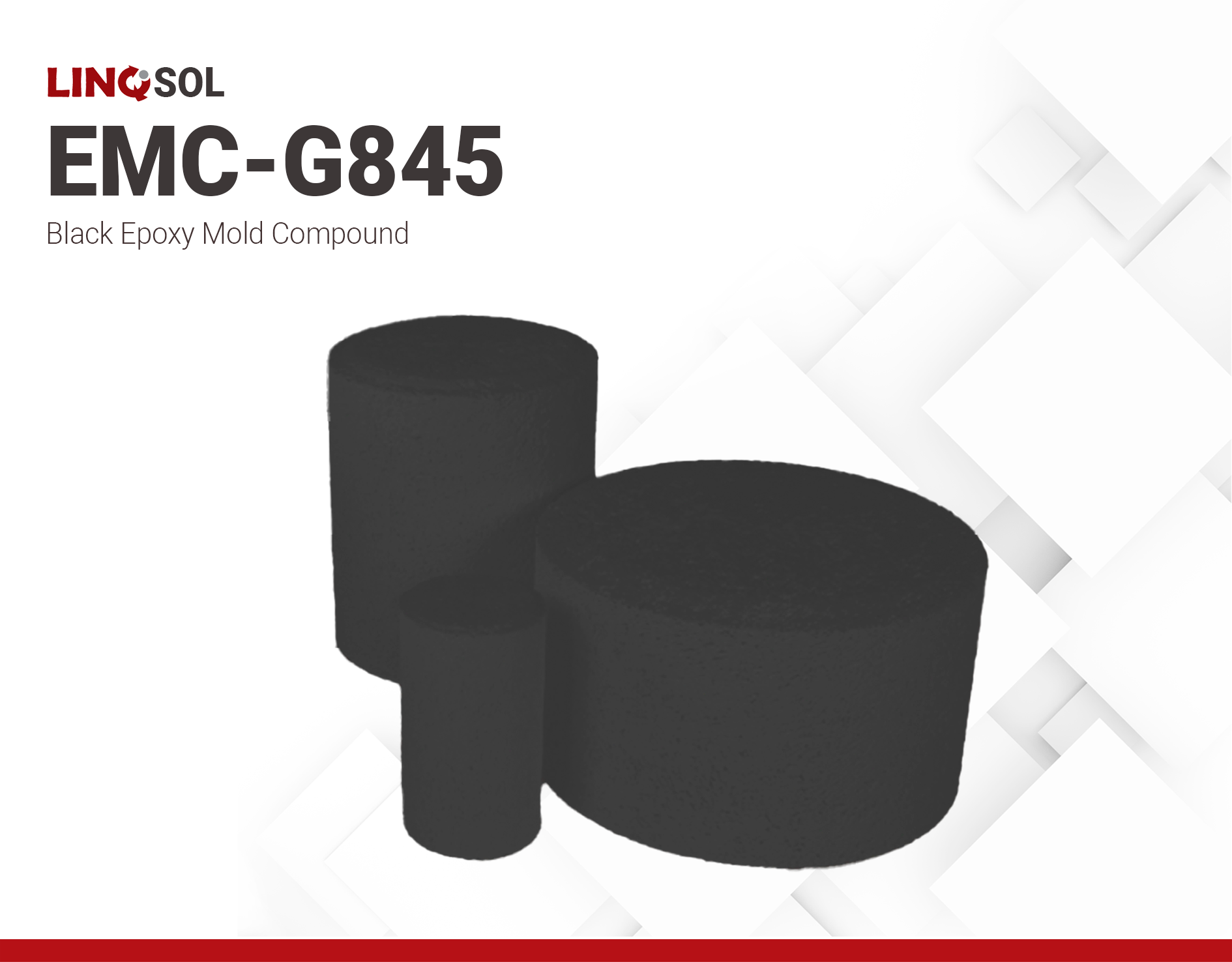
EMC-G845 | Black Epoxy Molding Compound
Harmonization Code : 3907.30.00.40 | Epoxy Mold Compounds containing by weight more than 70 % silicon dioxide

Main features
- Green epoxy molding compound
- Designed for QFN & QFP packages
- Satisfies JEDEC MSL 3 reliability
Product Description
LINQSOL EMC-G845 is a halogen-free epoxy molding compound that reliably encapsulates various semiconductor devices. EMC-G845 is particularly well-suited for thin, high-density packages like Quad Flat No-Leads (QFN) and Quad Flat (QFP). This advanced compound combines superior processing characteristics with robust performance and strict safety compliance, offering a comprehensive solution for your encapsulation needs.
Product Key Features
- Optimized Flowability — Has broad gel time and high spiral flow, allowing a wide processing window for efficient molding of complex packages.
- Low Water Absorption — Ensures outstanding reliability and long-term performance of encapsulated semiconductor devices.
- RoHS and REACH Compliant
Applications
- Encapsulation of quad flat no-leads (QFN) & quad flat (QFP) packages.
- Also suitable for a variety of other semiconductor packages requiring precise and robust encapsulation.
Technical Specifications
| General Properties | |||||||
|
Specific Gravity
Specific Gravity
Specific gravity (SG) is the ratio of the density of a substance to the density of a reference substance; equivalently, it is the ratio of the mass of a substance to the mass of a reference substance for the same given volume. For liquids, the reference substance is almost always water (1), while for gases, it is air (1.18) at room temperature. Specific gravity is unitless. |
1.98 | ||||||
| Thermal Properties | |||||||
|
Glass Transition Temperature (Tg)
Glass Transition Temperature (Tg)
The glass transition temperature for organic adhesives is a temperature region where the polymers change from glassy and brittle to soft and rubbery. Increasing the temperature further continues the softening process as the viscosity drops too. Temperatures between the glass transition temperature and below the decomposition point of the adhesive are the best region for bonding. The glass-transition temperature Tg of a material characterizes the range of temperatures over which this glass transition occurs. |
128 °C | ||||||
|
Thermal Conductivity
Thermal Conductivity
Thermal conductivity describes the ability of a material to conduct heat. It is required by power packages in order to dissipate heat and maintain stable electrical performance. Thermal conductivity units are [W/(m K)] in the SI system and [Btu/(hr ft °F)] in the Imperial system. |
0.88 W/m.K | ||||||
|
UL 94 Rating
UL 94 Rating
Flammability rating classification. It determines how fast a material burns or extinguishes once it is ignited. HB: slow burning on a horizontal specimen; burning rate less than 76 mm/min for thickness less than 3 mm or burning stops before 100 mm V-2: burning stops within 30 seconds on a vertical specimen; drips of flaming particles are allowed. V-1: burning stops within 30 seconds on a vertical specimen; drips of particles allowed as long as they are not inflamed. V-0: burning stops within 10 seconds on a vertical specimen; drips of particles allowed as long as they are not inflamed. 5VB: burning stops within 60 seconds on a vertical specimen; no drips allowed; plaque specimens may develop a hole. 5VA: burning stops within 60 seconds on a vertical specimen; no drips allowed; plaque specimens may not develop a hole |
V-0 | ||||||
|
|||||||
|
|||||||
| Electrical Properties | |||||||
|
|||||||
|
|||||||
| Mechanical Properties | |||||||
|
|||||||
|
|||||||
| Physical Properties | |||||||
| Spiral Flow @ 175°C | 165.1 cm | ||||||
|
Viscosity
Viscosity
Viscosity is a measurement of a fluid’s resistance to flow. Viscosity is commonly measured in centiPoise (cP). One cP is defined as the viscosity of water and all other viscosities are derived from this base. MPa is another common unit with a 1:1 conversion to cP. A product like honey would have a much higher viscosity -around 10,000 cPs- compared to water. As a result, honey would flow much slower out of a tipped glass than water would. The viscosity of a material can be decreased with an increase in temperature in order to better suit an application |
13000 mPa.s | ||||||