
-
Home

-
Products
-
Coatings, powders & Resins
-
Conformal Coatings
- HumiSeal 1A27LTX Urethane Conformal Coating
HumiSeal 1A27LTX Urethane Conformal Coating
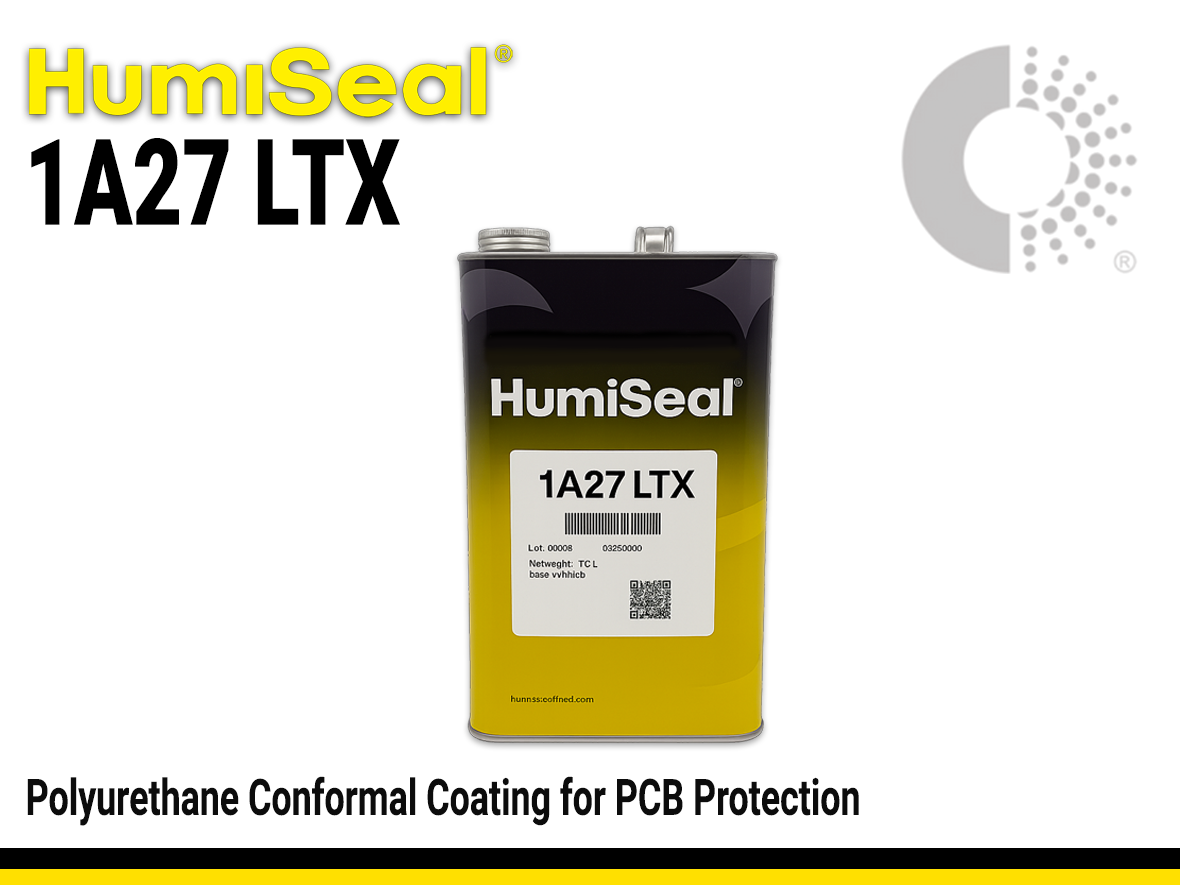
- Single-component polyurethane conformal coating
- UL 94 V-0 Flame Retardant
- No free isocyanates
Product Description
HumiSeal 1A27 LTX is a high-performance, single-component polyurethane conformal coating designed for advanced PCB protection. Engineered with a low-VOC formulation, it meets stringent environmental regulations—including China’s GB30981-2020—without compromising on performance.
Product Key Features
- Single-component polyurethane conformal coating
- Protection against moisture, corrosive environments, and contamination
- Low moisture vapor permeability for long-term reliability
- Easy application using automated or manual methods
- Reduced xylene and toluene formulation
- No free isocyanates
- Compliant with GB30981-2020 VOC regulations
- UL 94 V-0 flame retardant
Applications
- General printed circuit board (PCB) protection
- Consumer, industrial, and automotive electronics
- Assemblies exposed to moisture, dust, or corrosive environments
- Electronics requiring long-term insulation resistance and dielectric strength
Technical Specifications
| General Properties | |||||
| Solids | 50 % | ||||
| Thickness range | 0.025 - 0.075 mm | ||||
| Physical Properties | |||||
|
Viscosity
Viscosity
Viscosity is a measurement of a fluid’s resistance to flow. Viscosity is commonly measured in centiPoise (cP). One cP is defined as the viscosity of water and all other viscosities are derived from this base. MPa is another common unit with a 1:1 conversion to cP. A product like honey would have a much higher viscosity -around 10,000 cPs- compared to water. As a result, honey would flow much slower out of a tipped glass than water would. The viscosity of a material can be decreased with an increase in temperature in order to better suit an application |
3000 mPa.s | ||||
| Thermal Properties | |||||
|
Glass Transition Temperature (Tg)
Glass Transition Temperature (Tg)
The glass transition temperature for organic adhesives is a temperature region where the polymers change from glassy and brittle to soft and rubbery. Increasing the temperature further continues the softening process as the viscosity drops too. Temperatures between the glass transition temperature and below the decomposition point of the adhesive are the best region for bonding. The glass-transition temperature Tg of a material characterizes the range of temperatures over which this glass transition occurs. |
28 °C | ||||
| Mechanical Properties | |||||
|
|||||
| Electrical Properties | |||||
|
Breakdown Voltage
Breakdown Voltage
Breakdown voltage is the minimum voltage necessary to force an insulator to conduct some amount of electricity. It is the point at which a material ceases to be an insulator and becomes a resistor that conducts electricity at some proportion of the total current. After dielectric breakdown, the material may or may not behave as an insulator any more because of the molecular structure alteration. The current flow tend to create a localised puncture that totally alters the dielectric properties of the material. This electrical property is thickness dependent and is the maximum amount of voltage that a dielectric material can withstand before breaking down. The breakdown voltage is calculated by multiplying the dielectric strength of the material times the thickness of the film. |
7500 V | ||||
|
|||||
|
|||||
Additional Information
Learn More About HumiSeal® 1A27 LTX
Application Methods
HumiSeal® 1A27 LTX is designed for flexible application across automated and manual coating processes.
Application Methods:
- Dipping: Viscosity may be adjusted using HumiSeal® Thinner 789 to ensure uniform film thickness. Controlled immersion and withdrawal rates of 5–15 cm/min are recommended. Viscosity should be monitored regularly using Zahn or Ford cups.
- Spraying: Suitable for conventional spray equipment. Thinning with HumiSeal® Thinner 789 is required to achieve a uniform, pinhole-free coating. Adequate ventilation must be provided.
- Brushing: Can be applied by brush with minor thinning. Final film quality depends on component density and operator technique.
Important Notes:
- Substrates must be clean, dry, and free of flux, grease, and contaminants.
- Contamination beneath the coating can lead to electrical or mechanical failure.
- Allow sufficient curing time to reach optimum performance.
Application Compatibility
HumiSeal® 1A27 LTX is compatible with a wide range of PCB materials and electronic components.
Compatible With:
✔ Printed circuit boards and electronic assemblies
✔ Automated dip, spray, and selective coating systems
✔ Standard electronics manufacturing materials
Additional Guidance:
For optimal performance, ensure proper cleaning prior to coating. Consult Technical Support for guidance on viscosity adjustment, equipment selection, or pre-blend solutions.
Safety and Handling Precautions ⚠️
- Use only in well-ventilated areas.
- Avoid inhalation of vapors or spray mist.
- Avoid contact with skin and eyes.
- Keep away from sparks, hot surfaces, and open flames.
- Follow all local and national health and safety regulations.
Always consult the Safety Data Sheet (SDS) before use.
Storage Recommendations 📦
Store HumiSeal® 1A27 LTX in tightly closed containers, away from excessive heat or cold. Recommended storage temperature is 0–35°C. Prior to use, allow the material to equilibrate for 24 hours at room temperature (18–32°C).
Compliance You Can Trust ✅
HumiSeal® 1A27 LTX meets stringent regulatory and performance standards for conformal coatings:
✔ GB30981-2020 compliant
✔ UL 94 V-0 flammability rated
✔ High dielectric strength and insulation resistance
✔ Designed for long-term electronic protection