- Home

- Products
- Molding Compounds
- Semiconductor Epoxy Mold Compounds
- Hysol GR900 Q1G2 | Black Epoxy Mold Compound
Hysol GR900 Q1G2 | Black Epoxy Mold Compound
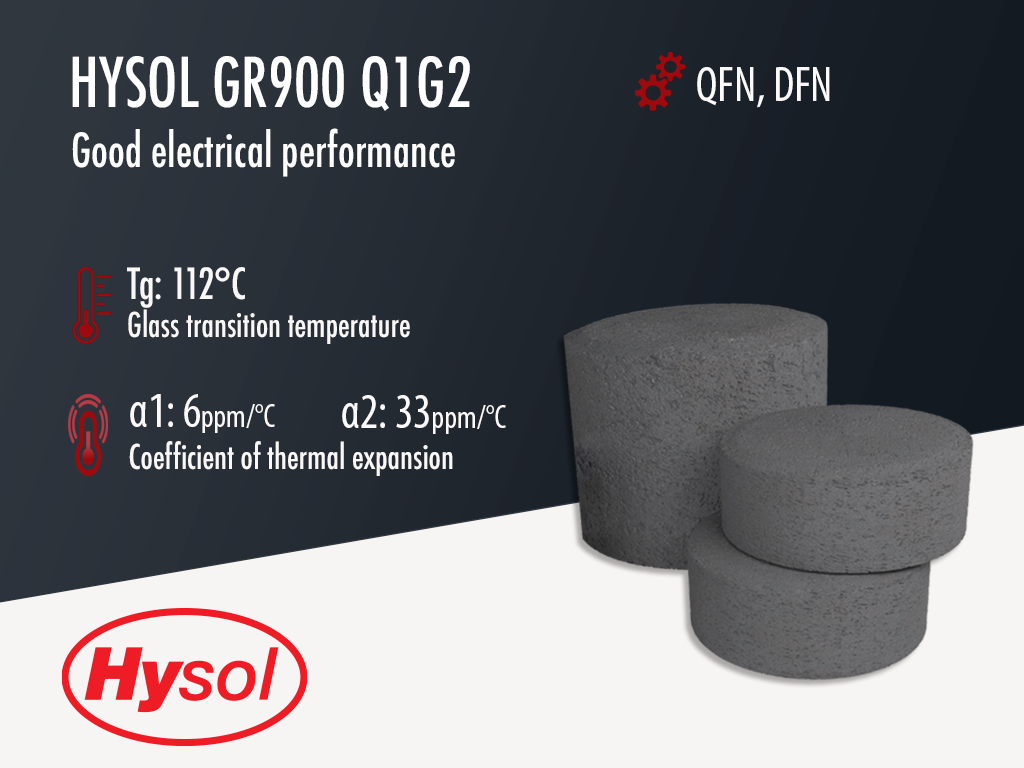

- Designed for DFN and small QFN packages
- Excellent electrical capabilities
- Compatible with Copper Wire
Product Description
Hysol GR900 Q1G2 is a similar but alternative version of Q1L4. While Q1L4 offers great HTRB performance, Q1G2 offers better electrical performance for DFNs and small QFNs. It is a black semiconductor-grade epoxy molding compound designed for the encapsulation and protection of quad-flat no-leads (QFN) and dual-flat no-leads (DFN).
Hysol GR900 Q1G2 is a relatively softer, spherical silica filled (89%) high end epoxy, typically used for QFN and DFN packages. QFN and DFN packages are low-profile packages that are MAP molded. This means that the packages are molded together in one large mold and then separated by cutting through the entire package. Epoxy molding compounds made for these type packages, like Q1G2, must have a low warpage.
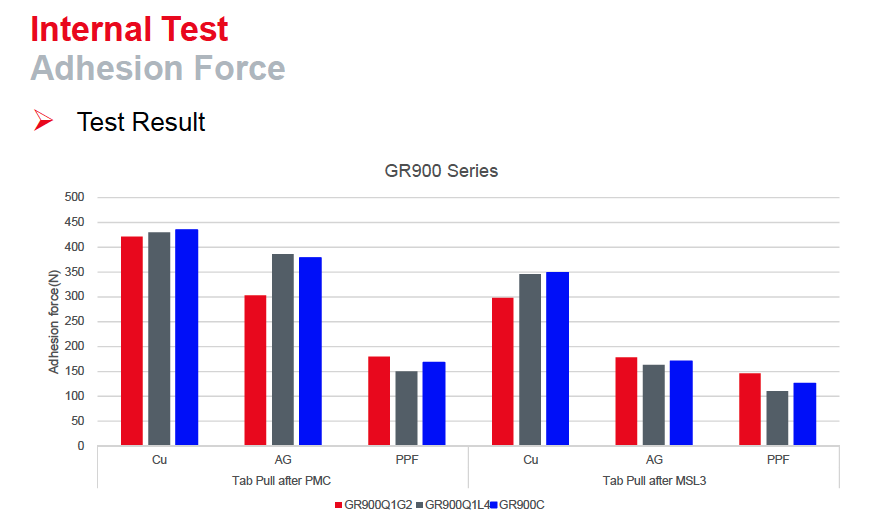
Hysol GR900 Q1G2 is an environmentally "green" halogen free product, meaning that it doesn't contain any bromine, antimony or phosphorus flame retardants. It offers good adhesion after MSL 3 and meets UL 94 V-0 Flammability at 1/8 inch (3.18mm) thickness. If you are not after the electrical performance, then by all accounts GR 900 Q1L4 will probably be the better option.
Technical Specifications
| General Properties | |
| Color Color The color | Black |
| Filler Content | 89 % |
| Thermal Properties | |
| Glass Transition Temperature (Tg) Glass Transition Temperature (Tg) The glass transition temperature for organic adhesives is a temperature region where the polymers change from glassy and brittle to soft and rubbery. Increasing the temperature further continues the softening process as the viscosity drops too. Temperatures between the glass transition temperature and below the decomposition point of the adhesive are the best region for bonding. The glass-transition temperature Tg of a material characterizes the range of temperatures over which this glass transition occurs. | 112 °C |
| UL 94 Rating UL 94 Rating Flammability rating classification. It determines how fast a material burns or extinguishes once it is ignited. HB: slow burning on a horizontal specimen; burning rate less than 76 mm/min for thickness less than 3 mm or burning stops before 100 mm V-2: burning stops within 30 seconds on a vertical specimen; drips of flaming particles are allowed. V-1: burning stops within 30 seconds on a vertical specimen; drips of particles allowed as long as they are not inflamed. V-0: burning stops within 10 seconds on a vertical specimen; drips of particles allowed as long as they are not inflamed. 5VB: burning stops within 60 seconds on a vertical specimen; no drips allowed; plaque specimens may develop a hole. 5VA: burning stops within 60 seconds on a vertical specimen; no drips allowed; plaque specimens may not develop a hole | V0 |
| Physical Properties | |
| Spiral Flow @ 175°C | 137 cm |
| Mechanical Properties | |
| Molded Shrinkage | 0.19 % |
| Curing Conditions | |
| Transfer Pressure | 40 - 100 kg/cm2 |
| Transfer Time | 5 - 30 s |
Additional Information