
-
Home

-
Products
-
Molding Compounds
-
Semiconductor Epoxy Mold Compounds
- Hysol MG15F-0140B | Black Epoxy Mold Compound
Hysol MG15F-0140B | Black Epoxy Mold Compound
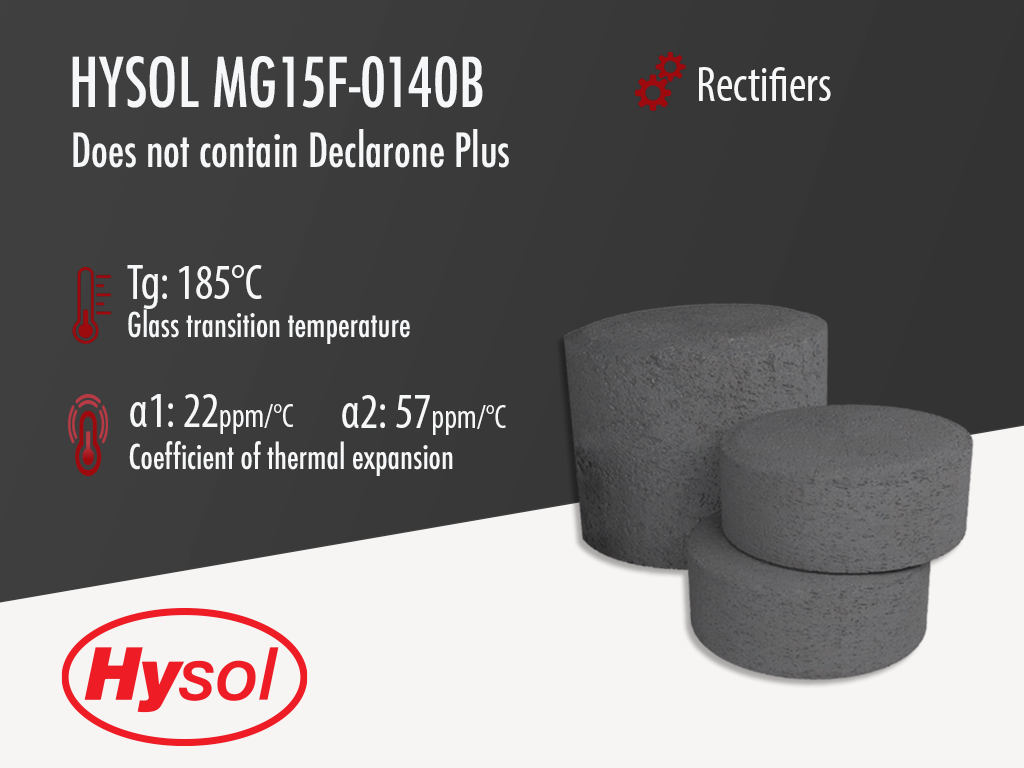

- Anhydride cured
- Tg: 185°C
- For power discretes and high voltage rectifiers
Product Description
Hysol MG15F-0140B is a black, semiconductor grade, anhydride curing epoxy molding compound designed for high voltage power applications requiring good electrical stability at high temperature. A real classic. The work horse, as the industry would call it, product of the halogen and anhydride containing chemistries.
Hysol MG15F-0140B was typically used for power discretes and high voltage rectifiers. Despite its glorious history, the industry has been leaning towards next generation compounds that are future proof while still maintaining the same, or sometimes even better mold properties. GR 750 and the GR 750 XX series in general have nothing to envy and are good drop in candidates for the old guard.
Technical Specifications
| General Properties | |||||||
|
Color
Color
The color |
black | ||||||
|
Specific Gravity
Specific Gravity
Specific gravity (SG) is the ratio of the density of a substance to the density of a reference substance; equivalently, it is the ratio of the mass of a substance to the mass of a reference substance for the same given volume. For liquids, the reference substance is almost always water (1), while for gases, it is air (1.18) at room temperature. Specific gravity is unitless. |
1.81 | ||||||
|
|||||||
| Thermal Properties | |||||||
|
Glass Transition Temperature (Tg)
Glass Transition Temperature (Tg)
The glass transition temperature for organic adhesives is a temperature region where the polymers change from glassy and brittle to soft and rubbery. Increasing the temperature further continues the softening process as the viscosity drops too. Temperatures between the glass transition temperature and below the decomposition point of the adhesive are the best region for bonding. The glass-transition temperature Tg of a material characterizes the range of temperatures over which this glass transition occurs. |
185 °C | ||||||
|
UL 94 Rating
UL 94 Rating
Flammability rating classification. It determines how fast a material burns or extinguishes once it is ignited. HB: slow burning on a horizontal specimen; burning rate less than 76 mm/min for thickness less than 3 mm or burning stops before 100 mm V-2: burning stops within 30 seconds on a vertical specimen; drips of flaming particles are allowed. V-1: burning stops within 30 seconds on a vertical specimen; drips of particles allowed as long as they are not inflamed. V-0: burning stops within 10 seconds on a vertical specimen; drips of particles allowed as long as they are not inflamed. 5VB: burning stops within 60 seconds on a vertical specimen; no drips allowed; plaque specimens may develop a hole. 5VA: burning stops within 60 seconds on a vertical specimen; no drips allowed; plaque specimens may not develop a hole |
V0 | ||||||
|
|||||||
|
|||||||
| Mechanical Properties | |||||||
|
|||||||
|
|||||||
| Chemical Properties | |||||||
|
|||||||
| Physical Properties | |||||||
| Spiral Flow @ 175°C | 56 cm | ||||||
| Curing Conditions | |||||||
| Transfer Pressure | 42-84 kg/cm2 | ||||||
| Transfer Time | 6-15 s | ||||||
|
|||||||
Additional Information
Property Comparison Table of Hysol MG 15F-0140B vs Hysol MG15F-0140
| Property | Unit | MG 15F-0140B | MG15F-0140 |
|---|---|---|---|
| Gel time at 175°C | s | 18 | 17 |
| Spiral flow at 175°C | cm | 56 | 56 |
| Filler content | % | - | 69 |
| Shelf life at 5°C | days | 365 | 365 |
| Preheat temperature (conventional mold) | °C | 77 to 94 | 75 to 95 |
| Molding temperature | °C | 177 to 200 | 175 to 200 |
| Molding pressure | kgf/cm² | 42 to 84 | 42 to 84 |
| Transfer time | s | 6 to 15 | 6 to 15 |
| Curing time (3 mm) at 177°C | s | 60 to 75 | 60 to 75 |
| Curing time (3 mm) at 190°C | s | 45 to 60 | 45 to 60 |
| Post cure time at 175°C | h | 8 to 12 | 8 to 12 |
| Post cure time at 190°C | h | 2 to 4 | 2 to 6 |
| Glass transition temperature (Tg) | °C | 185 | 195 |
| CTE (alpha 1) below Tg | ppm/°C | 22 | 21 |
| CTE (alpha 2) above Tg | ppm/°C | 57 | 70 |
| Specific gravity | - | 1.81 | 1.81 |
| Molded shrinkage | % | 0.34 | 0.2 |
| Flexural strength | MPa | 115 | 127.5 |
| Flexural modulus | GPa | 10.3 | 13.7 |
| Thermal conductivity | W/m-K | - | 0.65 |
| Moisture absorption at 85°C/85% RH, 168 h | % | - | 0.5 |
| Volume resistivity at 500 V @ 21°C | ohm-cm | 4.3 × 10¹⁶ | 3.0 × 10¹⁶ |
| Extractable ionic content: Chloride (Cl-) | ppm | 9.9 | - |
| Extractable ionic content: Sodium (Na+) | ppm | 5 | - |
| Water extract conductivity | micromhos | - | 3 |
| pH of extract | - | - | 5.4 |
| Flammability rating at 3 mm | UL-94 | V-0 | V-0 |
Notes: Values are typical and should be confirmed against the latest product TDS and your process conditions. "-" indicates not yet available
This table summarizes and compares typical processing and cured-performance properties for two anhydride-cured epoxy molding compounds used in high-voltage power applications, showing that the molding window and cure conditions are broadly similar (gel time, spiral flow, transfer time, and cure schedules), while key material differences appear in thermo-mechanical and moisture-related behavior: MG15F-0140B reports lower Tg (195°C vs 185°C), lower CTE above Tg (70 vs 57 ppm/°C), lower flexural modulus (13.7 vs 10.3 GPa), but higher molded shrinkage (0.2% vs 0.34%), while both grades meet UL-94 V-0 at 3 mm and show high volume resistivity at 500 V and 21°C.