
-
Home

-
Products
-
Molding Compounds
-
Optoelectronic Epoxy Mold Compounds
- WMC-G261 | White Epoxy Molding Compound for Optocouplers
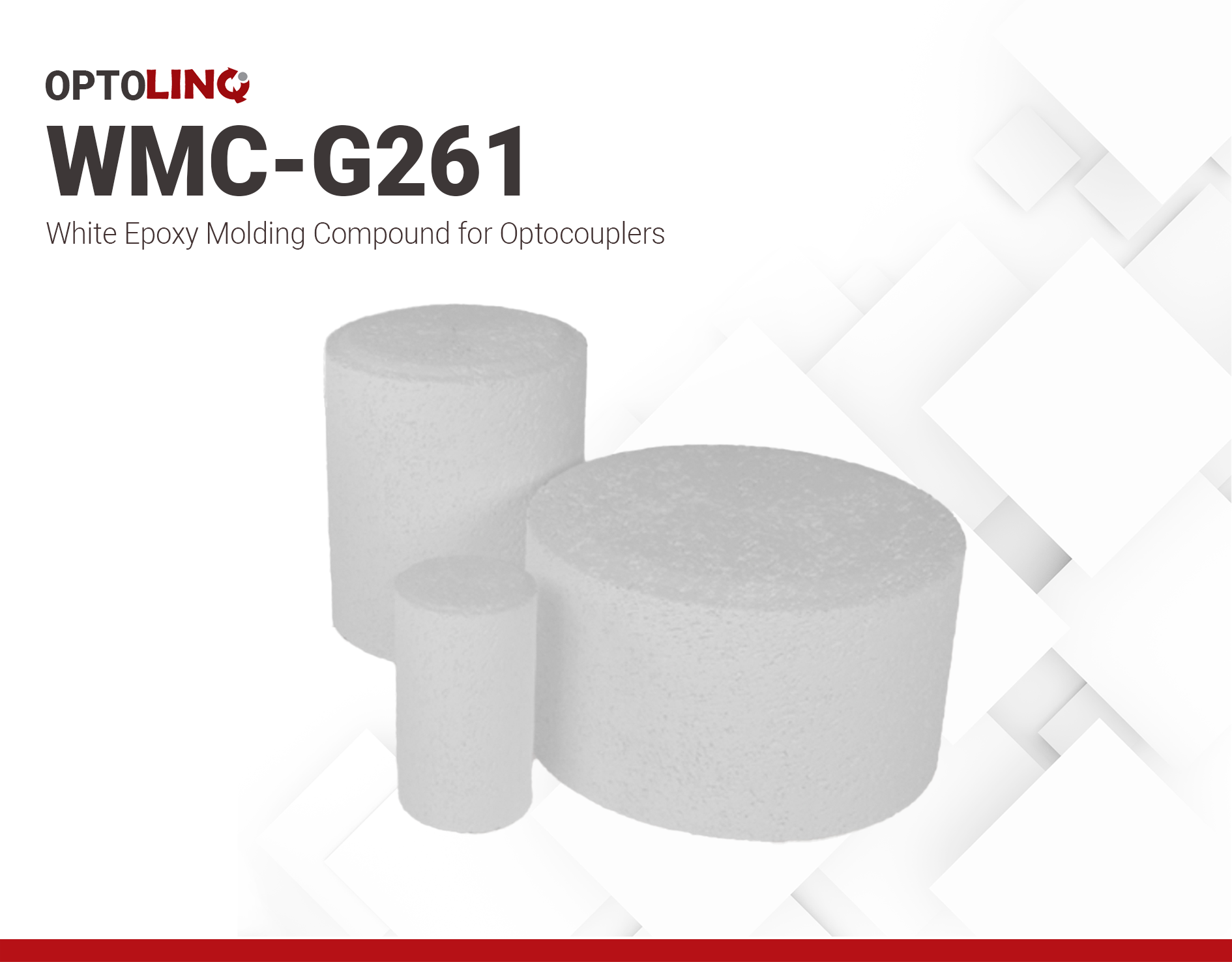
WMC-G261 | White Epoxy Molding Compound for Optocouplers
Harmonization Code : 3907.30.00.85 | Polyacetals, other polyethers and epoxide resins, in primary forms; polycarbonates, alkyd resins, polyallyl esters and other polyesters, in primary forms : Epoxide resins : Other

Main features
- Excellent reflectance
- Ideal spiral flow
- Superior moldability and reliability
Product Description
OPTOLINQ WMC-G261 is a specialized coupler epoxy molding compound that provides superior protection and performance for optoelectronic devices. WMC-G261's unique formulation ensures excellent encapsulation, protecting sensitive components from environmental stresses, improving device reliability.
Product Key Features
- Optimized Spiral Flow — Perfectly suited for typical molding conditions, ensuring complete and uniform encapsulation without voids.
- High Heat Resistance & Reflectance — Crucial for optoelectronic applications, maximizing light output and efficiency.
- Superior Moldability & Reliability — Allows for precise and consistent shaping around delicate components, which in turn leads to enhanced long-term reliability of the encapsulated device.
Applications
- Encapsulation of various optoelectronic devices, including LED lead frames and fiber optic components.
- Ideal for protecting and coupling passive optical components.
- Suitable for encapsulating optical sensors and detectors.
OPTOLINQ WMC-G261 is recommended for use in conjuction with CHEMLINQ semiconductor mold maintenance products to ensure proper release from mold dies.
Technical Specifications
| General Properties | |||||||
|
Specific Gravity
Specific Gravity
Specific gravity (SG) is the ratio of the density of a substance to the density of a reference substance; equivalently, it is the ratio of the mass of a substance to the mass of a reference substance for the same given volume. For liquids, the reference substance is almost always water (1), while for gases, it is air (1.18) at room temperature. Specific gravity is unitless. |
1.9-2.1 | ||||||
| Thermal Properties | |||||||
|
Glass Transition Temperature (Tg)
Glass Transition Temperature (Tg)
The glass transition temperature for organic adhesives is a temperature region where the polymers change from glassy and brittle to soft and rubbery. Increasing the temperature further continues the softening process as the viscosity drops too. Temperatures between the glass transition temperature and below the decomposition point of the adhesive are the best region for bonding. The glass-transition temperature Tg of a material characterizes the range of temperatures over which this glass transition occurs. |
150 °C | ||||||
|
|||||||
|
|||||||
| Mechanical Properties | |||||||
| Molded Shrinkage | 0.5 % | ||||||
|
|||||||
|
|||||||
|
|||||||
| Physical Properties | |||||||
| Spiral Flow @ 175°C | 70-100 cm | ||||||