
-
Home

-
Products
-
Adhesive
-
Acrylic Adhesives
- 3M™ VHB™ Tape GPH-160GF
3M™ VHB™ Tape GPH-160GF
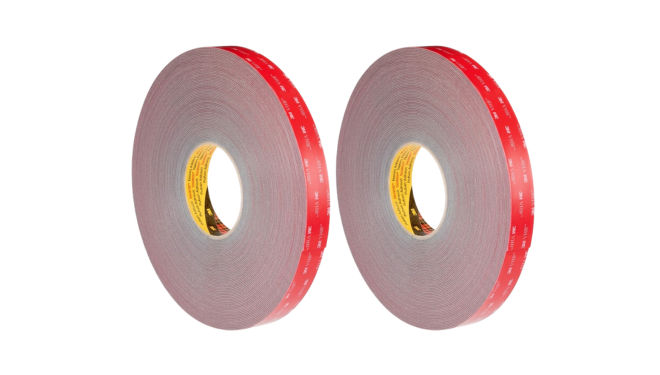
- High Temperature Performance (Up to 230°C)
- 1.6 mm thickness
- Permanent seal against water, moisture, etc.
Product Description
3M VHB™ Tape GPH-160GF is a high-temperature resistant, multi-purpose acrylic foam tape designed for industrial bonding applications that require strong adhesion, conformability, and durable performance across a wide range of substrates. It combines the proven bonding reliability of 3M VHB™ technology with enhanced temperature resistance, making it suitable for demanding applications exposed to elevated temperatures, thermal cycling, vibration, and environmental stress.
GPH-160GF features a 1.6 mm (63 mil) thick gray acrylic foam core with multi-purpose adhesive on both sides, delivering excellent adhesion to metals, glass, high surface energy plastics, and painted surfaces. The viscoelastic acrylic foam construction provides stress relaxation, impact resistance, and long-term durability while maintaining strong bond performance under dynamic loads and thermal expansion mismatch.
The tape offers excellent resistance to moisture, UV exposure, solvents, and outdoor weathering, supporting long-term reliability in both indoor and outdoor environments. It also supports simplified assembly by replacing mechanical fasteners, liquid adhesives, rivets, screws, and welds in many bonding applications.
Product Key Features
- High Temperature Resistance - designed for applications requiring elevated temperature performance during operation or processing.
- Strong Durable Bond - provides high-strength permanent bonding to a variety of metals and high surface energy materials.
Viscoelastic Acrylic Foam Core - absorbs and distributes stress caused by vibration, impact, and thermal expansion mismatch. - Conformable Construction - foam core adapts to irregular surfaces and supports bonding across complex geometries.
Multi-Purpose Adhesive - bonds effectively to aluminum, stainless steel, galvanized steel, glass, acrylic, and painted surfaces.
Environmental Resistance - excellent resistance to UV, moisture, solvents, and outdoor weathering conditions.
Fast and Clean Assembly - eliminates drilling, welding, grinding, and mechanical fastening operations in many applications.
Applications
3M VHB™ Tape GPH-160GF is suited for industrial bonding and attachment applications requiring durable adhesion, temperature resistance, and long-term environmental performance.
- Suitable for masking applications prior to powder coating or liquid paint processes
- Suitable for operations involving a bake cycle and high operating temperatures
- Ideal for stiffeners applied to equipment enclosures, metal cabinets, appliances, and signage
Technical Specifications
Additional Information
3M® VHB®Tape GPH-160GF
3M VHB™ Tape GPH-160GF is a high-temperature resistant, multi-purpose acrylic foam tape designed for industrial bonding applications that require strong adhesion, conformability, and durable performance across a wide range of substrates. It combines the proven bonding reliability of 3M VHB™ technology with enhanced temperature resistance, making it suitable for demanding applications exposed to elevated temperatures, thermal cycling, vibration, and environmental stress.
Note: Property values shown are typical and not intended for specification. Verify suitability under your geometry, dispense method, and cure profile.
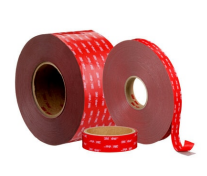
Key Features
- Fast and easy to use
- Invisible fastening to keep surfaces smooth
- High temperature resistance
- Eliminates drilling, grinding, refinishing, screwing, welding and associated re-work
- Pressure-sensitive adhesive bonds on contact to provide immediate handling strength
Processing Summary
Typical Physical Properties
Cure basis: 60 minutes at 125°C (time at temperature after the part reaches target temperature).
| Property | Typical value | Test method |
|---|---|---|
| Color | Gray | |
| Adhesive Type | Acrylic | |
| Density | 710 kg/m³ | ASTM D3574 |
| Adhesive Carrier | Conformable Acrylic Foam (closed cell) | |
| Total Tape Thickness | 1.6 mm | ASTM D3652 |
| Thickness Tolerance | ±10 % | |
| Liner | Red PE film with 3M™ VHB™ print | |
| 90 Peel Adhesion | 34 N/cm | ASTM D330 |
| Normal Tensile | 720 kPa | ASTM D897 |
| Overlap Shear Strength | 570 kPa | ASTM D1002, ISO 4587 |
| Static Shear | 1000 g @ 23 °C , 500 g @ 177 °C | |
| Minimum Application Temperature | 10 °C | |
| Short Term Temp Resistance | 230 °C | |
| Long Term Temp Resistance | 150 °C |
The manufacturing date is available on all 3M™ VHB™ Tapes as the lot number, typically marked on the core or on a label on the outer roll lap. The lot number, typically a 4 digit code, is a Julian date (Y D D D). The first digit refers to the year of manufacture, the last 3 digits refer to the days after January 1.
Example: A lot number of 7266 (or 17266) would translate to a date of manufacture of Sept. 23 (266th day of year) in 2017.
Surface Preparation and Application Techniques
Proper surface preparation and application technique are critical to achieving the maximum bond strength, durability, and long-term performance of 3M VHB™ Tape GPH-160GF across a wide range of industrial substrates and operating conditions.
)
Exceptions that may require additional surface preparation include:
• Heavy Oils: A degreaser or solvent-based cleaner may be required to remove heavy oil or grease from a surface and
should be followed by cleaning with IPA/water.
• Abrasion: Abrading a surface, followed by cleaning with IPA/water, can remove heavy dirt or oxidation and can
increase surface area to improve adhesion.
• Adhesion Promoters: Priming a surface can significantly improve initial and ultimate adhesion to many materials such
as plastics and paints.
• Porous surfaces: Most porous and fibered materials such as wood, particleboard, concrete, etc. need to be sealed to
provide a unified surface.
• Unique Materials: Special surface preparation may be needed for glass and glass-like materials, copper and copper
containing metals, and plastics or rubber that contain components that migrate (e.g. plasticizers).
)
)
*Note: Initial tape application to surfaces at temperatures below these suggested minimums is not suggested because the adhesive becomes too firm to adhere readily. Ideally, all substrates and tape should be conditioned above the minimum application temperature in covered, weatherproof conditions until it is verified the substrates are at or above the minimum temperature. Once properly applied, low-temperature holding is generally satisfactory.
Bond Build Rate
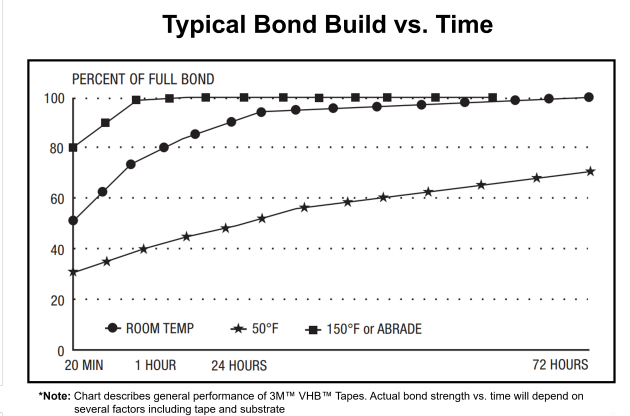
After application, the bond strength will gradually increase as the adhesive flows onto to the surface (also referred to as “wet out”). The bond build rate will depend on both tape and substrate, but generally, at room temperature, approximately 50% of ultimate bond strength will be achieved after 20 minutes, 90% after 24 hours, and 100% after 72 hours. Adhesive flow is faster at higher temperatures and slower at lower temperatures. Ultimate bond strength can be accelerated (and in some cases bond strength can be increased) by exposure to elevated temperature (e.g. 66°C [150°F] for 1 hour). This can provide better adhesive wet out onto the substrates. Abrasion (~180 grit), or the use of primers/adhesion promoters, can also increase both bond strength as well as the bond build rate.
Tips and Troubleshooting
| Issue | Recommended Action |
|---|---|
| Adhesion |
Adhesion to the substrate is critical to achieving high bond strength. Adhesives must flow onto the substrate surfaces in order to achieve an intimate contact area and allow the molecular force of attraction to develop. The degree of flow of theadhesive on the substrate is largely determined by the surface energy of the substrate. |
| Tape Usage |
Use the right amount of VHB™ Tape to handle the expected stresses. Because 3M™ VHB™ Tapes are viscoelastic by |
| Tape Thickness |
Achieving good contact is also important. The necessary thickness of tape depends on the rigidity of substrates as well |
| Thermal Expansion/Contraction |
3M™ VHB™ Tapes perform well in applications where two bonded surfaces may expand and contract at different rates. |
| Bond Flexibility |
While an advantage for many applications where allowing differential movement is a benefit, the tape bonds are |