
-
Home

-
Products
-
Adhesives
-
Instant Adhesives
- 3M™ Fastbond™ 2000NF
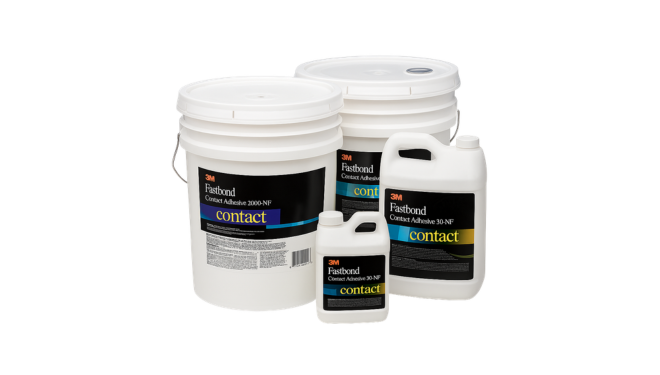
3M™ Fastbond™ 2000NF
Harmonization Code : 3506.91.90.99 | Prepared glues and other prepared adhesives, not elsewhere specified or included; products suitable for use as glues or adhesives, put up for retail sale as glues or adhesives, not exceeding a net weight of 1 kg ; Adhesives based on polymers of headings 3901 to 3913 or on rubber; Other ; Other
Main features
- Quick bonding without heat
- Immediate handling strength.
- Post-formable and heat resistant
Product Description
3M™ Fastbond™ Contact Adhesive 2000-NF with Spray Activator #1 is a waterdispersed, high solid, activated adhesive which provides immediate bonding capabilities and handling strength without forced drying equipment for most applications.
Product Key Features
- Quick bonding without heat
- Immediate handling strength
- Bonds flexible polyurethane and latex foams, plastic laminate, wood, plywood, particle board, fabrics, fiber, aluminum, galvanized steel and many plastics
- Designed to be applied between two substrates
Applications
- Furniture & Seating: Attaching foam cushions and upholstery fabrics to wood, metal, or plastic frames.
- Cabinetry & Woodworking: Laminating high-pressure plastics (HPL) to countertops, MDF, or plywood.
- Acoustic & Wall Panels: Adhering fiberglass insulation, fabrics, and acoustic foam to partitions.
- Transportation Interiors: Assembling headliners, trim, and seating in aerospace, marine, and RV industries.
Technical Specifications
| General Properties | |
| Chemistry Type | Polychloroprene |
|
Color
Color
The color |
Blue, Light Orange or Neutral |
| Solids | 47-51 % |
| Physical Properties | |
|
Viscosity
Viscosity
Viscosity is a measurement of a fluid’s resistance to flow. Viscosity is commonly measured in centiPoise (cP). One cP is defined as the viscosity of water and all other viscosities are derived from this base. MPa is another common unit with a 1:1 conversion to cP. A product like honey would have a much higher viscosity -around 10,000 cPs- compared to water. As a result, honey would flow much slower out of a tipped glass than water would. The viscosity of a material can be decreased with an increase in temperature in order to better suit an application |
200-750 mPa.s |