
-
Home

-
Products
-
Adhesives
-
Epoxy Adhesives
- 3M™ Scotch-Weld™ 420
3M™ Scotch-Weld™ 420
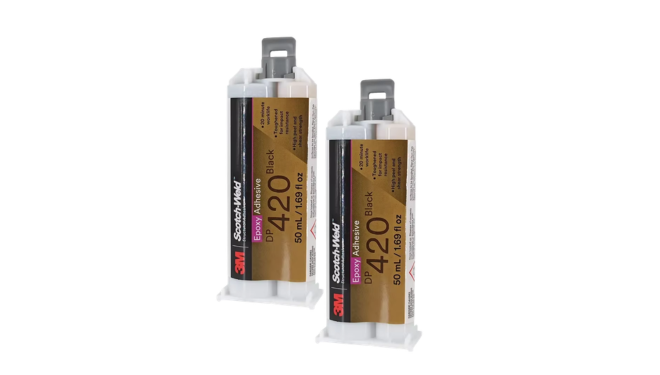
- Bonds metals, composites, glass, ceramics, plastics, and wood
- 20-minute work life at 72°F (22°C) for positioning and alignment before cure
- Handling strength in approximately 2 hours; full cure in 24 hours at room temperature
Product Description
3M Scotch-Weld Epoxy Adhesive DP420 Black
3M™ Scotch-Weld™ Epoxy Adhesive DP420 Black is a toughened, two-part structural epoxy adhesive engineered for demanding industrial bonding applications requiring high impact resistance, fatigue resistance, and long-term bond durability across a wide range of substrates and operating environments.
Designed for structural assembly applications, DP420 mixes at a 2:1 volume ratio (Part A to Part B) and offers a 20-minute work life at 72°F (22°C), providing adequate time for part positioning and alignment before curing begins. The adhesive reaches handling strength in approximately 2 hours and achieves full cure within 24 hours at room temperature.
Key Properties
-
Toughened epoxy formulation for enhanced impact and fatigue resistance
-
High shear and peel strength for durable structural bonding performance
-
20-minute work life supports positioning and assembly before cure initiation
-
Maintains bond integrity across both elevated and low-temperature environments
-
Bonds a broad range of substrates including metals, composites, glass, ceramics, plastics, and wood
-
Available in Duo-Pak cartridges and bulk packaging formats for scalable production use
Typical Applications
-
Structural bonding of metal components as an alternative to spot welds, screws, and rivets
-
Carbon fiber and composite bonding in aerospace, automotive, and sporting goods manufacturing
-
Panel bonding and stiffener attachment in automotive body and chassis assembly
-
Joining, potting, gluing, and encapsulation in electronics and electrical assemblies
-
Glass and ceramic bonding in industrial equipment and consumer products
-
Dissimilar material bonding in multi-substrate automotive and industrial assemblies
-
Bonded assemblies exposed to paint bake or e-coat oven processing after application
Technical Specifications
| General Properties | |||||
| Chemistry Type | Epoxy amine | ||||
|
Color
Color
The color |
Black/Amber | ||||
|
Mix Ratio
Mix Ratio
The amount of a constituent divided by the total amount of all other constituents in a mixture |
2:1 | ||||
|
Work life @25°C
Work life @25°C
Work life is the amount of time we have to work with a material until it is no longer able to be easily worked and applied on a substrate. It is based on the change in viscosity and it can rely on the application requirements. |
0.25-0.5 hours | ||||
| Mechanical Properties | |||||
|
|||||
| Electrical Properties | |||||
|
Volume Resistivity
Volume Resistivity
Volume resistivity, also called volume resistance, bulk resistance or bulk resistivity is a thickness dependent measurement of the resistivity of a material perpendicular to the plane of the surface. |
1.6x10¹⁵ Ohms⋅cm | ||||
Additional Information
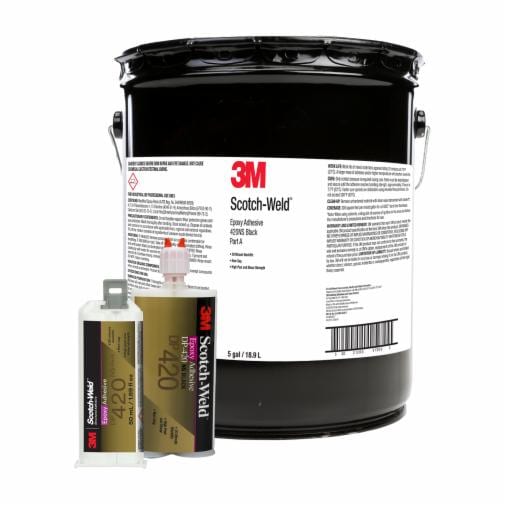
3M™ Scotch-Weld™ Epoxy Adhesive DP420 Black
Toughened two-part structural epoxy with 20-minute work life, high shear and peel strength, and broad substrate compatibility for demanding industrial bonding applications.
3M™ Scotch-Weld™ Epoxy Adhesive DP420 Black is a toughened, two-part structural epoxy adhesive formulated for demanding bonding applications that require high impact resistance, fatigue resistance, and durable bond performance across a wide range of substrates and service environments. Mixed at a 2:1 volume ratio (Part A to Part B), DP420 provides a 20-minute work life at 72°F (22°C), giving operators sufficient time for positioning and alignment before the adhesive begins to set. Handling strength is reached in approximately 2 hours and full cure is achieved in 24 hours at room temperature.
DP420 is formulated to bond metals, ceramics, glass, wood, many composites including carbon fiber reinforced polymers (CFRP), and many plastics, making it suitable for multi-substrate assemblies across automotive, aerospace, electronics, and general industrial applications. The adhesive can replace mechanical fasteners, screws, rivets, and spot welds in many applications, and it maintains bond strength across high and low temperature extremes, including paint bake operations up to 400°F (204°C) for 60 minutes. Available in 50 mL, 200 mL, and 400 mL Duo-Pak cartridges for EPX applicator dispensing, as well as 5-gallon and 55-gallon bulk formats for high-volume production use.
Toughened formulation for high impact and fatigue resistance
DP420 is formulated as a toughened epoxy, incorporating flexibility modifiers that improve resistance to impact loads and cyclic fatigue compared to standard brittle epoxies. This makes it well suited to bonded joints that will experience vibration, shock, or dynamic loading in service, such as in automotive assemblies, electronic enclosures, or structural components in transport applications.
High shear and peel strength for durable structural bonds
DP420 delivers shear strength up to approximately 4,500 psi and peel strength of 20 to 60 piw depending on temperature and substrate, providing the load-bearing capacity needed for structural bonding tasks. This combination of shear and peel performance supports both rigid and flexible joint designs and makes DP420 a viable replacement for mechanical fasteners in many assembly configurations.
20-minute work life allows positioning before cure begins
After mixing, DP420 provides approximately 20 minutes of open work life at 72°F (22°C), allowing operators to apply the adhesive, position the substrates, and make alignment adjustments before the adhesive begins to develop handling strength. This work life is sufficient for most manual assembly tasks without requiring clamping fixtures to be applied immediately on contact.
Maintains bond strength at high and low temperatures
DP420 retains useful bond strength at elevated and reduced temperatures and is capable of withstanding paint bake operations up to 400°F (204°C) for 60 minutes after full cure. This thermal performance makes it suitable for assemblies that pass through oven cure or e-coat processes after bonding, as well as for applications exposed to temperature cycling in service.
Bonds metals, composites, glass, ceramics, plastics, and wood
DP420 bonds effectively to a broad range of substrate materials, including steels, aluminum and other metals, CFRP and other composites, glass, ceramics, wood, and many engineering plastics. This broad substrate compatibility supports multi-material assemblies and reduces the need to maintain separate adhesive products for different material combinations in a single production environment.
Available in Duo-Pak cartridges and bulk formats for any production scale
DP420 is available in 50 mL, 200 mL, and 400 mL Duo-Pak cartridges for metered dispensing through the 3M EPX applicator system, as well as in 5-gallon and 55-gallon bulk formats for high-volume automated dispensing operations. This range of packaging formats allows the same adhesive formulation to be used across development, pilot production, and full-scale manufacturing without reformulation.
Why DP420 Is Suited to Demanding Structural Bonding
Not all epoxy adhesives are equal. Standard epoxies trade off toughness for strength, producing brittle bonds that can crack under impact or fatigue loading even when initial shear strength is high. DP420 is specifically formulated to deliver both high structural strength and toughness, addressing the failure modes most common in bonded assemblies under real service conditions.
Toughened epoxies outperform standard epoxies in real service conditions
Standard epoxy adhesives can achieve high shear strength but are often brittle under peel, impact, or dynamic loading. DP420's toughened formulation absorbs energy at the bond line under these loading modes, reducing the incidence of sudden cohesive failure in assemblies that experience vibration, shock, or thermal cycling during their service life.
Adhesive bonding distributes load more evenly than mechanical fasteners
Rivets, screws, and spot welds concentrate stress at discrete points, which can initiate fatigue cracks in the surrounding substrate material over time. Adhesive bonding distributes the load continuously across the full bonded area, reducing peak stress concentrations and improving the fatigue life of the joint and the assembly as a whole.
20-minute work life reduces assembly errors without slowing throughput
Adhesives with very short work lives require immediate fixturing after application, leaving little tolerance for positioning errors. DP420's 20-minute open time gives assembly operators a practical window to place, align, and adjust parts before the adhesive sets, reducing the incidence of misaligned or rejected assemblies without significantly impacting cycle time in most production workflows.
Application Spotlight
Structural Bonding for eMobility
Structural adhesives like DP420 play a critical role in eMobility assemblies, from battery enclosure bonding and thermal interface attachment to lightweight multi-material structures in electric vehicles. Learn how structural bonding solutions are being applied in eMobility design and manufacturing.
Packaging Options
DP420 Black is available in five packaging configurations to match different dispensing methods and production volumes. Duo-Pak cartridges are dispensed using the 3M EPX applicator system with an EPX Mixing Nozzle (sold separately). Bulk formats are intended for automated dispensing and proportioning equipment.

50 mL Duo-Pak Cartridge — 12 per Case
For use with the 3M Scotch-Weld EPX Plus II Manual Applicator. Suited to low-volume bonding, development, prototyping, repair, and maintenance tasks where smaller quantities of adhesive are needed per session. Compatible with 3M EPX Mixing Nozzles for 50 mL cartridges at 2:1 mix ratio.
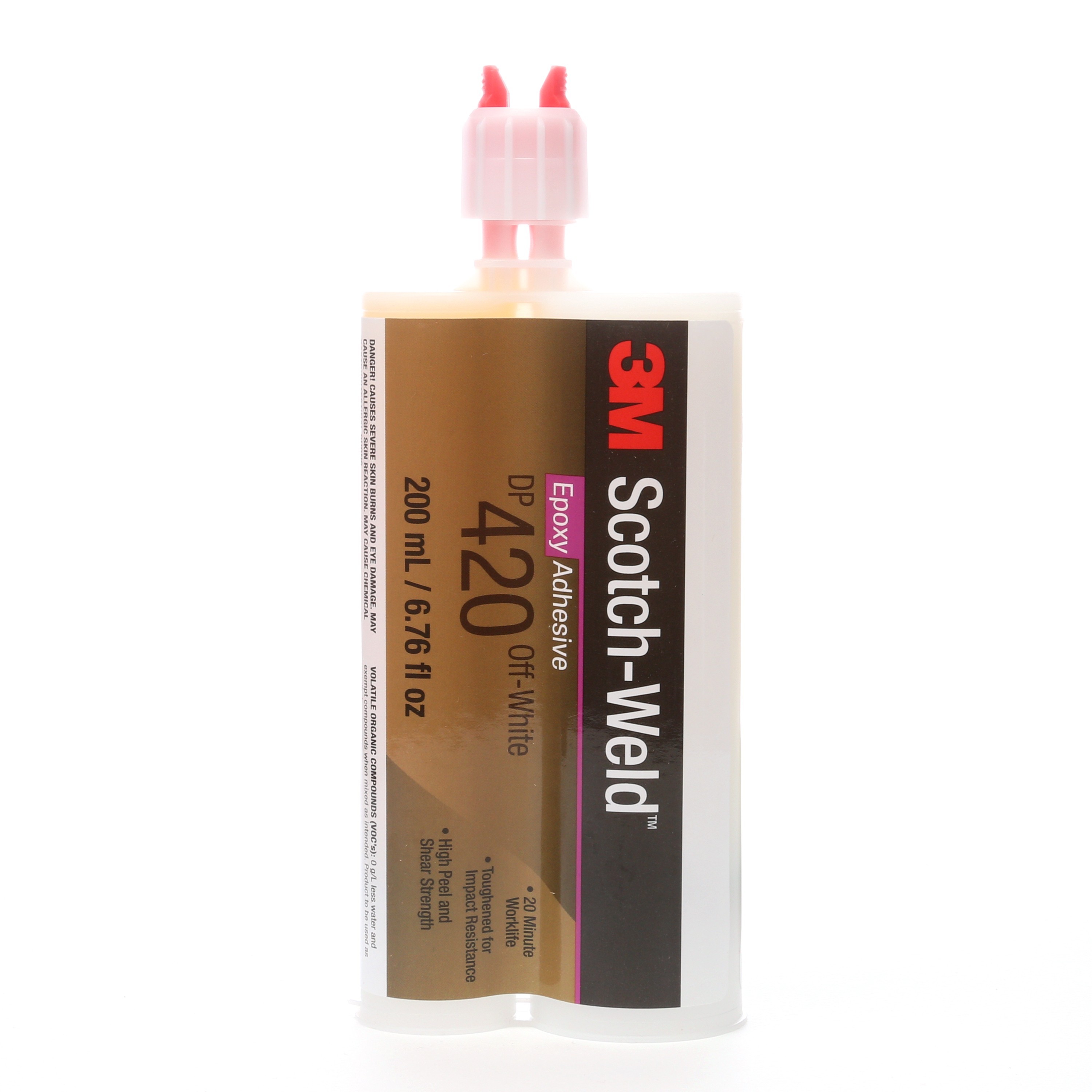
200 mL Duo-Pak Cartridge — 12 per Case
For use with the 3M Scotch-Weld EPX Dual Drive 200 mL Manual or Pneumatic Applicator. Suited to medium-volume production bonding tasks. Compatible with 3M EPX Mixing Nozzles for 200 mL cartridges at 2:1 mix ratio.
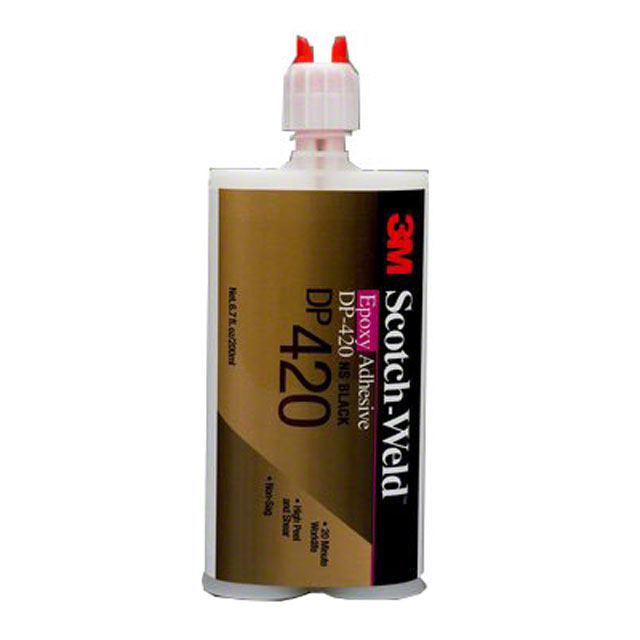
400 mL Duo-Pak Cartridge — 6 per Case
For use with the 3M Scotch-Weld EPX Dual Drive 400 mL Manual or Pneumatic Applicator. Suited to medium to higher-volume production bonding where more adhesive is dispensed per cartridge before a changeover. Compatible with 3M EPX Mixing Nozzles for 400 mL cartridges at 2:1 mix ratio.
Part A — 5 Gallon (18.9 L) Pail
Part A supplied in a 5-gallon pail for high-volume production use with automated two-component proportioning and dispensing equipment. Must be combined with the corresponding Part B at the correct 2:1 volume ratio. Intended for facilities with established bulk adhesive dispensing infrastructure.
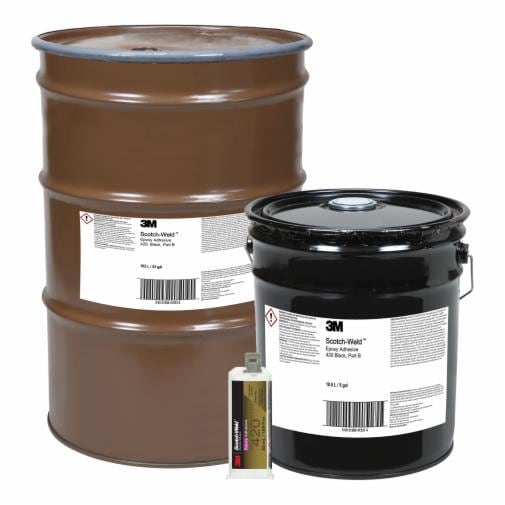
Part A — 55 Gallon (43 Gallon Net) Drum
Part A supplied in a 55-gallon drum (43-gallon net fill) for large-scale production with automated dispensing and proportioning systems. Must be combined with the corresponding Part B at the correct 2:1 volume ratio. Contact 3M or your distributor for Part B bulk supply options and dispensing equipment recommendations for this format.
Technical Specifications
Uncured Properties
| Property | Value |
|---|---|
| Adhesive Type | Toughened two-part epoxy |
| Color | Black (mixed) |
| Mix Ratio (Volume) | 2:1 (Part A : Part B) |
| Work Life at 72°F (22°C) | Approximately 20 minutes |
| Viscosity — Part A | 20,000 to 50,000 cP |
| Viscosity — Part B | 8,000 to 14,000 cP |
| Specific Gravity — Part A | 1.12 |
| Specific Gravity — Part B | 1.14 |
Cured Properties
| Property | Value |
|---|---|
| Handling Strength | Approximately 2 hours at 72°F (22°C) |
| Full Cure | 24 hours at 72°F (22°C) |
| Shear Strength | Up to approximately 4,500 psi |
| Peel Strength | 20 to 60 piw (temperature dependent) |
| Hardness (Shore D) | 75 to 80 |
| Heat Resistance (post cure) | Up to 400°F (204°C) for 60 minutes |
| Flammability | Meets UL 94 HB requirements |
Compatible Substrates
DP420 bonds effectively to the following substrate categories when surfaces are properly prepared:
- Steel and stainless steel
- Aluminum and other metals
- Carbon fiber (CFRP) and composites
- Glass and ceramics
- Wood
- Many engineering plastics
Bond strength on specific substrates depends on surface preparation, bondline thickness, and curing conditions. Always test on actual production substrates before committing to final assembly parameters. Refer to the DP420 Technical Data Sheet for substrate-specific strength data.
Recommended Dispensing Equipment
- 50 mL Duo-Pak: 3M™ Scotch-Weld™ EPX Plus II Manual Applicator with 1:1/2:1 plunger and EPX Mixing Nozzle (50 mL, square or helical)
- 200 mL Duo-Pak: 3M™ Scotch-Weld™ EPX Dual Drive 200 mL Manual or Pneumatic Applicator with EPX Mixing Nozzle (200 mL, square or helical)
- 400 mL Duo-Pak: 3M™ Scotch-Weld™ EPX Dual Drive 400 mL Manual or Pneumatic Applicator with EPX Mixing Nozzle (400 mL, square or helical)
- Bulk pail and drum: Two-component automated proportioning and dispensing equipment capable of maintaining a 2:1 volume ratio. Contact 3M for equipment recommendations.
Surface Preparation
Bond strength with DP420 is directly affected by the cleanliness and condition of the substrate surfaces before adhesive application. Surface preparation is a required step before bonding and should not be skipped regardless of how clean substrates appear visually.
Metal Substrates
- Remove all oil, grease, and release agents by solvent wiping with isopropyl alcohol (IPA) or an equivalent cleaner. Wipe in one direction only using a clean, lint-free cloth.
- Lightly abrade the bonding surface with fine-grit abrasive paper or a Scotch-Brite pad to increase surface area and remove surface oxides.
- Wipe again with IPA after abrasion to remove abrasive particles and contamination generated during the abrasion step.
- Apply adhesive immediately after surface preparation. Do not allow prepared surfaces to be exposed to airborne contamination or touched with bare hands before bonding.
Composite, Plastic, Glass, and Ceramic Substrates
- Solvent wipe bonding surfaces with IPA or an appropriate solvent for the substrate material to remove mold release agents, processing oils, and surface contamination.
- For composites and plastics, light abrasion followed by a second solvent wipe is recommended to improve mechanical adhesion and expose a fresh bonding surface.
- For glass and ceramics, consider a primer suited to the substrate material to improve adhesion durability. Contact 3M for primer recommendations for specific substrate and service condition combinations.
- Bond immediately after surface preparation and do not allow surfaces to become re-contaminated before adhesive application.
Note: The surface preparation procedures described above are general guidance. Bond strength on specific substrate and surface condition combinations should always be verified by testing on representative samples before committing to final assembly parameters. Refer to the 3M™ Scotch-Weld™ DP420 Technical Data Sheet for detailed surface preparation procedures and substrate-specific test data.
Safe Use and Storage
DP420 is a two-component reactive epoxy adhesive. Refer to the Safety Data Sheet (SDS) for complete hazard information, personal protective equipment requirements, and disposal guidance before handling.
Safe Handling
- Wear chemical-resistant gloves (nitrile or equivalent) and eye protection when handling either component or the mixed adhesive. Epoxy components can cause skin sensitization on repeated contact.
- Use in well-ventilated areas. Avoid prolonged inhalation of vapors from either component, particularly Part B (hardener).
- Do not allow either component to contact skin, eyes, or mucous membranes. In the event of skin contact, wash immediately with soap and water. For eye contact, flush with water for at least 15 minutes and seek medical attention.
- For industrial and occupational use only. Not for consumer sale or use.
Storage Conditions
- Store DP420 in original sealed containers at temperatures between 60°F and 80°F (16°C and 27°C). Avoid storage above 90°F (32°C), which can accelerate degradation and reduce shelf life.
- Do not freeze. Freezing may cause permanent changes to the adhesive viscosity and mixing characteristics of either component.
- Shelf life is typically 12 months from date of manufacture when stored in original sealed containers at recommended temperatures. Check the product label for the specific shelf life and expiry date before use.
- Store away from heat sources, open flames, and incompatible materials. Refer to the SDS for specific storage incompatibilities.
- Dispose of unused material and empty containers in accordance with applicable local and national regulations for epoxy adhesive waste.
Best Practices for Consistent Bond Performance
- Allow adhesive cartridges to equilibrate to room temperature before use if stored in a cool location. Cold adhesive has higher viscosity and may not dispense evenly, affecting mix ratio and bead consistency.
- Always dispense a short purge bead before applying to the workpiece to confirm that both components are flowing and that the mixing nozzle is delivering properly blended material.
- Do not exceed the 20-minute work life. Once the adhesive begins to gel, repositioning the substrates will disrupt the bond and compromise joint integrity. If the work life has been exceeded, remove the adhesive and apply a fresh bead.
- Apply consistent clamping pressure or fixturing to hold the bond line at the correct gap during cure. Refer to the Technical Data Sheet for recommended bondline thickness ranges for the specific substrate combination.
- For applications where mix quality needs to be verified in real time during dispensing, consider pairing DP420 with the 3M™ Adhesive Mix Monitor for in-line mix ratio monitoring.