
-
Home

-
Products
-
Adhesives
-
Epoxy Adhesives
- 3M™ Scotch-Weld™ Epoxy Adhesive DP190
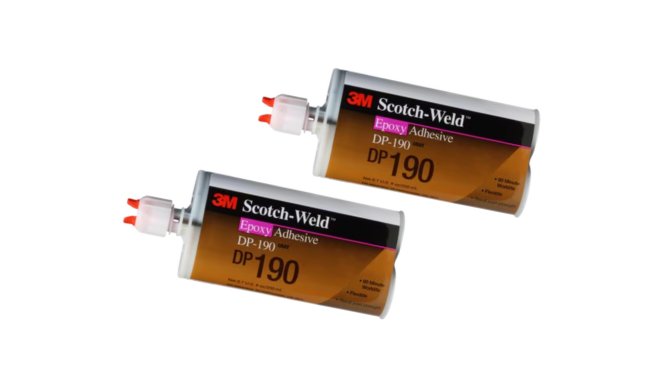
3M™ Scotch-Weld™ Epoxy Adhesive DP190
Harmonization Code : 3506.91.90.99 | Prepared glues and other prepared adhesives, not elsewhere specified or included; products suitable for use as glues or adhesives, put up for retail sale as glues or adhesives, not exceeding a net weight of 1 kg ; Adhesives based on polymers of headings 3901 to 3913 or on rubber; Other ; Other

Main features
- 90-minute work life
- 1:1 mix ratio
- High shear and peel strength
Product Description
3M™ Scotch-Weld™ Epoxy Adhesive DP190 is a versatile, two-part epoxy designed for strong, durable bonding with a convenient 1:1 mix ratio. Available in both translucent and grey variants, this adhesive offers reliable performance across a range of materials while maintaining flexibility and resistance to environmental stress. It is formulated to deliver excellent handling properties and consistent results, making it suitable for industrial and general-purpose applications.
Product Key Features
- Convenient 1:1 mix ratio for easy and accurate dispensing
- Extended 90-minute work life for improved positioning and assembly time
- High shear and peel strength for durable, long-lasting bonds
- Flexible formulation to accommodate movement and reduce stress on bonded joints
- Available in translucent or grey to suit different application and aesthetic needs
- Excellent environmental resistance, including aging performance
- Consistent performance comparable to 3M™ Scotch-Weld™ Epoxy Adhesive 2216 B/A, with faster curing (translucent variant)
- Suitable for bulk and cartridge applications for production efficiency
Technical Specifications
| General Properties | |||||||
| Chemistry Type | Epoxy/Amine | ||||||
|
Work life @25°C
Work life @25°C
Work life is the amount of time we have to work with a material until it is no longer able to be easily worked and applied on a substrate. It is based on the change in viscosity and it can rely on the application requirements. |
1.33-1.5 hours | ||||||
| Mechanical Properties | |||||||
|
|||||||
|
Elongation
Elongation
Elongation is the process of lengthening something. It is a percentage that measures the initial, unstressed, length compared to the length of the material right before it breaks. It is commonly referred to as Ultimate Elongation or Tensile Elongation at break. |
30 - 120 % | ||||||
|
|||||||
| Thermal Properties | |||||||
|
Glass Transition Temperature (Tg)
Glass Transition Temperature (Tg)
The glass transition temperature for organic adhesives is a temperature region where the polymers change from glassy and brittle to soft and rubbery. Increasing the temperature further continues the softening process as the viscosity drops too. Temperatures between the glass transition temperature and below the decomposition point of the adhesive are the best region for bonding. The glass-transition temperature Tg of a material characterizes the range of temperatures over which this glass transition occurs. |
7 -10 °C | ||||||
|
Thermal Conductivity
Thermal Conductivity
Thermal conductivity describes the ability of a material to conduct heat. It is required by power packages in order to dissipate heat and maintain stable electrical performance. Thermal conductivity units are [W/(m K)] in the SI system and [Btu/(hr ft °F)] in the Imperial system. |
0.079 - 0.220 W/m.K | ||||||
|
|||||||
| Electrical Properties | |||||||
|
Dielectric Strength
Dielectric Strength
Dielectric strength is measured in kV per mm and is calculated by the Breakdown voltage divided by the thickness of the tested material. Those two properties go hand in hand and while Breakdown voltage is always thickness dependent, dielectric strength is a general material property. As an example, the dielectric strength of Polyimide is 236 kV/mm. If we place 1mm of Polyimide between two electrodes, it will act as an insulator until the voltage between the electrodes reaches 236 kV. At this point it will start acting as a good conductor, causing sparks, potential punctures and current flow. |
0.83 - 0.85 kV/mm | ||||||
|
|||||||