
-
Home

-
Products
-
Encapsulants & Underfills
-
Liquid Encapsulants
- ABchimie 80K UV High Viscosity Resin
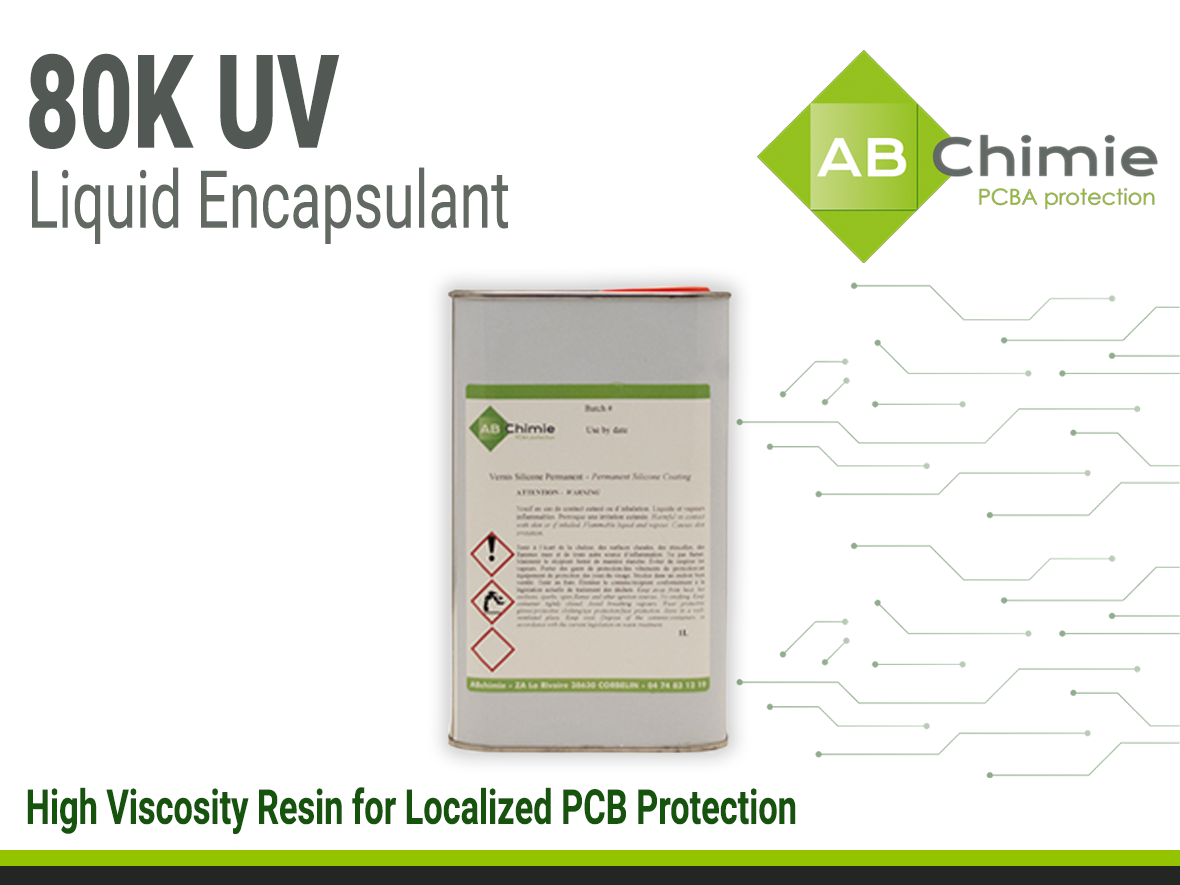
ABchimie 80K UV High Viscosity Resin
- Soft, shock‑absorbing resin
- Excellent adhesion
- One‑component formulation
Product Description
ABchimie 80K UV is a soft, one‑component UV‑curable resin designed to provide localized protection for electronic components. Its formulation delivers excellent adhesion across a wide variety of substrates— including PCBs and plastics, while offering strong mechanical reinforcement for high and sensitive components.
Capable of being applied in thick layers up to 5 mm, ABchimie 80K UV is ideal for applications requiring cushioning and vibration resistance. Its curing is instant under UV radiation, significantly improving processing speed and throughput. This resin contains no VOC, supporting cleaner and safer manufacturing environments.
Product Key Features
- Excellent adhesion to PCBs, plastics, and multiple substrates
- Provides mechanical reinforcement and vibration protection
- Designed for high‑speed, high‑productivity processes
- One‑component formulation (no mixing required)
- UL 94 V‑0 flammability resistance qualified (QMJU2‑E308681)
Applications
- Local protection of high components on PCBs
Technical Specifications
| General Properties | |
|
Appearance
Appearance
Appearance at room temperature. |
Transparent liquid |
|
Specific Gravity
Specific Gravity
Specific gravity (SG) is the ratio of the density of a substance to the density of a reference substance; equivalently, it is the ratio of the mass of a substance to the mass of a reference substance for the same given volume. For liquids, the reference substance is almost always water (1), while for gases, it is air (1.18) at room temperature. Specific gravity is unitless. |
1.1 |
| Physical Properties | |
|
Viscosity
Viscosity
Viscosity is a measurement of a fluid’s resistance to flow. Viscosity is commonly measured in centiPoise (cP). One cP is defined as the viscosity of water and all other viscosities are derived from this base. MPa is another common unit with a 1:1 conversion to cP. A product like honey would have a much higher viscosity -around 10,000 cPs- compared to water. As a result, honey would flow much slower out of a tipped glass than water would. The viscosity of a material can be decreased with an increase in temperature in order to better suit an application |
80000 mPa.s |
| Mechanical Properties | |
| Durometer (Shore D) | 15 |
| Thermal Properties | |
|
Coefficient of Thermal Expansion (CTE), α1
Coefficient of Thermal Expansion (CTE), α1
CTE α1 (alpha 1) is the slope of the Coefficient of thermal expansion in a temperature range below the Glass transition temperature (Tg). It explains how much a material will expand until it reaches Tg. |
50 ppm/°C |
|
Coefficient of Thermal Expansion (CTE), α2
Coefficient of Thermal Expansion (CTE), α2
CTE α2 (alpha 2) is the slope of the Coefficient of thermal expansion in a temperature range above the Glass transition temperature (Tg). It explains the extent to which a material will expand after it passes Tg. |
150 ppm/°C |
|
Glass Transition Temperature (Tg)
Glass Transition Temperature (Tg)
The glass transition temperature for organic adhesives is a temperature region where the polymers change from glassy and brittle to soft and rubbery. Increasing the temperature further continues the softening process as the viscosity drops too. Temperatures between the glass transition temperature and below the decomposition point of the adhesive are the best region for bonding. The glass-transition temperature Tg of a material characterizes the range of temperatures over which this glass transition occurs. |
-19 °C |
| Electrical Properties | |
|
Breakdown Voltage
Breakdown Voltage
Breakdown voltage is the minimum voltage necessary to force an insulator to conduct some amount of electricity. It is the point at which a material ceases to be an insulator and becomes a resistor that conducts electricity at some proportion of the total current. After dielectric breakdown, the material may or may not behave as an insulator any more because of the molecular structure alteration. The current flow tend to create a localised puncture that totally alters the dielectric properties of the material. This electrical property is thickness dependent and is the maximum amount of voltage that a dielectric material can withstand before breaking down. The breakdown voltage is calculated by multiplying the dielectric strength of the material times the thickness of the film. |
1500 V |
|
Dielectric Strength
Dielectric Strength
Dielectric strength is measured in kV per mm and is calculated by the Breakdown voltage divided by the thickness of the tested material. Those two properties go hand in hand and while Breakdown voltage is always thickness dependent, dielectric strength is a general material property. As an example, the dielectric strength of Polyimide is 236 kV/mm. If we place 1mm of Polyimide between two electrodes, it will act as an insulator until the voltage between the electrodes reaches 236 kV. At this point it will start acting as a good conductor, causing sparks, potential punctures and current flow. |
60 kV/mm |
Additional Information
Curing Profile
Recommended settings for the best properties of the resin ABchimie80K UV:
- Hg Lamp (Miniterm UV 250f Super, Aeroterm), 120W/cm
- Minimum UVA dose : 3000mJ/cm2 (to a 1mm-thickness)
The UVA dose is a minimum dose recommended. The intensity depends on the lamp power and the lampe distance.
UVA dose may be increased by a longer exposure time. A higher dose of UV or a overexposure will not damaged the product. However a lower UVA dose can have a detrimental effect on product final properties therefore it is very important to ensure minimum recommended UVA dose is met with your curing system.
