
-
Home

-
Products
-
Coatings, powders & Resins
-
Conformal Coatings
- ABchimie AVR80 BA GEL Removable Acrylic Coating
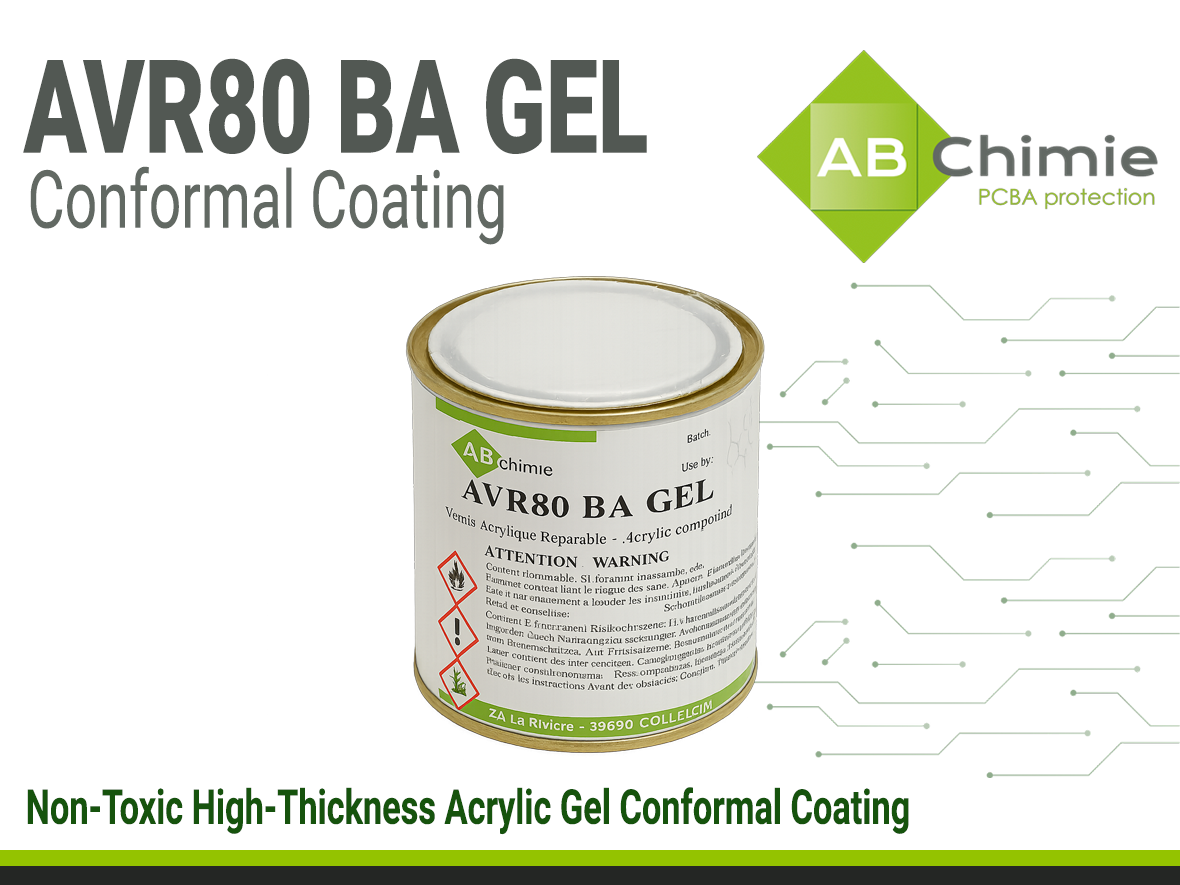
ABchimie AVR80 BA GEL Removable Acrylic Coating
- Can be soldered through
- Wide temperature range -65°C to +150°C
- Excellent adhesion
Product Description
ABchimie AVR80 BA GEL is a non‑toxic, flexible, transparent acrylic gel coating developed to provide high‑performance protection for electronic circuitry. Engineered for applications requiring enhanced environmental resistance and thicker protective layers, the gel formulation allows for damming and the creation of high‑thickness deposits with excellent clarity and adhesion.
This coating is fully repairable and can be completely removed using ABchimie SND or DNS (both 100% ozone‑friendly), making it ideal for assemblies that may require rework while still maintaining top‑tier protective performance.
Product Key Features
- Allows creation of dams and high‑thickness protective layers
- Excellent adhesion under a wide range of climatic conditions
- Broad operating temperature range: –65°C to +150°C
- Can be soldered through safely without producing toxic gases
- Resistant to mold growth and environmental contaminants
- Fully removable with ABchimie SND or ABclean
Applications
- High‑thickness conformal coating applications
- Protective damming for selective coating areas
Technical Specifications
| General Properties | |
|
Appearance
Appearance
Appearance at room temperature. |
Transparent thixotropic liquid with blue reflection |
| Density (g) | 0.95 g/cm3 |
| Electrical Properties | |
|
Breakdown Voltage
Breakdown Voltage
Breakdown voltage is the minimum voltage necessary to force an insulator to conduct some amount of electricity. It is the point at which a material ceases to be an insulator and becomes a resistor that conducts electricity at some proportion of the total current. After dielectric breakdown, the material may or may not behave as an insulator any more because of the molecular structure alteration. The current flow tend to create a localised puncture that totally alters the dielectric properties of the material. This electrical property is thickness dependent and is the maximum amount of voltage that a dielectric material can withstand before breaking down. The breakdown voltage is calculated by multiplying the dielectric strength of the material times the thickness of the film. |
1500 V |
|
Dielectric Strength
Dielectric Strength
Dielectric strength is measured in kV per mm and is calculated by the Breakdown voltage divided by the thickness of the tested material. Those two properties go hand in hand and while Breakdown voltage is always thickness dependent, dielectric strength is a general material property. As an example, the dielectric strength of Polyimide is 236 kV/mm. If we place 1mm of Polyimide between two electrodes, it will act as an insulator until the voltage between the electrodes reaches 236 kV. At this point it will start acting as a good conductor, causing sparks, potential punctures and current flow. |
50 kV/mm |
| Thermal Properties | |
|
Glass Transition Temperature (Tg)
Glass Transition Temperature (Tg)
The glass transition temperature for organic adhesives is a temperature region where the polymers change from glassy and brittle to soft and rubbery. Increasing the temperature further continues the softening process as the viscosity drops too. Temperatures between the glass transition temperature and below the decomposition point of the adhesive are the best region for bonding. The glass-transition temperature Tg of a material characterizes the range of temperatures over which this glass transition occurs. |
29 °C |
| Operating Temperature | -65 to +150 °C |
Additional Information
Product Selector Guide Between AVR80 BA GEL and AVR80 GEL
| Property | AVR80 BA GEL | AVR80 GEL |
| Type | Flexible, transparent acrylic gel coating | Gel‑form acrylic for high‑thickness deposits |
| Transparency |
Transparent gel
|
Ultra‑clear gel for optical/sensor application
|
| Form / Viscosity | Gel consistency | Gel consistency |
| Operating Temperature | −65 °C to +150 °C | −65 °C to +150 °C |
| Removability | Fully removable with ABchimie SND or ABclean | Removable with ABchimie SND or DNS |
| Solder‑Through Capability | Yes, no toxic gases produced | Yes, no isocyanates present |
| Drying / Curing | Air‑dries at room temperature | Touch‑dry <30 min; full cure 24h |
| Advantages | Applications requiring non‑toxic, thick protective gel layers (dams, barriers) | Applications requiring optical clarity, sensor encapsulation, or transparent high‑thickness protection |
Instructions for Use
Workshop temperatures of less than 16°C or relative humidities in excess of 75% are unsuitable for the application of AVR80 BA GEL.
Before coating Pcbs must be clean, dry and without moisture. The CI being humidity sensor, it is important to remove it before coating. A passage in oven from 1 to 2 hours at 60°C is generally enough.
AVR80 BA GEL contains a UV trace which allows inspection of the PCB after coating to ensure complete and even coverage. The stonger the reflected light, the thicker the coating layer is.