
-
Home

-
Products
-
Coatings, powders & Resins
-
Conformal Coatings
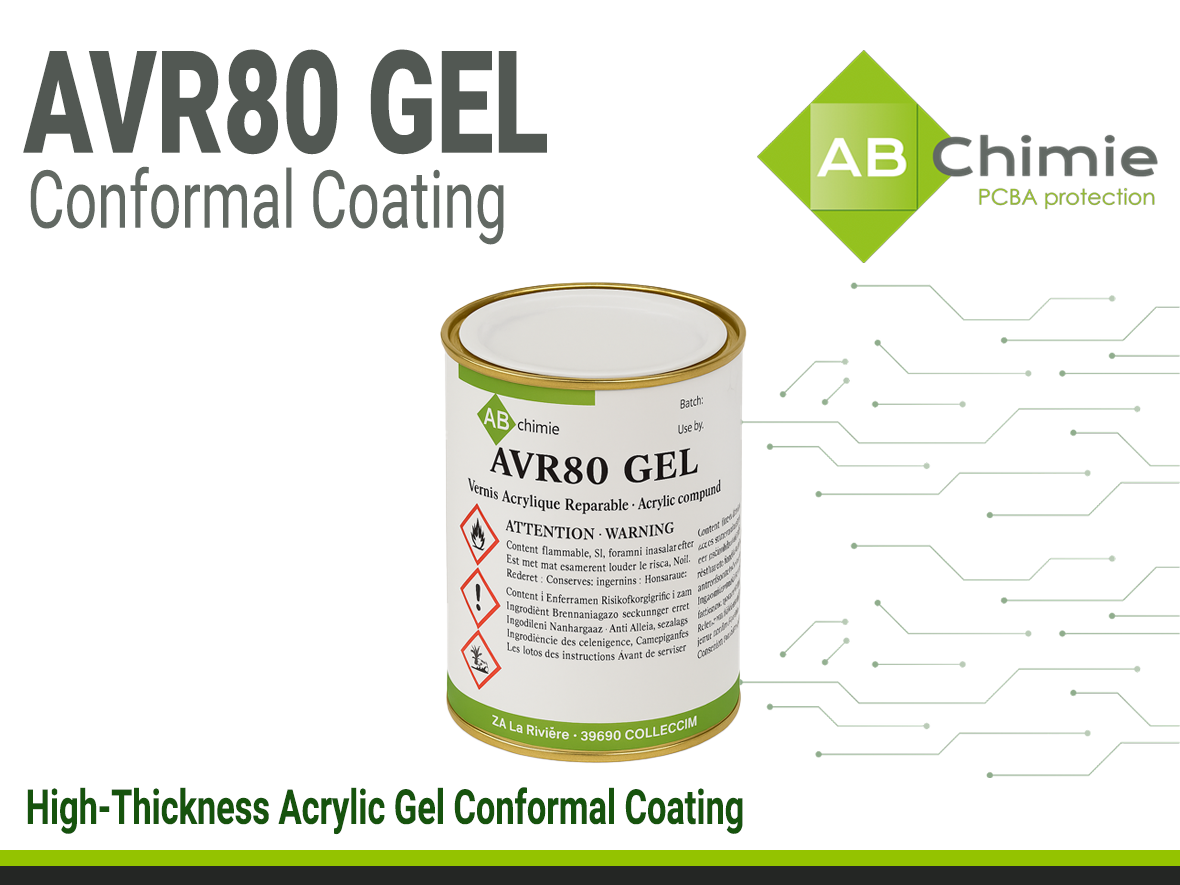
- ABchimie AVR80 GEL Removable Acrylic Coating
ABchimie AVR80 GEL Removable Acrylic Coating
- Excellent adhesion
- Wide temperature range (-65°C to +150°C.)
- Resistant to mold growth.
Product Description
ABchimie AVR80 GEL is a flexible, transparent acrylic gel coating designed for the protection of electronic circuitry requiring high‑performance environmental resistance. Its gel‑like viscosity allows the formation of dams and high‑thickness deposits, making it ideal for applications where additional mechanical or environmental protection is needed.
The coating is repairable and can be fully removed using ABchimie SND or DNS, both of which are 100% ozone‑friendly. AVR80 GEL combines strong adhesion, excellent dielectric properties, and reliable performance across a wide temperature range, ensuring dependable long‑term protection.
Product Key Features
- Flexible, transparent acrylic gel coating
- Allows damming and high‑thickness coating deposits
- Excellent adhesion in a wide range of climatic conditions
- Fluoresces under UV light for easy inspection
- Wide operating temperature range (–65°C to +150°C)
Applications
- High‑thickness conformal coating for PCBs
- Damming and gel barrier applications for selective coating areas
Technical Specifications
| General Properties | |
|
Appearance
Appearance
Appearance at room temperature. |
Transparent thixotropic liquid with blue reflection |
| Density (g) | 0.96 g/cm3 |
| Thermal Properties | |
|
Flash Point
Flash Point
The flashpoint of a solvent is the lowest possible temperature at which it can vaporize to form an ignitable vapor. Flashpoint is often confused with “autoignition temperature”, which is the temperature at which a solvent ignites without an ignition source. |
25 °C |
Additional Information
Product Selector Guide Between AVR80 BA GEL and AVR80 GEL
| Property | AVR80 BA GEL | AVR80 GEL |
| Type | Flexible, transparent acrylic gel coating | Gel‑form acrylic for high‑thickness deposits |
| Transparency |
Transparent gel
|
Ultra‑clear gel for optical/sensor application
|
| Form / Viscosity | Gel consistency | Gel consistency |
| Operating Temperature | −65 °C to +150 °C | −65 °C to +150 °C |
| Removability | Fully removable with ABchimie SND or ABclean | Removable with ABchimie SND or DNS |
| Solder‑Through Capability | Yes, no toxic gases produced | Yes, no isocyanates present |
| Drying / Curing | Air‑dries at room temperature | Touch‑dry <30 min; full cure 24h |
| Advantages | Applications requiring non‑toxic, thick protective gel layers (dams, barriers) | Applications requiring optical clarity, sensor encapsulation, or transparent high‑thickness protection |
Instructions for Use
Workshop temperatures of less than 16°C or relative humidities in excess of 75% are unsuitable for the application of AVR80 GEL.
Before coating Pcbs must be clean, dry and without moisture. The CI being humidity sensor, it is important to remove it before coating. A passage in oven from 1 to 2 hours at 60°C is generally enough.
AVR80 GEL contains a UV trace which allows inspection of the PCB after coating to ensure complete and even coverage. The stonger the reflected light, the thicker the coating layer is.
Drying Times and Curing Conditions
AVR80 GEL will be touch dry after few minutes at room temperature and does not require a thermal cure. The full properties of AVR80 will be obtained after a 24 hours at room temperature.
Removing AVR80 GEL
AVR80 GEL can be soldered through. But, if necessary, it can be easily removed with SND or DNS solvents. To remove AVR80 GEL, dip the full PCBA into a bath of SND during 3 to 10 minutes (depending the thickness of the gel). Then, brush it and after that rince the PCB with SND. To remove AVR80 GEL locally, use SND400B (aerosol) and work with absorbent paper to eliminate all the gel.