-
Home

-
Products
-
Coatings, powders & Resins
-
Conformal Coatings
- ABchimie AVR80 XY Removable Acrylic Coating
ABchimie AVR80 XY Removable Acrylic Coating
- Excellent dielectric properties
- Wide operating temperature range (-65°C to +150°C)
- Removable
Product Description
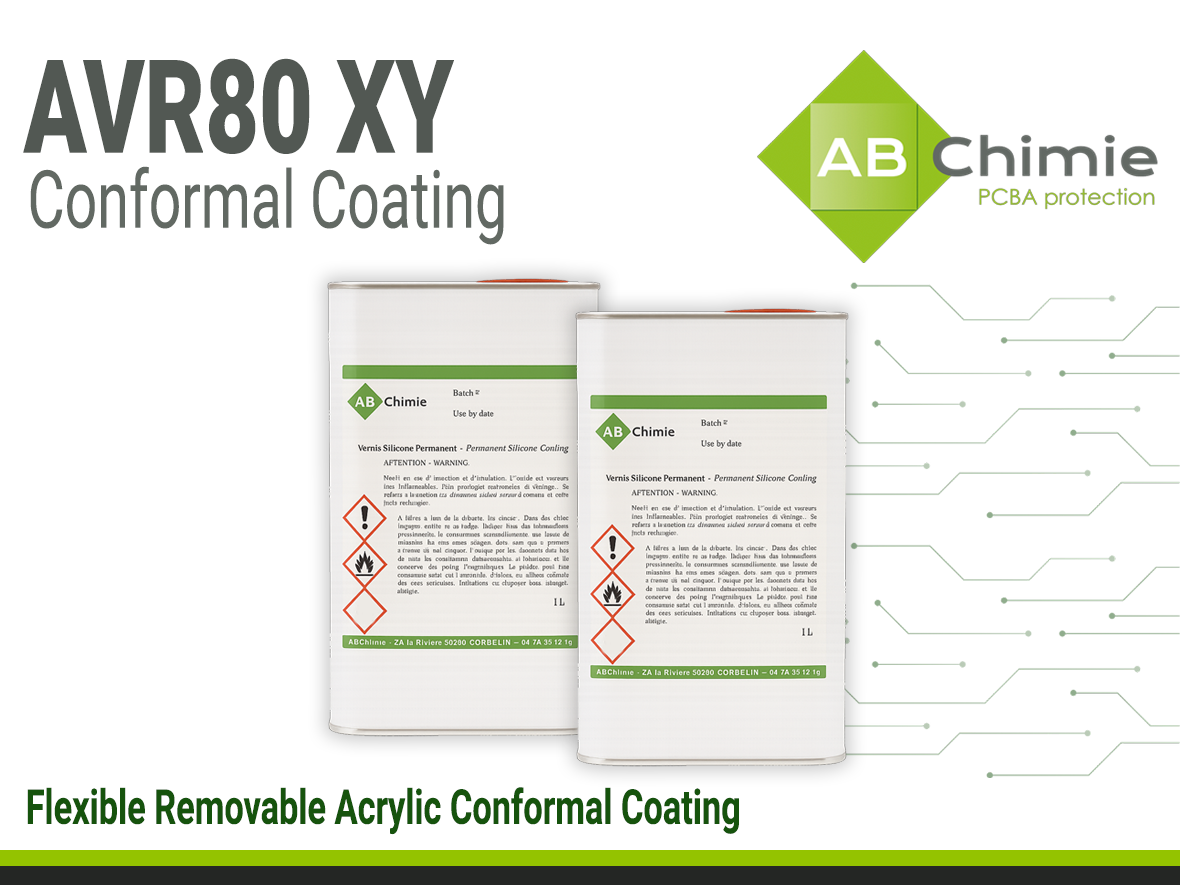
ABchimie AVR80 XY is a flexible, transparent acrylic conformal coating designed to provide high‑performance protection for electronic assemblies operating in demanding environments. Formulated to meet stringent resistance and inspection requirements, AVR80 XY ensures long‑term reliability of sensitive circuitry. The coating can be completely removed using ABchimie SND (100% ozone‑friendly) or DNS removers.
Product Key Features
- Excellent adhesion in all climatic conditions
- Resistant to mould growth
- Wide operating temperature range: –65°C to +150°C
- Can be soldered through without generating toxic gases
- Halogen-free formulation
Applications
- Protection of printed circuit boards (PCBs) in harsh environments
- Electronics exposed to thermal cycling, moisture, or chemical stress
Qualifications
- L QMJU2 approval (File E308681)
- Meets IPC‑CC‑830 requirements
- Certified to NF EN 61086‑2, NF EN 45545, NF EN 16101, and NF EN 16102
Technical Specifications
| General Properties | |
|
Appearance
Appearance
Appearance at room temperature. |
Pale liquid |
| Electrical Properties | |
|
Breakdown Voltage
Breakdown Voltage
Breakdown voltage is the minimum voltage necessary to force an insulator to conduct some amount of electricity. It is the point at which a material ceases to be an insulator and becomes a resistor that conducts electricity at some proportion of the total current. After dielectric breakdown, the material may or may not behave as an insulator any more because of the molecular structure alteration. The current flow tend to create a localised puncture that totally alters the dielectric properties of the material. This electrical property is thickness dependent and is the maximum amount of voltage that a dielectric material can withstand before breaking down. The breakdown voltage is calculated by multiplying the dielectric strength of the material times the thickness of the film. |
1500 V |
|
Dielectric Strength
Dielectric Strength
Dielectric strength is measured in kV per mm and is calculated by the Breakdown voltage divided by the thickness of the tested material. Those two properties go hand in hand and while Breakdown voltage is always thickness dependent, dielectric strength is a general material property. As an example, the dielectric strength of Polyimide is 236 kV/mm. If we place 1mm of Polyimide between two electrodes, it will act as an insulator until the voltage between the electrodes reaches 236 kV. At this point it will start acting as a good conductor, causing sparks, potential punctures and current flow. |
50 kV/mm |
| Dissipation Factor @ 25°C /1000 kHz | 0.01 |
| Thermal Properties | |
|
Coefficient of Thermal Expansion (CTE), α1
Coefficient of Thermal Expansion (CTE), α1
CTE α1 (alpha 1) is the slope of the Coefficient of thermal expansion in a temperature range below the Glass transition temperature (Tg). It explains how much a material will expand until it reaches Tg. |
130 ppm/°C |
|
Coefficient of Thermal Expansion (CTE), α2
Coefficient of Thermal Expansion (CTE), α2
CTE α2 (alpha 2) is the slope of the Coefficient of thermal expansion in a temperature range above the Glass transition temperature (Tg). It explains the extent to which a material will expand after it passes Tg. |
280 ppm/°C |
|
Flash Point
Flash Point
The flashpoint of a solvent is the lowest possible temperature at which it can vaporize to form an ignitable vapor. Flashpoint is often confused with “autoignition temperature”, which is the temperature at which a solvent ignites without an ignition source. |
25 °C |
|
Glass Transition Temperature (Tg)
Glass Transition Temperature (Tg)
The glass transition temperature for organic adhesives is a temperature region where the polymers change from glassy and brittle to soft and rubbery. Increasing the temperature further continues the softening process as the viscosity drops too. Temperatures between the glass transition temperature and below the decomposition point of the adhesive are the best region for bonding. The glass-transition temperature Tg of a material characterizes the range of temperatures over which this glass transition occurs. |
29 °C |
| Operating Temperature | -65 - +150 °C |
|
UL 94 Rating
UL 94 Rating
Flammability rating classification. It determines how fast a material burns or extinguishes once it is ignited. HB: slow burning on a horizontal specimen; burning rate less than 76 mm/min for thickness less than 3 mm or burning stops before 100 mm V-2: burning stops within 30 seconds on a vertical specimen; drips of flaming particles are allowed. V-1: burning stops within 30 seconds on a vertical specimen; drips of particles allowed as long as they are not inflamed. V-0: burning stops within 10 seconds on a vertical specimen; drips of particles allowed as long as they are not inflamed. 5VB: burning stops within 60 seconds on a vertical specimen; no drips allowed; plaque specimens may develop a hole. 5VA: burning stops within 60 seconds on a vertical specimen; no drips allowed; plaque specimens may not develop a hole |
V-0 |
Additional Information
Frequently Asked Questions About ABchimie® AVR80 XY
What makes AVR80 XY suitable for high-spec industries?
AVR80 XY is formulated to meet the most stringent resistance requirements. It holds UL QMJU2 (File E308681), NF EN 61086-2, and railway fire/smoke approvals (NF EN 45545, 16101, 16102). It is specifically engineered for environments requiring elite protection against moisture and contaminants.
ABchimie® AVR80 XY: Elite Circuit Protection
ABchimie® AVR80 XY is a flexible, Halogen-free transparent acrylic coating designed for electronic circuitry in extreme conditions. It offers excellent dielectric properties and a wide operating temperature range from -65°C to +150°C, ensuring stability where standard coatings might fail.
Key Features & Benefits
Exceptional bonding under all climatic conditions. Its resistance to mould growth makes it ideal for tropical and high-humidity applications.
Contains a built-in UV fluorescing tracer to facilitate rapid inspection of coverage and uniformity under blacklight.
Product Selector Guide
| Property | AVR80 | AVR80 BA | AVR80R | AVR80 XY |
|---|---|---|---|---|
| Type | Standard | Non-Toxic | High Solid | High-Spec Flex |
| Thinner | DVA | DVA BA | DVA / DVA-R | DVA-XY |
| Best For | General Use | Eco-Fast | High Solids | Railway/Military |
Instructions for Use
AVR80 XY can be applied via spraying, dipping, or brushing. To ensure full environmental protection, a minimum dry film thickness of 25 microns is recommended. Application is most effective when workshop temperatures are above 16°C and relative humidity is below 75%.
Moisture Management & Application
All PCBs, being composite materials, naturally absorb moisture. If this is not removed, the conformal coating may not protect to its fullest extent.
- Pre-Drying: We recommend oven drying (3-4 hours at 60°C) or vacuum desiccation prior to coating to ensure maximum adhesion and reliability.
- Repairability: Rework can be performed by soldering directly through the coating or by total removal using ABchimie SND or DNS.
- Inspection: Use UV light after application; stronger reflected light indicates a thicker coating layer, allowing for precise quality control.