-
Home

-
Products
-
Coatings, powders & Resins
-
Conformal Coatings
- ABchimie 6028UV UV LED Cure Thixotropic Resin
ABchimie 6028UV UV LED Cure Thixotropic Resin
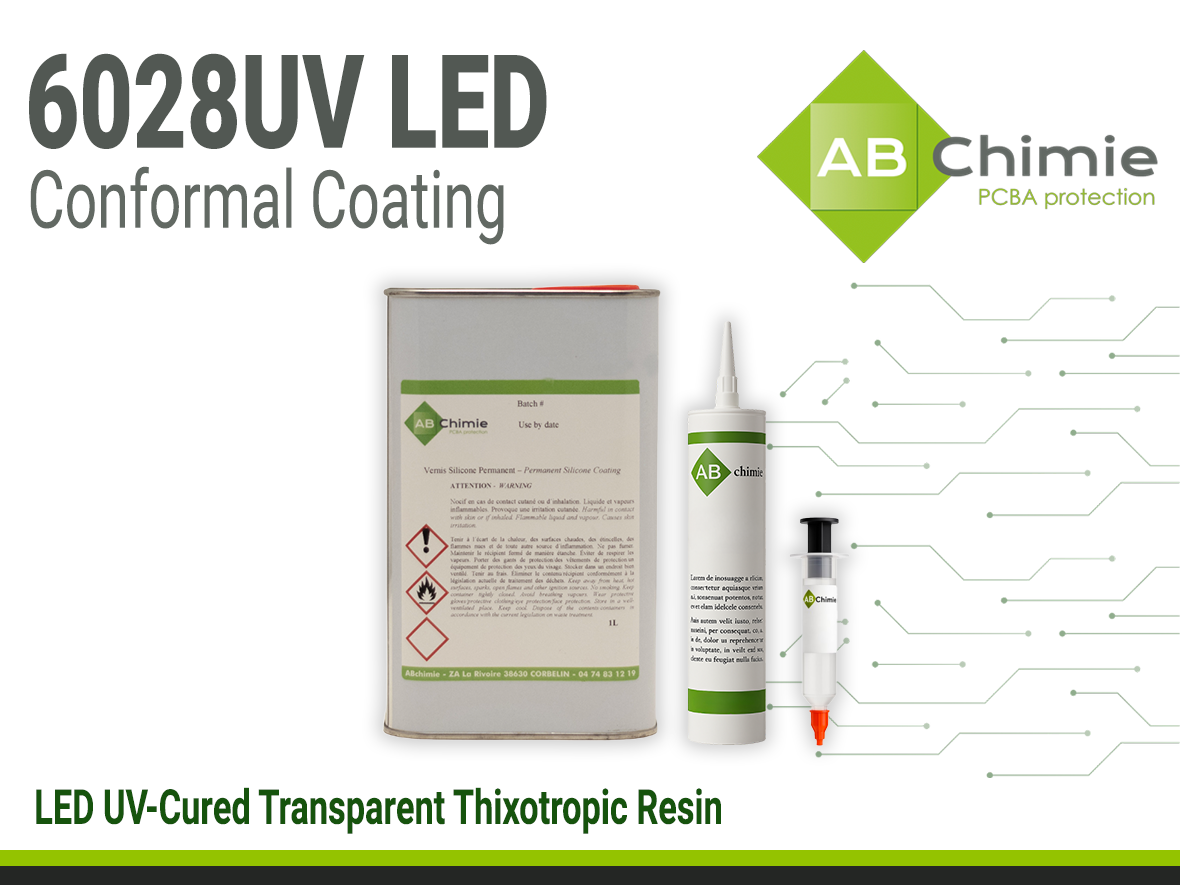
- One-component
- Fast UV Curing
- Excellent adhesion to plastics
Product Description
ABChimie® 6028UV LED is a transparent thixotropic resin coating designed to provide mechanical and environmental protection to electronic components and assemblies. Its thixotropic quality allows for controlled application with high thicknesses (up to 4mm) without sagging. This makes it ideal for encapsulation or localized protection.
ABChimie® 6028UV LED is acrylic-based and has excellent adhesion to many substrates, including flexible ones like plastics. One of its advantages is that it cures rapidly under UV LED light (395nm), has zero VOCs, and can be applied to high-speed manufacturing processes to increase productivity. ABChimmie 6028UV LED is in full compliance with REACH and RoHS regulations.
Product Key Features
- Transparent, thixotropic UV-curing resin
- Allows for thick, controlled application without sagging
- Fast UV cure for high-sp
- Solvent-free formulation (no VOCs)
- LED light cure for environmental / worker safety
Applications
- Encapsulation of electronic components requiring high volumes, localized protection, and a thick coating
- Sensors on PCBs, wire-bonded chips, and reinforcement of solder joints.
- Can be used to seal plastic casings on PCBs
- Printed circuit assemblies.
Technical Specifications
| General Properties | |
|
Appearance
Appearance
Appearance at room temperature. |
Thixotropic translucent liquid |
| Density (g) | 1.06 g/cm3 |
| Mechanical Properties | |
| Durometer (Shore D) | 45 |
| Thermal Properties | |
|
Coefficient of Thermal Expansion (CTE), α1
Coefficient of Thermal Expansion (CTE), α1
CTE α1 (alpha 1) is the slope of the Coefficient of thermal expansion in a temperature range below the Glass transition temperature (Tg). It explains how much a material will expand until it reaches Tg. |
63 ppm/°C |
|
Coefficient of Thermal Expansion (CTE), α2
Coefficient of Thermal Expansion (CTE), α2
CTE α2 (alpha 2) is the slope of the Coefficient of thermal expansion in a temperature range above the Glass transition temperature (Tg). It explains the extent to which a material will expand after it passes Tg. |
118 ppm/°C |
|
Flash Point
Flash Point
The flashpoint of a solvent is the lowest possible temperature at which it can vaporize to form an ignitable vapor. Flashpoint is often confused with “autoignition temperature”, which is the temperature at which a solvent ignites without an ignition source. |
100 °C |
|
Glass Transition Temperature (Tg)
Glass Transition Temperature (Tg)
The glass transition temperature for organic adhesives is a temperature region where the polymers change from glassy and brittle to soft and rubbery. Increasing the temperature further continues the softening process as the viscosity drops too. Temperatures between the glass transition temperature and below the decomposition point of the adhesive are the best region for bonding. The glass-transition temperature Tg of a material characterizes the range of temperatures over which this glass transition occurs. |
-35.5 °C |
| Physical Properties | |
| Young's modulus | 84 MPa |
Additional Information
ABChimie® 6028 UV LED: Advanced Electronics Protection
ABChimie® 6028 UV LED is a high-performance LED UV-curable resin designed to protect printed circuit board assemblies (PCBs) and components in demanding manufacturing environments. It delivers rapid curing, excellent electrical insulation, and thixotropic properties for precise, high-thickness application.
Cures rapidly under 395nm LED light, enabling seamless integration into high-throughput batch and inline production lines without the thermal stress of mercury lamps.
Achieves a Shore D hardness of 45, providing a durable barrier that resists scratches, abrasion, and minor impacts for long-term component stability.
Maintains a stable, non-running consistency at rest while flowing easily under shear. Allows for deposits up to 4mm without sagging or running.
Bonds strongly to flexible substrates, plastics, and polymer-based PCBs, ensuring protection on assemblies that bend, flex, or experience vibration.
Engineering Takeaway: It is crucial to use a 395nm LED lamp with a minimum UVA dose of 5000 mJ/cm² for a 1mm thickness to achieve the specified protective properties.
Emission Spectrum vs. Relative Power
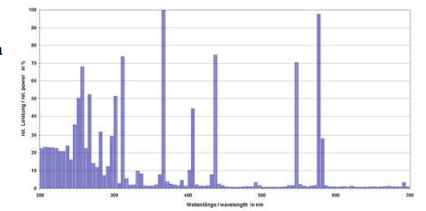
Relative Power (%) over Wavelength (nm) for LED 395nm.
Key Curing Parameters
*Higher UVA doses do not negatively affect final properties.
Frequently Asked Questions
Where is ABChimie® 6028 UV LED typically used?
Automotive electronics (control units, sensors), Industrial automation (PLCs, drives), and high-reliability consumer wearables.
What is the shelf life and storage requirement?
12 months when stored at 5–30°C. Equilibrate the resin for 24 hours at room temperature (18–32°C) prior to use.
Can the viscosity be adjusted?
Yes, viscosity can be customized for specific application requirements. Contact our engineering team for guidance on variable viscosities.
Is it RoHS and REACH compliant?
Yes, it meets stringent standards including REACH and RoHS 2011/65/EU, ensuring regulatory adherence for OEMs.
Alternative for Mercury Lamp Curing
Need to use a traditional mercury lamp? We offer a standard UV version of this thixotropic resin.
- Same Shore D 45 hardness
- Excellent adhesion to flexible substrates
- Immediate curing with standard UV exposure
Need Technical Guidance?
Our engineers can help you select the right resin, application method, and curing equipment for your specific assembly requirements.
Contact Us Now →