
-
Home

-
Products
-
Encapsulants & Underfills
-
Liquid Encapsulants
- DOWSIL™ EI-2888 Primerless Silicone Encapsulant Kit
DOWSIL™ EI-2888 Primerless Silicone Encapsulant Kit
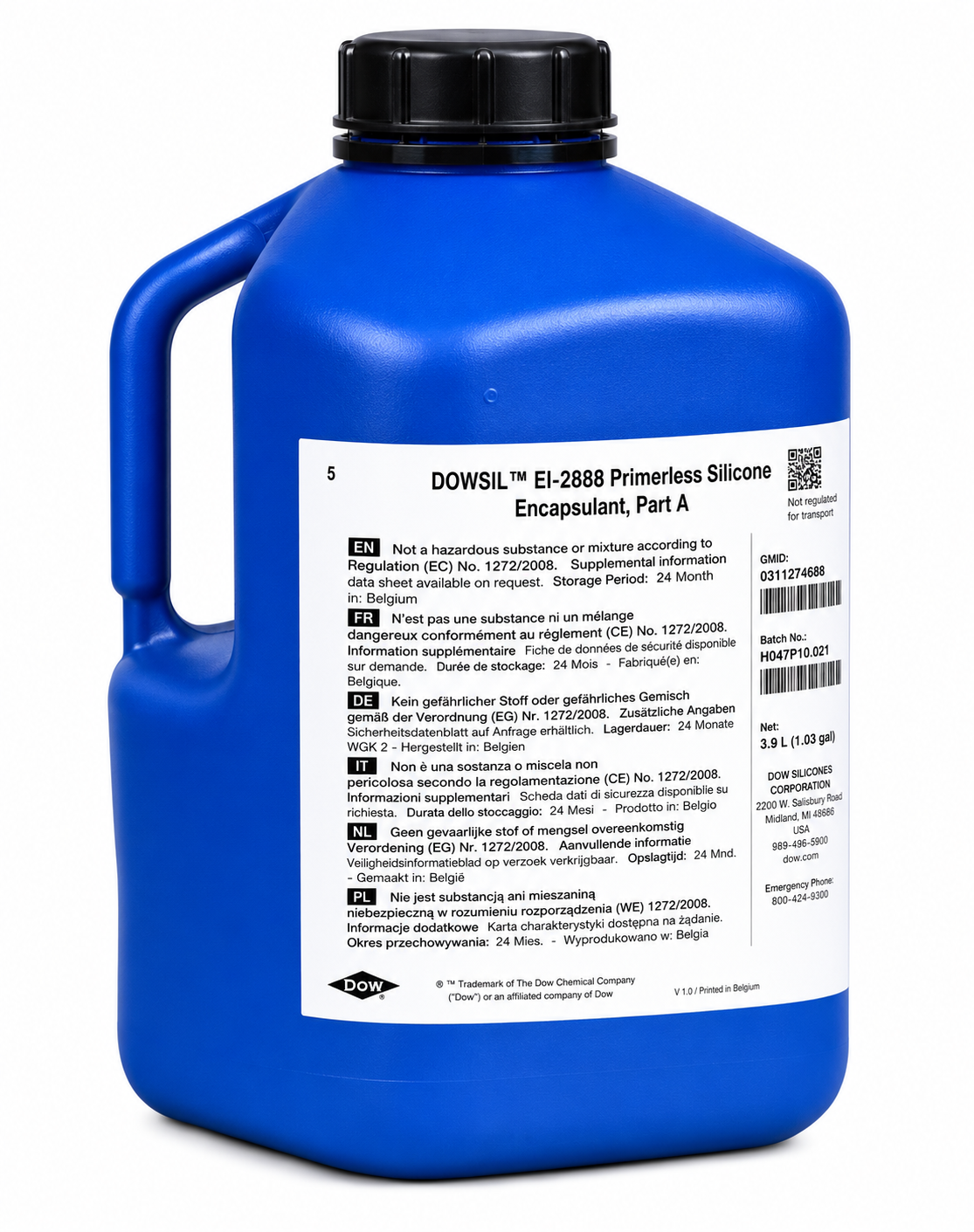
- Primerless processing for simpler assembly workflows
- Optically clear protection for LED and display electronics
- Soft silicone encapsulation for environmental and electrical protection
Product Description
DOWSIL™ EI-2888 Primerless Silicone Encapsulant Kit is a two-part, 1:1 mix ratio, optically clear silicone encapsulant designed for potting rigid and flexible printed circuit board assemblies used in LED lighting, high ingress protection luminaires, explosion proof luminaires, and outdoor displays. It provides 2700 mPa.s mixed viscosity, 60 Shore 00 hardness after 21 days at 22°C, and UL 94 HB and UL 746C f1 recognition while supporting room temperature cure or heat-accelerated cure up to 100°C. This makes it a candidate for assemblies requiring optical clarity, electrical insulation, stress relief, and environmental protection, subject to application-specific testing and qualification.
Key features
- Primerless silicone encapsulant - self-priming formulation can develop adhesion on many common substrates without a separate primer, with adhesion testing required for each assembly.
- Optically clear - supports review for LED lighting and display assemblies where light transmission through the encapsulant matters.
- Low mixed viscosity - 2700 mPa.s mixed viscosity supports flow, pour, or needle dispensing into populated assemblies.
- Soft cured elastomer - 60 Shore 00 hardness after 21 days at 22°C can help reduce mechanical stress on sensitive components.
- Room temperature or heat-accelerated cure - cure can proceed at 25°C or be accelerated with mild heat up to 100°C.
- Outdoor-use recognition - UL 746C f1 recognition supports review for outdoor applications involving UV exposure and water immersion.
Applications / Suitable for
This product fits assemblies that require a balance of optical clarity, electrical insulation, soft silicone protection, and process-friendly encapsulation.
- LED lighting: Encapsulation of rigid and flexible circuit boards used in indoor and outdoor lighting assemblies.
- High ingress protection luminaires: Potting of electronics where environmental exposure, insulation, and primerless processing need to be evaluated together.
- Explosion proof luminaires: Encapsulation of luminaire electronics where soft silicone protection and process-controlled cure are part of the design review.
- Outdoor displays: Encapsulation of display electronics where optical transmission and outdoor-use recognition are part of qualification review.
Technical Specifications
| General Properties | |||||||||||
| Chemistry Type | Silicone | ||||||||||
|
Component System
Component System
Describes the number of components that must be supplied, mixed, or activated before application or cure. |
2 - part | ||||||||||
|
Mix Ratio
Mix Ratio
The amount of a constituent divided by the total amount of all other constituents in a mixture |
1:1 | ||||||||||
|
Pot Life
Pot Life
Pot life is the amount of time it takes for the viscosity of a material to double (or quadruple for lower viscosity materials) in room temperature after a material is mixed. It is closely related to work life but it is not application dependent, less precise and more of a general indication of how fast a system is going to cure. |
130 minutes | ||||||||||
|
Product Type
Product Type
Material category or functional product class. |
Primerless Encapsulant | ||||||||||
|
|||||||||||
| Physical Properties | |||||||||||
|
|||||||||||
|
|||||||||||
| Mechanical Properties | |||||||||||
|
|||||||||||
|
Elongation
Elongation
Elongation is the process of lengthening something. It is a percentage that measures the initial, unstressed, length compared to the length of the material right before it breaks. It is commonly referred to as Ultimate Elongation or Tensile Elongation at break. |
190 % | ||||||||||
| Electrical Properties | |||||||||||
|
Dielectric Strength
Dielectric Strength
Dielectric strength is measured in kV per mm and is calculated by the Breakdown voltage divided by the thickness of the tested material. Those two properties go hand in hand and while Breakdown voltage is always thickness dependent, dielectric strength is a general material property. As an example, the dielectric strength of Polyimide is 236 kV/mm. If we place 1mm of Polyimide between two electrodes, it will act as an insulator until the voltage between the electrodes reaches 236 kV. At this point it will start acting as a good conductor, causing sparks, potential punctures and current flow. |
19 kV/mm | ||||||||||
|
Volume Resistivity
Volume Resistivity
Volume resistivity, also called volume resistance, bulk resistance or bulk resistivity is a thickness dependent measurement of the resistivity of a material perpendicular to the plane of the surface. |
10000000000000000 Ohms⋅cm | ||||||||||
| Thermal Properties | |||||||||||
|
|||||||||||
|
UL 94 Rating
UL 94 Rating
Flammability rating classification. It determines how fast a material burns or extinguishes once it is ignited. HB: slow burning on a horizontal specimen; burning rate less than 76 mm/min for thickness less than 3 mm or burning stops before 100 mm V-2: burning stops within 30 seconds on a vertical specimen; drips of flaming particles are allowed. V-1: burning stops within 30 seconds on a vertical specimen; drips of particles allowed as long as they are not inflamed. V-0: burning stops within 10 seconds on a vertical specimen; drips of particles allowed as long as they are not inflamed. 5VB: burning stops within 60 seconds on a vertical specimen; no drips allowed; plaque specimens may develop a hole. 5VA: burning stops within 60 seconds on a vertical specimen; no drips allowed; plaque specimens may not develop a hole |
HB | ||||||||||
| Curing Conditions | |||||||||||
|
|||||||||||
Additional Information
DOWSIL™ EI-2888 Primerless Silicone Encapsulant Kit
DOWSIL™ EI-2888 Primerless Silicone Encapsulant Kit is a two-part, 1:1 mix ratio, optically clear, self-priming silicone encapsulant designed for potting rigid and flexible PCB assemblies in LED lighting, high ingress protection luminaires, explosion proof luminaires, and outdoor displays. It provides 2700 mPa.s mixed viscosity and 8 h gel time at 22°C, giving engineers a practical starting point for evaluating optical protection, electrical insulation, stress relief, and environmental exposure requirements.
Review substrate adhesion, cure schedule, optical path, potting depth, and exposure profile before qualification.

Key features
- Optically clear system: 94% light transmission at 450 nm and 95% at 760 nm, measured at 5 mm by ASTM D 1003.
- Self-priming adhesion: formulated to develop adhesion to many common substrates without primer, with substrate-specific testing required.
- Low mixed viscosity: 2700 mPa.s mixed viscosity can help support pour, flow, and needle dispense processing.
- Soft cured profile: 60 Shore 00 after 21 days at 22°C can help support low-stress encapsulation.
- Agency recognition: UL 94 HB and UL 746C f1 recognition support review for flame and outdoor-use requirements where applicable.
Processing summary
Mixing, dispensing, and cure considerations
Mixing setup
Mix Part A and Part B thoroughly before dispense. Automated metered mixing can help support ratio control in production, while manual mixing should be evaluated for air entrapment and repeatability.
Void control
Where practical, dispense under vacuum. If vacuum dispensing is not available, evacuate the assembly after dispense, especially when the PCB or housing contains small voids.
Surface preparation
Apply to clean and dry substrates. Low-surface-energy materials, release agents, oils, greases, oxide films, or other contamination can affect adhesion and should be checked during qualification.
Cure review
Adhesion develops during cure and increases toward full cure at room temperature. Confirm handling time, cure time, and minimum acceptable properties on the actual assembly.
Uncured and processing properties
Values are typical and not intended for specification writing. Review the current technical data sheet before qualification.
| Property | Typical value | Unit | Test method / condition |
|---|---|---|---|
| System format | Two-part | Not applicable | Per technical data sheet; Part A and Part B |
| Mix ratio | 1:1 | Not applicable | By weight or volume |
| Appearance | Clear | Not applicable | CTM 0176B; uncured material |
| Viscosity, Part A | 2000 | mPa.s | CTM 0050; unmixed component |
| Viscosity, Part B | 2300 | mPa.s | CTM 0050; unmixed component |
| Viscosity, mixed | 2700 | mPa.s | CTM 0050; after mixing Part A and Part B |
| Gel time at 22°C | 8 | h | ASTM D 4440; G prime = G double prime at 22°C |
| Pot life at 22°C | 130 | min | CTM 0055; can vary with humidity, temperature, and mixing method |
Cured mechanical and adhesion properties
Cure basis: room temperature cure at 22°C unless otherwise stated in the property line.
| Property | Typical value | Unit | Test method / condition |
|---|---|---|---|
| Durometer after 24 h at 22°C and 50°C | 12 to 28 | Shore 00 | ASTM D 2240; 12 at 22°C and 28 at 50°C |
| Durometer after 3 days at 22°C | 35 | Shore 00 | ASTM D 2240; room temperature cure |
| Durometer after 7 days at 22°C | 45 | Shore 00 | ASTM D 2240; room temperature cure |
| Durometer after 21 days at 22°C | 60 / 10 | Shore 00 / Shore A | ASTM D 2240; room temperature cure |
| Tensile strength | 0.2 | MPa | ASTM D 412; cured elastomer |
| Elongation | 190 | % | ASTM D 412; cured elastomer |
| Unprimed lap shear, aluminum | 0.17 | MPa | CTM 0243; unprimed aluminum substrate |
Electrical, optical, and recognition data
| Property | Typical value | Unit | Test method / condition |
|---|---|---|---|
| Dielectric strength | 19 | kV/mm | CTM 0114; cured material |
| Volume resistivity | 1E+16 | Ohm*cm | CTM 0249; cured material |
| Light transmission at 380 nm, 5 mm | 91 | % | ASTM D 1003; 5 mm thickness |
| Light transmission at 450 nm, 5 mm | 94 | % | ASTM D 1003; 5 mm thickness |
| Light transmission at 760 nm, 5 mm | 95 | % | ASTM D 1003; 5 mm thickness |
| Flammability test | UL 94 HB | Not applicable | UL 94; review current listing before specification |
| Outdoor use recognition, UV exposure and water immersion | f1 | Not applicable | UL 746C; UV exposure and water immersion |
| Shelf life at 22°C | 12 | months | Per technical data sheet; at 22°C |
Recommended handling time versus curing temperature
| Temperature | Time | Basis |
|---|---|---|
| 25°C | 10 to 12 h | Recommended handling time |
| 50°C | 6 to 7 h | Recommended handling time |
| 80°C | 3 to 4 h | Recommended handling time |
| 100°C | 1 to 2 h | Recommended handling time |
Where DOWSIL™ EI-2888 fits
Review the product in application context
Product proposition video
Review the Dow product proposition video for an overview of how DOWSIL™ EI-2888 is positioned for LED protection and optical performance.
Primerless encapsulant webinar
Review the Dow webinar for additional context on primerless silicone encapsulation in lighting and outdoor display applications.
Plan packaging, storage, and application review
- Multiple packaging sizes are available.
- Store in original packaging with the cover tightly attached.
- Keep containers tightly closed and minimize headspace.
- Use by the Use Before date shown on the product label.
- Substrate stack and surface condition.
- Potting depth, cavity geometry, and optical path.
- Dispense method, mix method, and cure constraints.
- Operating temperature, humidity, UV, and water exposure profile.
Tips and troubleshooting
| Issue | Recommended action |
|---|---|
| Voids or air entrapment |
|
| Cure variation or slow handling time |
|
| Adhesion below target |
|
| Optical performance below target |
|
| Storage or shelf-life deviation |
|
| Mixing or ratio error |
|