
-
Home

-
Products
-
Adhesives
-
Silicone Adhesives
- DOWSIL™ TC-5026 Thermally Conductive Compound
DOWSIL™ TC-5026 Thermally Conductive Compound
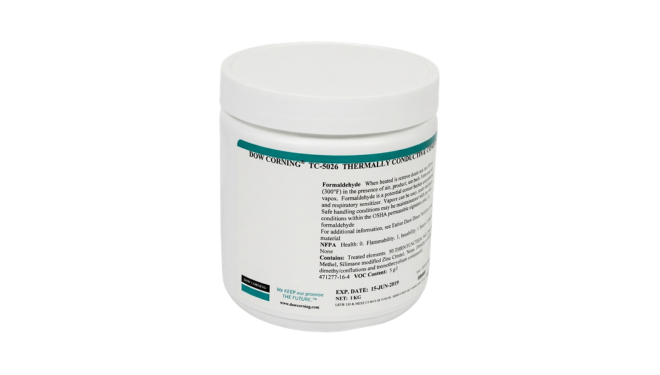
- Ultra-thin bondline capability of approximately 0.007 mm
- Suitable for CPU, GPU, MPU, ASIC, and processor
- Flowable silicone compound
Product Description
DOWSIL™ TC-5026 Thermally Conductive Compound is a high-performance, one-part, non-curing silicone thermal compound engineered to provide efficient heat transfer between processors and heat sinks in high-power electronic devices. Featuring 2.9 W/m·K thermal conductivity, very low thermal resistance of 0.03 °C·cm²/W, and the ability to achieve an ultra-thin bondline thickness of approximately 0.007 mm (0.3 mil) under compression, TC-5026 helps maximize thermal performance in space-constrained applications. Its solventless, grease-like formulation eliminates the need for curing ovens while maintaining excellent surface wet-out and long-term thermal stability. Designed specifically for microprocessor cooling, TC-5026 is well suited for servers, desktop computers, notebooks, gaming consoles, and other electronics requiring reliable processor-to-heat-sink thermal management.
Key Features
-
2.9 W/m·K thermal conductivity for efficient heat dissipation.
-
Ultra-low thermal resistance of 0.03 °C·cm²/W at 40 psi.
-
Non-curing formulation eliminates oven curing requirements.
-
Flowable silicone compound promotes excellent surface wet-out.
-
Ultra-thin bondline capability of approximately 0.007 mm (0.3 mil).
-
Solventless formulation with 99.95% non-volatile content.
-
Maintains a positive heat sink seal for improved thermal transfer.
-
Electrically insulating with 8.9 kV/mm dielectric strength.
-
High volume resistivity of 5.9 × 10¹¹ Ω·cm.
-
Suitable for CPU, GPU, MPU, ASIC, and processor cooling applications.
-
Designed for servers, desktops, notebooks, gaming consoles, and high-performance computing systems.
-
Supports improved device efficiency and long-term reliability through effective thermal management.
Technical Specifications
| General Properties | |
|
Color
Color
The color |
Gray |
|
Component System
Component System
Describes the number of components that must be supplied, mixed, or activated before application or cure. |
One Part |
| Physical Properties | |
|
Viscosity
Viscosity
Viscosity is a measurement of a fluid’s resistance to flow. Viscosity is commonly measured in centiPoise (cP). One cP is defined as the viscosity of water and all other viscosities are derived from this base. MPa is another common unit with a 1:1 conversion to cP. A product like honey would have a much higher viscosity -around 10,000 cPs- compared to water. As a result, honey would flow much slower out of a tipped glass than water would. The viscosity of a material can be decreased with an increase in temperature in order to better suit an application |
100000 mPa.s |
| Thermal Properties | |
|
Thermal Conductivity
Thermal Conductivity
Thermal conductivity describes the ability of a material to conduct heat. It is required by power packages in order to dissipate heat and maintain stable electrical performance. Thermal conductivity units are [W/(m K)] in the SI system and [Btu/(hr ft °F)] in the Imperial system. |
2.9 W/m.K |
| Thermal Impedance | 0.03 °C·cm²/W |
Additional Information
DOWSIL™ TC-5026: High-Performance Thermally Conductive Compound
DOWSIL™ TC-5026 Thermally Conductive Compound is a gray, flowable, non-curing silicone thermal compound designed to provide efficient heat transfer for microprocessor cooling in servers, desktops, notebooks, and game consoles. With 2.9 W/m·K thermal conductivity, very low thermal resistance, and the ability to achieve thin bondline thickness, TC-5026 helps conduct heat away from sensitive components and improve thermal efficiency in compact, high-performance electronic systems.
Thin bondline thermal performance — TC-5026 provides 2.9 W/m·K thermal conductivity and 0.03 °C·cm²/W thermal resistance at 40 psi for efficient processor-to-heat-sink heat transfer.
Its non-curing, solventless formulation eliminates the need for curing ovens and supports direct application as a grease-like thermal interface between heat-generating devices and heat sinks or chassis.
Thermal compound for processor cooling — suitable for MPUs, CPUs, GPUs, server processors, desktop systems, notebooks, and game consoles where low thermal resistance and thin bondlines are required.
TC-5026 acts as a thermal bridge between the heat source and heat sink, helping improve device efficiency, reduce operating temperature, and support long-term electronic reliability.
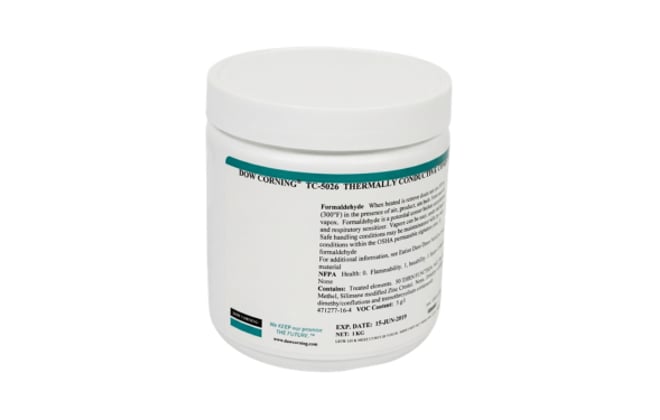
2.9 W/m·K Thermal Conductivity • Non-Curing • Very Low Thermal Resistance • Thin BLT Capability
Features & Benefits
- 2.9 W/m·K thermal conductivity — supports efficient heat transfer.
- Very low thermal resistance — 0.03 °C·cm²/W at 40 psi.
- Non-curing formulation — no curing ovens required.
- Flowable compound — supports easy application and interface wet-out.
- Thin BLT capability — achieves approximately 0.007 mm at 40 psi.
- Solventless formulation — high non-volatile content of 99.95%.
- Electrically insulating — dielectric strength of 8.9 kV/mm.
- Processor cooling optimized — designed for MPU cooling in servers, desktops, notebooks, and game consoles.
Typical Applications
- Server processor cooling.
- Desktop CPU thermal interfaces.
- Notebook processor thermal management.
- Game console processor and GPU cooling.
- MPU-to-heat-sink interfaces.
- PCB assembly thermal management.
- Heat sink or chassis thermal coupling.
Thermal Challenges in High-Performance Computing Devices
As servers, desktops, notebooks, and game consoles continue to deliver higher performance in smaller designs, processors generate more heat in limited spaces. DOWSIL™ TC-5026 helps address this challenge by forming a low-resistance thermal bridge between the heat source and the heat sink, enabling efficient heat removal and supporting improved device reliability.
Engineering Data for DOWSIL™ TC-5026
| Property | DOWSIL™ TC-5026 | Condition / Note |
|---|---|---|
| Type | One-part compound | Non-curing thermal compound |
| Color | Gray | Typical appearance |
| Viscosity | 100 Pa·s | 100,000 cP / mPa·s |
| Specific Gravity | 3.5 | Uncured |
| Non-Volatile Content | 99.95% | NVC |
| Thermal Conductivity | 2.9 W/m·K | 1.7 BTU/hr-ft-°F |
| Thermal Resistance | 0.03 °C·cm²/W | At 40 psi |
| Bondline Thickness | 0.007 mm / 0.3 mil | At 40 psi |
| Dielectric Strength | 8.9 kV/mm | 227 volts/mil |
| Volume Resistivity | 5.9E+11 ohm·cm | Electrical insulation |
| Dielectric Constant | 7.4 | At 1 kHz |
*Typical properties are not intended for specification writing. Verify performance under actual application, assembly pressure, bondline thickness, and reliability conditions.
Where DOWSIL™ TC-5026 Fits
- Servers
- Workstations
- Desktop computers
- Notebook CPUs
- Compact heat sinks
- Thin BLT interfaces
- Game consoles
- MPU cooling
- GPU thermal interfaces
How TC-5026 Supports Processor Thermal Design
| Design Challenge | DOWSIL™ TC-5026 Benefit |
|---|---|
| High-performance processors generate concentrated heat. | 2.9 W/m·K thermal conductivity helps transfer heat away from sensitive components. |
| Thick thermal interfaces increase thermal resistance. | Thin BLT capability helps optimize processor-to-heat-sink performance. |
| Cure steps add time and process complexity. | Non-curing formulation eliminates curing ovens and simplifies assembly. |
| Poor interface contact creates thermal bottlenecks. | Flowable compound supports surface wet-out and maintains a positive heat sink seal. |
Ready to Evaluate DOWSIL™ TC-5026?
```