
-
Home

-
Products
-
Encapsulants & Underfills
-
Liquid Encapsulants
- DOWSIL™ TC-6010 Thermally Conductive Encapsulant
DOWSIL™ TC-6010 Thermally Conductive Encapsulant
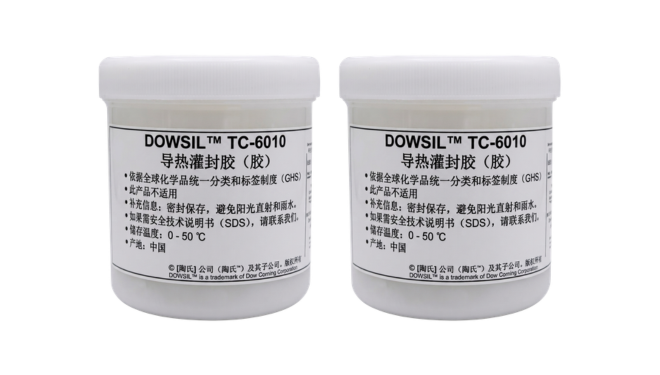
- Flowable and self-leveling formulation
- Excellent dielectric strength of 22 kV/mm
- 1.2 W/m·K thermal conductivity
Product Description
DOWSIL™ TC-6010 Thermally Conductive Encapsulant is a two-part, flowable silicone encapsulation material designed to provide both thermal management and environmental protection for electronic and electrical assemblies. Featuring 1.2 W/m·K thermal conductivity, excellent dielectric strength of 22 kV/mm, and a self-leveling formulation, TC-6010 effectively dissipates heat from sensitive components while protecting them against vibration, moisture, contaminants, and electrical stress. The material cures with heat to form a soft, elastic silicone rubber that accommodates thermal expansion mismatch and enhances long-term reliability in demanding operating environments. Designed for automated or manual dispensing, TC-6010 is particularly well suited for on-board chargers, inverters, converters, transformers, power electronics, and PCB assemblies where both thermal performance and component protection are critical.
Key Features
-
1.2 W/m·K thermal conductivity for efficient heat dissipation.
-
Two-part silicone encapsulant with a simple 1:1 mix ratio.
-
Flowable and self-leveling formulation for complete component coverage.
-
Heat-curing silicone elastomer forms a flexible protective encapsulant.
-
Excellent dielectric strength of 22 kV/mm for electrical insulation.
-
High volume resistivity of 3.2 × 10¹² Ω·cm for circuit protection.
-
UL 94 V-0 flame rating for enhanced safety compliance.
-
Soft Shore A 37 elastomer helps absorb vibration and mechanical stress.
-
2.5-hour working time at room temperature for processing flexibility.
-
Compatible with automated and manual dispensing systems.
-
Operating temperature range of -45°C to 150°C for long-term reliability.
-
Suitable for on-board chargers (OBC), DC-DC converters, inverters, transformers, power electronics modules, PCB assemblies, energy storage systems, and industrial electrical equipment.
Technical Specifications
| General Properties | |||||||
|
Color
Color
The color |
Part A: White | Part B: Blue | ||||||
|
Component System
Component System
Describes the number of components that must be supplied, mixed, or activated before application or cure. |
Two Part | ||||||
|
Mix Ratio
Mix Ratio
The amount of a constituent divided by the total amount of all other constituents in a mixture |
1:1 | ||||||
|
Pot Life
Pot Life
Pot life is the amount of time it takes for the viscosity of a material to double (or quadruple for lower viscosity materials) in room temperature after a material is mixed. It is closely related to work life but it is not application dependent, less precise and more of a general indication of how fast a system is going to cure. |
@25°C 2.5 hours | ||||||
|
Specific Gravity
Specific Gravity
Specific gravity (SG) is the ratio of the density of a substance to the density of a reference substance; equivalently, it is the ratio of the mass of a substance to the mass of a reference substance for the same given volume. For liquids, the reference substance is almost always water (1), while for gases, it is air (1.18) at room temperature. Specific gravity is unitless. |
1.67 | ||||||
| Physical Properties | |||||||
| Viscosity (Part A) | 2400 mPa.s | ||||||
| Viscosity (Part B) | 2400 mPa.s | ||||||
|
|||||||
| Curing Conditions | |||||||
|
|||||||
| Mechanical Properties | |||||||
|
|||||||
|
|||||||
|
Elongation
Elongation
Elongation is the process of lengthening something. It is a percentage that measures the initial, unstressed, length compared to the length of the material right before it breaks. It is commonly referred to as Ultimate Elongation or Tensile Elongation at break. |
50 % | ||||||
| Thermal Properties | |||||||
|
Thermal Conductivity
Thermal Conductivity
Thermal conductivity describes the ability of a material to conduct heat. It is required by power packages in order to dissipate heat and maintain stable electrical performance. Thermal conductivity units are [W/(m K)] in the SI system and [Btu/(hr ft °F)] in the Imperial system. |
1.2 W/m.K | ||||||
|
UL 94 Rating
UL 94 Rating
Flammability rating classification. It determines how fast a material burns or extinguishes once it is ignited. HB: slow burning on a horizontal specimen; burning rate less than 76 mm/min for thickness less than 3 mm or burning stops before 100 mm V-2: burning stops within 30 seconds on a vertical specimen; drips of flaming particles are allowed. V-1: burning stops within 30 seconds on a vertical specimen; drips of particles allowed as long as they are not inflamed. V-0: burning stops within 10 seconds on a vertical specimen; drips of particles allowed as long as they are not inflamed. 5VB: burning stops within 60 seconds on a vertical specimen; no drips allowed; plaque specimens may develop a hole. 5VA: burning stops within 60 seconds on a vertical specimen; no drips allowed; plaque specimens may not develop a hole |
V0 | ||||||
| Electrical Properties | |||||||
|
Dielectric Strength
Dielectric Strength
Dielectric strength is measured in kV per mm and is calculated by the Breakdown voltage divided by the thickness of the tested material. Those two properties go hand in hand and while Breakdown voltage is always thickness dependent, dielectric strength is a general material property. As an example, the dielectric strength of Polyimide is 236 kV/mm. If we place 1mm of Polyimide between two electrodes, it will act as an insulator until the voltage between the electrodes reaches 236 kV. At this point it will start acting as a good conductor, causing sparks, potential punctures and current flow. |
22 kV/mm | ||||||
|
Volume Resistivity
Volume Resistivity
Volume resistivity, also called volume resistance, bulk resistance or bulk resistivity is a thickness dependent measurement of the resistivity of a material perpendicular to the plane of the surface. |
3.2x10¹² Ohms⋅cm | ||||||
Additional Information
DOWSIL™ TC-6010: Thermally Conductive Encapsulant for Power Electronics
DOWSIL™ TC-6010 Thermally Conductive Encapsulant is a two-part, flowable silicone encapsulant designed to provide both thermal dissipation and electrical protection for electronic and electric components. With 1.2 W/m·K thermal conductivity, UL 94 V-0 flammability classification, excellent dielectric strength, and self-leveling flow after dispensing, TC-6010 is suitable for on-board chargers, inverters, converters, transformers, and other power electronics modules requiring heat dissipation from sensitive components.
Flowable encapsulation with thermal protection — TC-6010 combines 1.2 W/m·K thermal conductivity, self-leveling flow, elastic silicone protection, and strong dielectric insulation for power electronics assemblies.
The two-part silicone system cures with heat to form an elastic, thermally conductive rubber that helps protect sensitive circuits while transferring heat away from components.
Designed for encapsulating heat-generating electronics — suitable for power conversion modules, on-board chargers, inverter/converter assemblies, transformers, and PCB system assemblies.
TC-6010 fills and self-levels after dispensing, making it suitable for automated or manual mixing and dispensing processes where component coverage, dielectric protection, and thermal transfer are required.
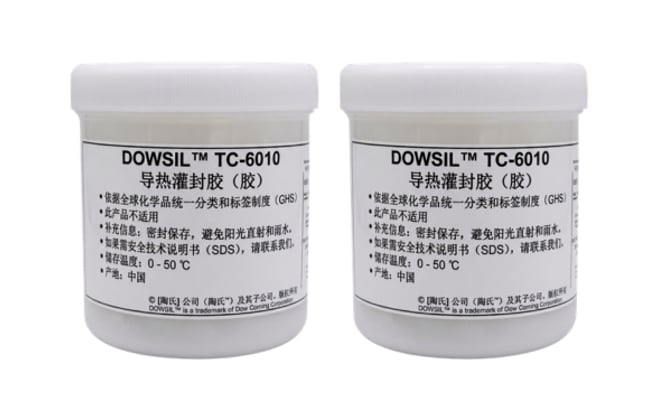
1.2 W/m·K Thermal Conductivity • Flowable & Self-Leveling • UL 94 V-0 • 22 kV/mm Dielectric Strength
Features & Benefits
- 1.2 W/m·K thermal conductivity — helps dissipate heat from sensitive components.
- Two-part silicone encapsulant — cures into elastic, thermally conductive rubber.
- Flowable and self-leveling — able to fill after dispensing.
- Versatile heat cure — 60 minutes at 60 °C or 30 minutes at 100 °C.
- Excellent dielectric strength — 22 kV/mm for electrical insulation.
- UL 94 V-0 flammability classification — suitable for flame-rated electronics assemblies.
- Automated or manual dispensing — supports flexible processing.
- Elastic silicone protection — helps protect electronics over a broad temperature range.
Typical Applications
- On-board chargers.
- Inverter and converter modules.
- Transformers.
- Power electronics assemblies.
- Electronic and electric components.
- PCB system assembly protection.
- Thermally conductive encapsulation.
Thermal and Electrical Protection for Power Modules
Power electronics such as on-board chargers, inverters, converters, and transformers require materials that can protect sensitive components while helping remove heat generated during operation. DOWSIL™ TC-6010 helps address these needs with a flowable silicone encapsulant that fills around components, cures to an elastic thermally conductive rubber, and provides durable dielectric insulation.
Engineering Data for DOWSIL™ TC-6010
| Property | DOWSIL™ TC-6010 | Condition / Note |
|---|---|---|
| Type | Two-part encapsulant | Thermally conductive silicone elastomer |
| Mix Ratio | 1:1 | By weight |
| Color | Part A: White Part B: Blue |
Typical appearance |
| Viscosity | Part A: 2400 mPa·s Part B: 2400 mPa·s Mixed: 2700 mPa·s |
Flowable material |
| Heat Cure Time | 60 min at 60 °C 30 min at 100 °C |
Cure should be validated in customer application |
| Specific Gravity, Cured | 1.67 | At 25 °C |
| Pot Life / Working Time | 2.5 hours | At 25 °C |
| Hardness | Shore A 37 | Elastic cured rubber |
| Thermal Conductivity | 1.2 W/m·K | At 25 °C |
| Tensile Strength | 0.93 MPa | Typical value |
| Elongation | 50% | Elastic silicone behavior |
| Dielectric Strength | 22 kV/mm | Electrical insulation |
| Volume Resistivity | 3.20E+12 ohm·cm | Typical value |
| CTE | 174 ppm/K | -40 °C to 150 °C |
| UL Flammability Classification | UL 94 V-0 | Flame-rated assemblies |
| Useful Temperature Range | -45 °C to 150 °C | Long-term operation guidance |
*Typical properties are not intended for specification writing. Cure condition and performance should be tested and optimized under actual customer application and curing environment.
Where DOWSIL™ TC-6010 Fits
- OBC modules
- Power conversion circuits
- Component protection
- Inverters
- Converters
- Power electronics
- Transformers
- Electronic components
- Electric assemblies
Mixing, Dispensing & Heat Cure
Mixing
Mix Part A and Part B at a 1:1 ratio by weight. Re-mix containers before use if filler settlement is observed after storage.
Dispensing
Suitable for automated or manual mixing and dispensing. Automated airless dispensing can reduce or avoid the need to de-air.
Curing
Typical heat cure options include 60 minutes at 60 °C or 30 minutes at 100 °C. Cure profile should be validated in the actual assembly.
How TC-6010 Supports Power Electronics Protection
| Design Challenge | DOWSIL™ TC-6010 Benefit |
|---|---|
| Power electronics generate heat while requiring electrical protection. | Thermally conductive encapsulation helps remove heat while providing dielectric insulation. |
| Complex modules require material flow around components. | Flowable, self-leveling behavior helps fill after dispensing. |
| Electronic components need mechanical and environmental protection. | Elastic silicone rubber protects sensitive assemblies after cure. |
| Flame-rated assemblies require suitable material classification. | UL 94 V-0 flammability classification supports flame-rated electronics design. |
Ready to Evaluate DOWSIL™ TC-6010?
```