
-
Home

-
Products
-
Adhesives
-
Silicone Adhesives
- DOWSIL™ 3-1598 HP Adhesive
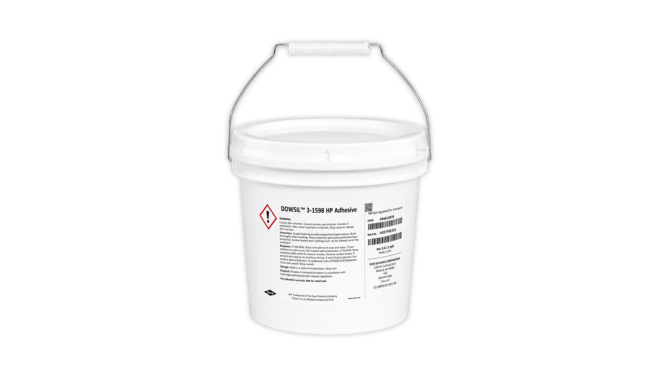
DOWSIL™ 3-1598 HP Adhesive
- High strength
- Low void
- Self-leveling rheology
Product Description
DOWSIL™ 3-1598 HP Adhesive is a high-performance, one-part, black silicone adhesive specifically engineered for precision sealing and structural bonding in demanding electronics and automotive environments. Formulated as a flowable, addition-curing system, it utilizes heat to provide a rapid and versatile cure that is easily controlled by temperature. Whether you are sealing sensitive substrates or deep-section housings, DOWSIL™ 3-1598 HP provides a high-tensile, impact-resistant bond with advanced low-void technology, ensuring maximum reliability and service life.
Product Key Features
- High Strength: demonstrates high tensile strength of 780 psi (5.4 MPa) for robust structural bonding.
- Low Void Technology: engineered to achieve superior sealing with very low void formation after cure, even on sensitive substrates.
- Versatile Heat Cure: cure rates are rapidly accelerated by heat, allowing for processing as fast as 15 minutes at 150°C.
- Self-Leveling Rheology: flowable composition allows the adhesive to fill complex geometries or self-level after dispensing.
- Environmentally Stable: retains physical and electrical properties over a broad operating range of -45°C to 200°C.
- Simplified Processing: as a one-part adhesive, it requires no mixing and is suitable for automated needle dispensing.
- Solvent-Free: formulated with no added solvents, supporting cleaner manufacturing processes.
Key Applications
- Sealing and gasketing for lids, housings, and connectors in automotive and industrial electronics.
- Attaching baseplates and securing components within engine control units, ABS, and transmission modules.
- High-reliability bonding for PCB system assemblies and sensitive electronic substrates.
- Automotive lighting applications require durable environmental sealing.
Technical Specifications
| General Properties | |||||
|
Appearance
Appearance
Appearance at room temperature. |
Black | ||||
| Density (g) | 10.6-12.8 g/cm3 | ||||
| Solids | 100 % | ||||
|
Specific Gravity
Specific Gravity
Specific gravity (SG) is the ratio of the density of a substance to the density of a reference substance; equivalently, it is the ratio of the mass of a substance to the mass of a reference substance for the same given volume. For liquids, the reference substance is almost always water (1), while for gases, it is air (1.18) at room temperature. Specific gravity is unitless. |
1.31 | ||||
| Physical Properties | |||||
|
Viscosity
Viscosity
Viscosity is a measurement of a fluid’s resistance to flow. Viscosity is commonly measured in centiPoise (cP). One cP is defined as the viscosity of water and all other viscosities are derived from this base. MPa is another common unit with a 1:1 conversion to cP. A product like honey would have a much higher viscosity -around 10,000 cPs- compared to water. As a result, honey would flow much slower out of a tipped glass than water would. The viscosity of a material can be decreased with an increase in temperature in order to better suit an application |
82000 mPa.s | ||||
| Thermal Properties | |||||
|
Glass Transition Temperature (Tg)
Glass Transition Temperature (Tg)
The glass transition temperature for organic adhesives is a temperature region where the polymers change from glassy and brittle to soft and rubbery. Increasing the temperature further continues the softening process as the viscosity drops too. Temperatures between the glass transition temperature and below the decomposition point of the adhesive are the best region for bonding. The glass-transition temperature Tg of a material characterizes the range of temperatures over which this glass transition occurs. |
-45 °C | ||||
|
|||||
| Mechanical Properties | |||||
|
|||||
|
|||||
|
Elongation
Elongation
Elongation is the process of lengthening something. It is a percentage that measures the initial, unstressed, length compared to the length of the material right before it breaks. It is commonly referred to as Ultimate Elongation or Tensile Elongation at break. |
260 % | ||||
|
|||||
|
|||||
| Electrical Properties | |||||
|
|||||
|
Dielectric Strength
Dielectric Strength
Dielectric strength is measured in kV per mm and is calculated by the Breakdown voltage divided by the thickness of the tested material. Those two properties go hand in hand and while Breakdown voltage is always thickness dependent, dielectric strength is a general material property. As an example, the dielectric strength of Polyimide is 236 kV/mm. If we place 1mm of Polyimide between two electrodes, it will act as an insulator until the voltage between the electrodes reaches 236 kV. At this point it will start acting as a good conductor, causing sparks, potential punctures and current flow. |
20 kV/mm | ||||
|
Volume Resistivity
Volume Resistivity
Volume resistivity, also called volume resistance, bulk resistance or bulk resistivity is a thickness dependent measurement of the resistivity of a material perpendicular to the plane of the surface. |
5.4 E+14 Ohms⋅cm | ||||
|
|||||
| Curing Conditions | |||||
|
|||||
Additional Information
DOWSIL™ 3-1598 HP Adhesive: High-Performance Flowable Heat-Cure Silicone
DOWSIL™ 3-1598 HP Adhesive is a one-part, black, flowable silicone adhesive designed for high-strength structural bonding and sealing in demanding electronic applications. Formulated with low-void technology, it provides superior sealing for sensitive substrates and maintains its physical and electrical properties over a broad operating range of -45°C to 200°C.
Rapid, Versatile Heat Cure — This addition-cure adhesive is specifically designed to cure rapidly with heat, achieving a full cure in as little as 15 minutes at 150°C, allowing for high-speed production and reduced processing costs.
As a flowable material, it can fill complex geometries or self-level after dispensing. The addition-cure chemistry generates no by-products, making it ideal for deep-section or confined cures where traditional silicones might fail.
Engineered for Structural Reliability — Featuring a high tensile strength of 780 psi, this adhesive is ideal for sealing lids and housings and for attaching baseplates in automotive systems such as ABS and engine control units.
Its unprimed adhesion to reactive metals, ceramics, and glass ensures long-term stability and enhanced service life for PCB system assemblies.
High Tensile Strength • Low Void Formation • Flowable & Self-Leveling • No Cure By-Products
Preparation, Dispensing & Curing
Surface Prep
Thoroughly clean and degrease surfaces with solvents like MEK or naphtha. Light abrasion is recommended to increase surface area for bonding.
Mixing & De-airing
Thoroughly mix prior to use as filler may settle. For void-free results, vacuum-deair at >28 inches Hg for 10 minutes.
Heat Curing
Apply heat to initiate cure: 180 min at 100°C, 30 min at 125°C, or 15 min at 150°C. Avoid materials that inhibit cure like sulfur or organotin.
Process Note: For thicker sections or to further reduce voiding, consider a 30-minute pre-cure at 70°C (158°F) before moving to higher temperatures.
Tips & Troubleshooting
| Issue | Recommended Action |
|---|---|
| Cure Inhibition (Sticky Surface) |
|
| Poor Adhesion |
|
| Voids in Thick Sections |
|
Standard Packaging & Storage
Supplied in multiple packaging sizes. To extend shelf life, keep containers tightly closed and store in cold storage at all times as indicated on the product label.
Ready to Implement DOWSIL™ 3-1598 HP?
Tell us about your performance, design, and manufacturing challenges. We can help you determine the optimal cure schedule for your process or assist with substrate compatibility testing to ensure a durable, high-strength bond.