
-
Home

-
Products
-
Coatings, powders & Resins
-
Conformal Coatings
- DOWSIL™ 3-1944 RTV Coating
DOWSIL™ 3-1944 RTV Coating
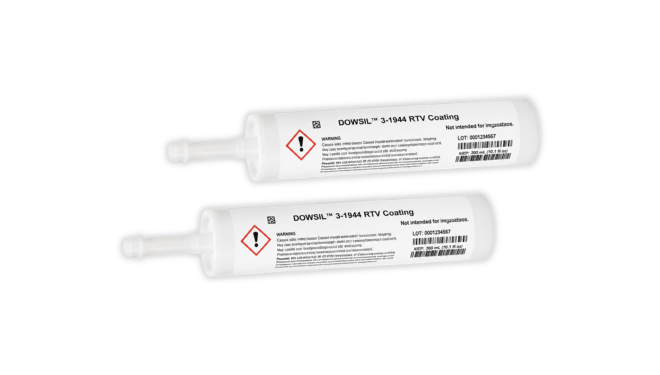
- One-part silicone coating, room-temperature curing
- Low viscosity for complete wetting of complex geometries
- Durable, flexible protective layer
Product Description
DOWSIL™ 3-1944 RTV Coating is a one-part, no-added-solvent silicone conformal coating designed for protection of printed circuit boards and electronic assemblies. It is formulated to provide high-viscosity, controlled flow application for targeted coating, spot protection, and thin-section encapsulation. The material cures at room temperature through exposure to atmospheric moisture and can be heat-accelerated to support manufacturing efficiency. Once cured, it forms a soft, flexible elastomer that provides electrical insulation, environmental protection, and stress relief for sensitive electronic components and interconnects.
Key features
- No-added-solvent silicone system - 100% silicone formulation eliminates solvent handling and evaporation concerns.
- High viscosity (~64,000 cP) - Enables controlled application and prevents excessive flow on vertical or localized areas.
- Moisture-cure RTV chemistry - Cures at room temperature with optional heat acceleration.
- Soft elastomer after cure - Provides low-stress protection for sensitive components and solder joints.
- Spot and localized application control - Suitable for selective coating and targeted protection areas.
- Electrical insulation performance - Provides reliable dielectric protection for PCB assemblies.
- UV indicator - Enables inspection and verification of coating coverage under UV light.
Applications
DOWSIL™ 3-1944 RTV Coating is used for conformal coating of printed circuit boards and electronic assemblies where localized protection, controlled application, and higher coating build-up are required.
- Pin/solder joint coverage: suitable for localized protection of exposed conductive areas such as pins, solder joints, and lead terminations where environmental sealing and electrical insulation are required.
- Thin-section encapsulation: suitable for encapsulating small electronic features and components where flexible, low-stress silicone protection is required in confined or delicate areas.
- Spot protection of pins or other devices: suitable for targeted application on connectors, pins, and sensitive components requiring localized environmental protection and moisture resistance.
Related resources
Technical Specifications
| Physical Properties | |||||
|
Viscosity
Viscosity
Viscosity is a measurement of a fluid’s resistance to flow. Viscosity is commonly measured in centiPoise (cP). One cP is defined as the viscosity of water and all other viscosities are derived from this base. MPa is another common unit with a 1:1 conversion to cP. A product like honey would have a much higher viscosity -around 10,000 cPs- compared to water. As a result, honey would flow much slower out of a tipped glass than water would. The viscosity of a material can be decreased with an increase in temperature in order to better suit an application |
63775 mPa.s | ||||
| Young's modulus | 1.54 MPa | ||||
| General Properties | |||||
|
Specific Gravity
Specific Gravity
Specific gravity (SG) is the ratio of the density of a substance to the density of a reference substance; equivalently, it is the ratio of the mass of a substance to the mass of a reference substance for the same given volume. For liquids, the reference substance is almost always water (1), while for gases, it is air (1.18) at room temperature. Specific gravity is unitless. |
1.03 | ||||
| Mechanical Properties | |||||
|
|||||
|
|||||
|
Elongation
Elongation
Elongation is the process of lengthening something. It is a percentage that measures the initial, unstressed, length compared to the length of the material right before it breaks. It is commonly referred to as Ultimate Elongation or Tensile Elongation at break. |
145 % | ||||
| Electrical Properties | |||||
|
Dielectric Strength
Dielectric Strength
Dielectric strength is measured in kV per mm and is calculated by the Breakdown voltage divided by the thickness of the tested material. Those two properties go hand in hand and while Breakdown voltage is always thickness dependent, dielectric strength is a general material property. As an example, the dielectric strength of Polyimide is 236 kV/mm. If we place 1mm of Polyimide between two electrodes, it will act as an insulator until the voltage between the electrodes reaches 236 kV. At this point it will start acting as a good conductor, causing sparks, potential punctures and current flow. |
21 kV/mm | ||||
|
Volume Resistivity
Volume Resistivity
Volume resistivity, also called volume resistance, bulk resistance or bulk resistivity is a thickness dependent measurement of the resistivity of a material perpendicular to the plane of the surface. |
1.6x10¹⁵ Ohms⋅cm | ||||
| Thermal Properties | |||||
|
UL 94 Rating
UL 94 Rating
Flammability rating classification. It determines how fast a material burns or extinguishes once it is ignited. HB: slow burning on a horizontal specimen; burning rate less than 76 mm/min for thickness less than 3 mm or burning stops before 100 mm V-2: burning stops within 30 seconds on a vertical specimen; drips of flaming particles are allowed. V-1: burning stops within 30 seconds on a vertical specimen; drips of particles allowed as long as they are not inflamed. V-0: burning stops within 10 seconds on a vertical specimen; drips of particles allowed as long as they are not inflamed. 5VB: burning stops within 60 seconds on a vertical specimen; no drips allowed; plaque specimens may develop a hole. 5VA: burning stops within 60 seconds on a vertical specimen; no drips allowed; plaque specimens may not develop a hole |
V-0 | ||||
Additional Information
DOWSIL™ 3-1944 RTV Coating
DOWSIL™ 3-1944 RTV Coating is a one-part, solvent-free silicone conformal coating designed to protect printed circuit boards and electronic assemblies from moisture, corrosion, thermal cycling, and environmental contaminants. The coating features a high viscosity of approximately 64,000 cP, cures at room temperature through exposure to atmospheric moisture, and can be heat-accelerated to support manufacturing efficiency.
Review the technical data sheet and SDS before handling, processing, or qualifying the material.
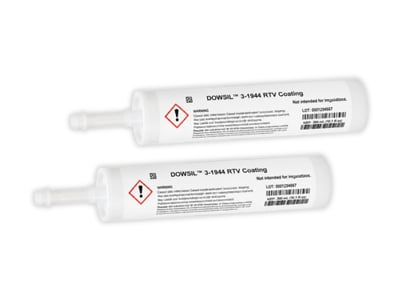
Silicone Conformal Coating for Electronic Protection
DOWSIL™ 3-1944 RTV Coating cures upon exposure to atmospheric moisture, eliminating the need for solvent evaporation during processing. Its room-temperature cure can be accelerated with mild heat to support faster production cycles. The coating's high-viscosity, self-leveling formulation is suitable for a range of application methods and provides consistent coverage of electronic assemblies.
As a cured elastomer, DOWSIL™ 3-1944 RTV Coating delivers excellent flexibility and low modulus properties, helping to minimize mechanical stress on sensitive components, solder joints, and interconnections during thermal cycling and environmental exposure.
Key features
- Moisture-cure RTV system - Cures at room temperature upon exposure to atmospheric moisture with optional heat acceleration.
- Solvent-free formulation - 100% solids silicone system with no solvents or by-products.
- High viscosity coating - ~64,000 cP viscosity enables controlled application and good coverage of PCB surfaces.
- Flexible elastomer after cure - Shore A 36 material reduces mechanical stress on sensitive components and solder joints.
- UV indicator - Facilitates inspection and verification of coating coverage under UV light.
- Reliable environmental protection - Provides resistance to moisture, corrosion, and contaminants in harsh environments.
Processing summary
Product Documents and Dow Coating Resources
Review the technical data sheet for typical product properties, the safety data sheet for handling and storage requirements, and the Dow conformal coatings selection guide for broader context on the coating family.
Use the selection guide to compare DOWSIL™ conformal coating options by viscosity, cure profile, hardness, and agency listing context.
The Dow conformal coatings selection guide explains how silicone coatings are positioned by viscosity, cure profile, hardness, stress relief, abrasion resistance, UV inspection, and agency listing context. It also includes a solventless coating section for applications where reducing solvent-handling complexity is a key selection driver, along with comparison tables for solventless RTV, solventless heat-cure, and solvent-based RTV conformal coatings.
Performance Properties
Cure basis and test conditions are per technical data sheet unless otherwise stated.
| Property | Typical value | Unit |
|---|---|---|
| Extrusion Rate | 1816 | g/min |
| Viscosity | 63775 63775 63.8 |
cP mPa-sec Pa-sec |
| Specific Gravity | 1.03 | |
| Tack-free Time at 25°C | 14 | minutes |
| Durometer Shore A | 36 | |
| Tack-free Time at 60°C/15% RH | 0.5 | minutes |
| Tensile Strength | 325 2.2 22 |
psi MPa kg/cm2 |
| Elongation | 145 | % |
| Youngs Modulus | 223 1.54 15.4 |
psi MPa kg/cm2 |
| Unprimed Adhesion - 180 Degree | 5 | ppi |
| Peel Strength | 3 | N/cm |
| Dielectric Strength | 525 21 |
volts/mil kV/mm |
| Volume Resistivity | 1.6 E15 | ohm*cm |
| Shelf Life at 25°C | 12 | months |
| UL Flammability Classification | 94 V-0 | - |
| Mil Specification | Mil I-46058C Amend 7 | - |
| Agency Listing | IPC-CC-830B, UL 746E |
Where DOWSIL™ 3-1944 fits
Tips and troubleshooting
| Issue | Recommended action |
|---|---|
| Air entrapment or voids |
|
| Adhesion below target |
|
| Curing |
|
| Moisture exposure during storage |
|
| Repair or rework requirement |
|
Frequently asked questions about DOWSIL™ 3-1944 RTV Coating
What is DOWSIL™ 3-1944 RTV Conformal Coating used for?
It is used as a protective conformal coating for rigid and flexible circuit boards and PCB system applications, particularly where flexibility, abrasion resistance, dielectric protection, and room temperature cure are part of the application review.
How does this coating cure?
DOWSIL™ 3-1944 RTV Coating can be applied through brush, flow coat, or needle/dispense. It cures by atmospheric moisture at room temperature. Mild heat can be used to accelerate processing after sufficient solvent flash-off.
Which application methods are supported?
DOWSIL™ 3-1944 RTV Coating can be applied through brush, flow coat, or needle/dispense. Process fit should be confirmed against the target wet-film thickness, board layout, masking approach, and keep-out areas.
What does the UV indicator confirm?
The UV indicator supports inspection of coating presence. It should not be treated as proof of final dry-film thickness, full cure, adhesion, absence of defects, or long-term electrical reliability.