
-
Home

-
Products
-
Adhesives
-
Silicone Adhesives
- DOWSIL™ 844 RTV Adhesive Sealant
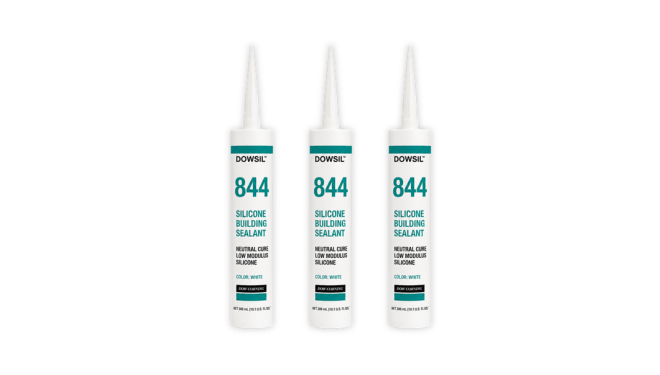
DOWSIL™ 844 RTV Adhesive Sealant

- One-part moisture cure
- Fast processing
- Broad adhesion
Product Description
DOWSIL™ 844 RTV Adhesive Sealant is a one-part, non-flowing moisture cure adhesive featuring a neutral alkoxy cure system. Designed for faster in-line processing, it offers a fast room temperature cure and high green strength. Its non-flowing nature and durable adhesion to a wide range of substrates make it ideal for various industrial bonding and sealing applications.
Product Key Features
- One-Part Moisture Cure - cures at room temperature in an environment of 30 to 80 percent relative humidity, eliminating the need for curing ovens.
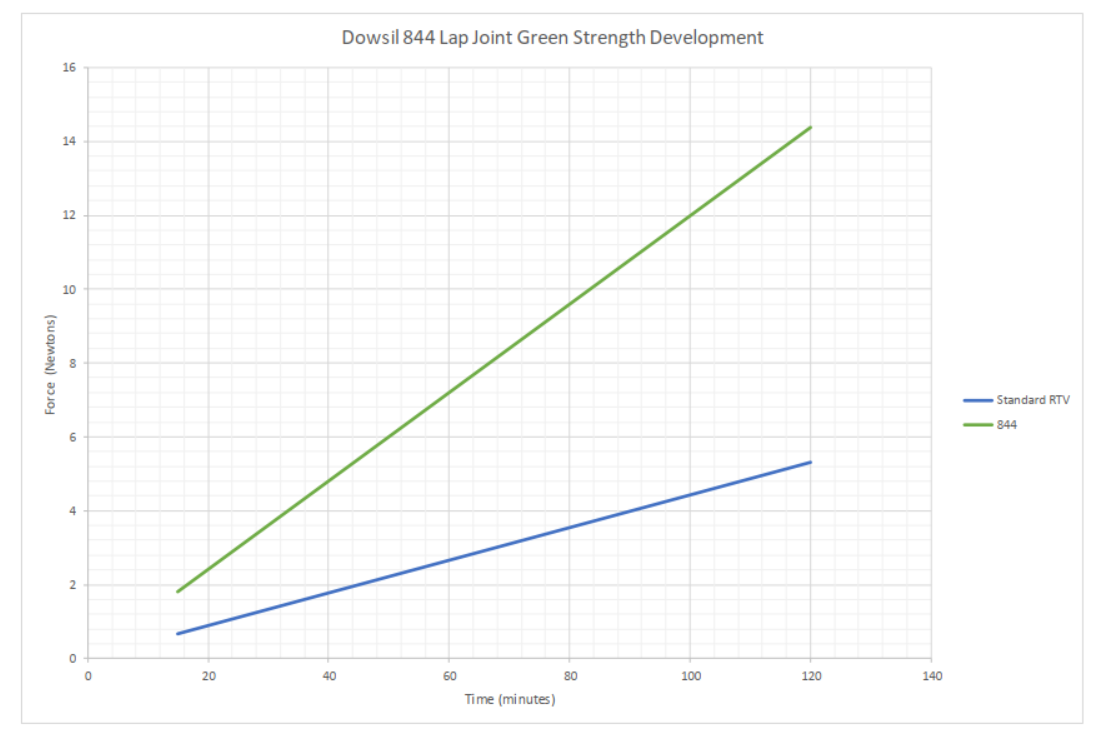
- Fast Processing & Green Strength - provides high green strength and a quick tack-free time of 25 minutes (at 25°C/40% RH) for faster manufacturing throughput.
- Non-Flowing Rheology - maintains its position upon dispensing, supporting both automated and manual dispensing systems.
- Robust Mechanical Profile - cures to deliver a Shore A hardness of 37, a tensile strength of 2.2 MPa (320 psi), and a high elongation of 400% for added stress relief.
- Broad Adhesion - delivers durable, unprimed adhesion to many reactive metals, ceramics, glass, and selected laminates, resins, and plastics.
Applications
This adhesive fits applications requiring fast room temperature curing, high elongation to relieve stress, and reliable adhesion across diverse substrates.
- Module Assembly: Ideal for the bonding and sealing of modules and multi-component assemblies.
- Gasketing: Highly effective as a formed-in-place gasketing material].
- Automated Production: Suitable for automated or manual dispensing systems where faster in-line processing is required.
Technical Specifications
| General Properties | |||||
|
Specific Gravity
Specific Gravity
Specific gravity (SG) is the ratio of the density of a substance to the density of a reference substance; equivalently, it is the ratio of the mass of a substance to the mass of a reference substance for the same given volume. For liquids, the reference substance is almost always water (1), while for gases, it is air (1.18) at room temperature. Specific gravity is unitless. |
1.35 | ||||
| Physical Properties | |||||
|
Viscosity
Viscosity
Viscosity is a measurement of a fluid’s resistance to flow. Viscosity is commonly measured in centiPoise (cP). One cP is defined as the viscosity of water and all other viscosities are derived from this base. MPa is another common unit with a 1:1 conversion to cP. A product like honey would have a much higher viscosity -around 10,000 cPs- compared to water. As a result, honey would flow much slower out of a tipped glass than water would. The viscosity of a material can be decreased with an increase in temperature in order to better suit an application |
paste mPa.s | ||||
| Mechanical Properties | |||||
|
|||||
|
|||||
|
Elongation
Elongation
Elongation is the process of lengthening something. It is a percentage that measures the initial, unstressed, length compared to the length of the material right before it breaks. It is commonly referred to as Ultimate Elongation or Tensile Elongation at break. |
400 % | ||||
|
|||||
Additional Information
DOWSIL™ 844 RTV Adhesive Sealant
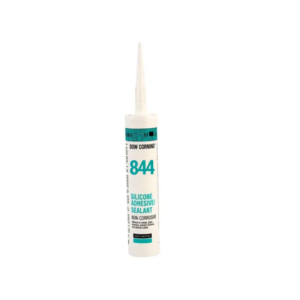
DOWSIL™ 844 RTV Adhesive Sealant is a premium, one-part, non-flowing moisture-cure silicone adhesive engineered for high-performance industrial sealing and structural assembly. This room-temperature vulcanizing (RTV) system requires no pre-mixing or specialized heat ovens, utilizing atmospheric moisture to develop high early green strength. Formulated to provide exceptional elongation for added stress relief, it delivers durable primerless adhesion across a broad variety of substrates, optimizing cycle times for rapid in-line production processes.
Typical values only. Performance parameters are measured at standard ambient room temperature conditions.
Key Features
- One-part RTV chemistry eliminates multi-component volumetric mixing machinery and capital costs.
- High green strength construction allows immediate part handling and faster in-line processing.
- Thixotropic non-flowing paste profile resists running or slumping on vertical or overhead component seams.
- Neutral alkoxy moisture-cure formulation cross-links cleanly without generating corrosive by-products.
- High elongation value (400%) provides optimal stress relief across varying joint assemblies.
- Stable chemistry maintains original mechanics over an extensive operational footprint from -45°C to 200°C.
Processing Summary
Process Notes
- Maintains a stable 12-month usable shelf life from the date of production.
- Store material at or below 25°C (77°F) inside original unopened container lines.
- Take special precautions to minimize head air space and isolate material from atmospheric moisture contact.
- Purge partially depleted bulk containers with an inert gas cover such as dry nitrogen.
- Joint surfaces must be thoroughly clean, dry, and cleared of manufacturing fluids, greases, or dirt.
- Degrease using DOWSIL™ OS Fluids, naphtha, mineral spirits, or methyl ethyl ketone (MEK).
- Avoid pure acetone or isopropyl alcohol (IPA) alone, as they do not remove heavy oils effectively.
- Apply fine mechanical surface abrasion whenever possible to expand active bonding area.
- Execute tooling actions and part mating swiftly before the surface layer skin initializes.
- Do not apply in highly confined manufacturing spaces completely restricted from atmospheric moisture.
- Run lab-scale lap shear evaluations to establish minimum line cure tracking prior to full production.
- Clean up any uncured paste overspray or line squeeze-out using standard ketone-type solvent systems.
Engineering Data for DOWSIL™ 844
Physical & Mechanical Performance Properties
| Mechanical Property | Typical Engineering Value | Condition / Standard |
|---|---|---|
| Appearance | Non-slump, non-flowing paste | - |
| Extrusion Rate | 120 g/minute | - |
| Flow - Slump | ≤ 0.2 inches (0.6 cm) | - |
| Specific Gravity | 1.35 | - |
| Durometer Hardness | 37 Shore A | - |
| Tensile Strength | 320 psi (2.2 MPa) | - |
| Elongation at Break | 400 % | - |
| Tensile Modulus | 100 psi (0.69 MPa) | - |
| Tear Strength | 35 ppi | Die B tear resistance |
| Unprimed Adhesion (Lap Shear) | 180 psi min (1.25 MPa) | Aluminum |
Cure Schedule
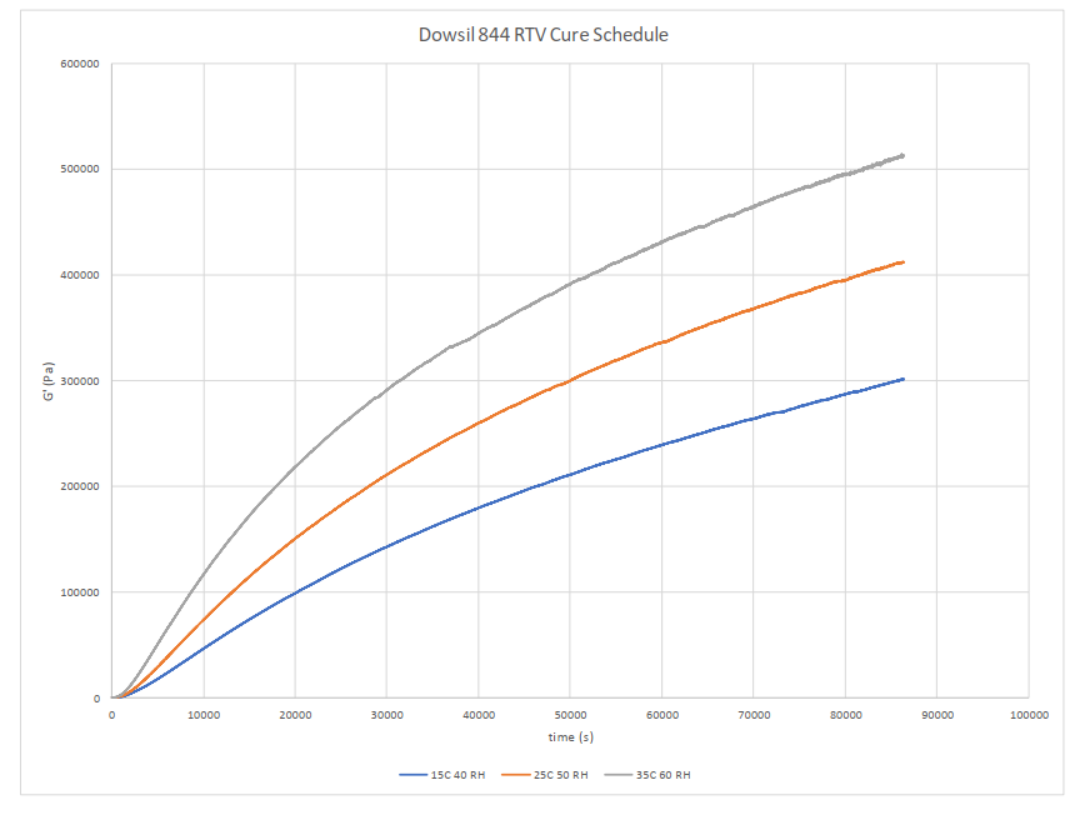
Green Strength Development
Where DOWSIL™ 844 Fits

- Structural bonding and sealing of modules.
- Attachment of multi-component industrial assemblies.
- High elongation provides stress relief under vibration.

- Conforms cleanly to complex or irregular mating surfaces.
- Thixotropic slump limits stay within ≤0.2 inches.
- Eliminate traditional pre-molded gasket tooling steps.

High-Speed In-line Processing
- Enables faster manufacturing throughput rates.
- Reduces handling wait windows down to 10–90 minutes.
- Eliminates continuous high-energy oven bake operations.
See One-Part Moisture-Curing RTV Silicone Dispensing Methods
Observe the high-precision processing of one-part non-flowing industrial RTV silicone adhesive sealants via automated needle dispensing setups. This practical reference highlights best practices for balancing track extrusion parameters, checking non-slump bead profiles, and verifying surface handling stability before complete room temperature cross-linking completes.
Standard Packaging & Technical Help
- Typically packaged in convenient 330 ml cartridges for manual application guns.
- Bulk delivery configurations are available in heavy-duty pails ranging from 18 to 25 kg.
- Supplied in nominal 3.6-kg, 18-kg, and 200-kg container net weights depending on product choice.
- Special bladder pack or tube sizes can be evaluated for distinct project needs.
- Assisting assembly lines with process tuning to eliminate curing ovens and associated energy costs.
- Evaluating substrate profiles to check unprimed cohesion limits over metals and engineering plastics.
- Configuring needle automated fluid tracks to maximize specified 120 g/min extrusion rates.
- Advising on texturing or secondary primer options when joining low surface energy matrices.
Tips and Troubleshooting
| Issue | Recommended Action |
|---|---|
| Premature layer skinning or surface tearing during finishing tooling steps |
|
| Incomplete structural cross-linking down through joint core zones |
|
| Adhesion tracking breakdown or low lap shear force values over difficult substrates |
|