
-
Home

-
Products
-
Adhesives
-
Silicone Adhesives
- DOWSIL™ EA-4700 CV Adhesive
DOWSIL™ EA-4700 CV Adhesive
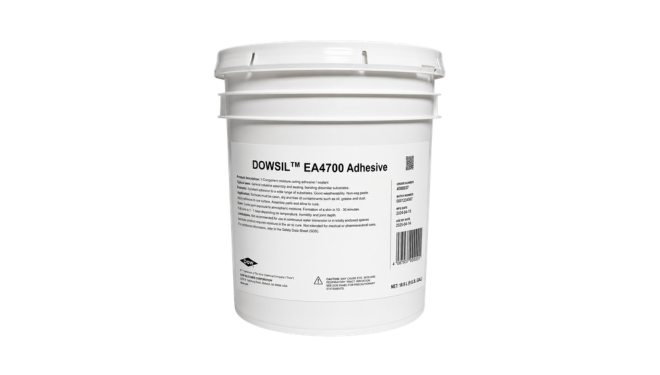
- Two-part system
- Fast curing options
- Controlled volatility
Product Description
DOWSIL™ EA-4700 CV Adhesive is a two-part, fast room temperature cure adhesive designed for critical adhesive and sealing performance. It features controlled silicone volatility and maintains high temperature stability after curing. With a dispensable formulation for easy application using standard equipment, it provides good sealing against environmental conditions.
Product Key Features
- Two-Part System - features a 1:1 mix ratio by weight or volume, making it easy to dispense and mix.
- Fast Curing Options - offers a fast cure at room temperature, reaching hardness completion in 2 hours at 25°C, or can be heat-accelerated for faster processing.
- Controlled Volatility - maintains a low volatile siloxane content (D4-D10) of 130 ppm.
- Robust Mechanical Profile - cures to deliver a JIS Type A hardness of 19, a tensile strength of 3.7 MPa, and an impressive elongation of 630%.
- Environmental Stability - delivers stable performance under typical operational environments, including exposure to 150°C, thermal shock, and 85°C/85% relative humidity.
Applications
This adhesive fits a variety of automotive applications requiring durable adhesion to typical substrates used in automotive electronics, such as aluminum, PBT, and PPS.
- Automotive Electronics: Ideal for electronics control units, sensor modules, and battery pack applications.
- Component Assembly: Used effectively for lid sealing, base plate attaching, and connector sealing where reliable adhesion is necessary.
- Gasketing: Provides reliable gasketing with durable sealing against the environment.
Technical Specifications
| General Properties | |||||
|
Color
Color
The color |
White/ Black | ||||
|
Density
Density
Volumetric mass per unit |
1.16 kg/m3 | ||||
| Physical Properties | |||||
|
Thixotropic index
Thixotropic index
Thixotropic Index is a ratio of a material s viscosity at two different speeds in Ambient temperature, generally different by a factor of ten. A thixotropic material s viscosity will decrease as agitation or pressure is increased. It indicates the capability of a material to hold its shape. Mayonnaise is a great example of this. It holds its shape very well, but when a shear stress is applied, the material easily spreads. It helps in choosing a material in accordance to the application, dispense method and viscosity of a material. |
3.8 | ||||
|
Viscosity
Viscosity
Viscosity is a measurement of a fluid’s resistance to flow. Viscosity is commonly measured in centiPoise (cP). One cP is defined as the viscosity of water and all other viscosities are derived from this base. MPa is another common unit with a 1:1 conversion to cP. A product like honey would have a much higher viscosity -around 10,000 cPs- compared to water. As a result, honey would flow much slower out of a tipped glass than water would. The viscosity of a material can be decreased with an increase in temperature in order to better suit an application |
27,000 mPa.s | ||||
| Mechanical Properties | |||||
|
|||||
|
Elongation
Elongation
Elongation is the process of lengthening something. It is a percentage that measures the initial, unstressed, length compared to the length of the material right before it breaks. It is commonly referred to as Ultimate Elongation or Tensile Elongation at break. |
630 % | ||||
|
|||||
|
|||||
|
|||||
| Electrical Properties | |||||
|
Dielectric Strength
Dielectric Strength
Dielectric strength is measured in kV per mm and is calculated by the Breakdown voltage divided by the thickness of the tested material. Those two properties go hand in hand and while Breakdown voltage is always thickness dependent, dielectric strength is a general material property. As an example, the dielectric strength of Polyimide is 236 kV/mm. If we place 1mm of Polyimide between two electrodes, it will act as an insulator until the voltage between the electrodes reaches 236 kV. At this point it will start acting as a good conductor, causing sparks, potential punctures and current flow. |
25 kV/mm | ||||
|
Volume Resistivity
Volume Resistivity
Volume resistivity, also called volume resistance, bulk resistance or bulk resistivity is a thickness dependent measurement of the resistivity of a material perpendicular to the plane of the surface. |
1.5E+15 Ohms⋅cm | ||||
|
|||||
|
|||||
Additional Information
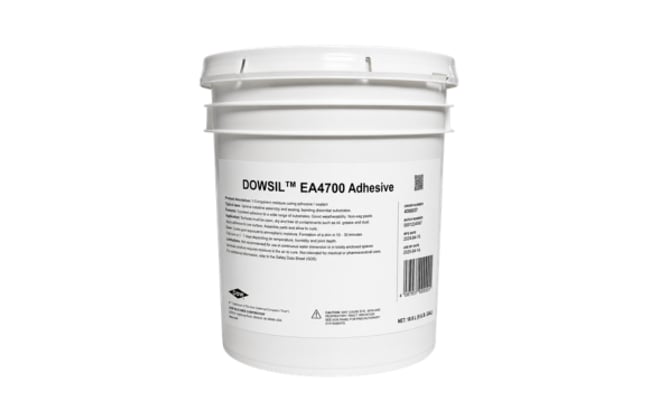
DOWSIL™ EA-4700 CV Adhesive
DOWSIL™ EA-4700 CV Adhesive is a high-performance, two-part silicone structural adhesive engineered to deliver exceptionally fast room temperature curing or rapid heat-accelerated bonding. Formulated with an advanced addition-cure mechanism, it cross-links uniformly through deep sections or complete component confinement without releasing volatile by-products. This adhesive features controlled silicone volatility with reduced volatile siloxane content (D4-D10) and is highly specialized to provide a durable, fluid-tight environmental seal. Its robust, tough matrix offers excellent stress relief and reliable performance for sensitive automotive electronics exposed to extreme high-temperature stability up to 150°C, severe thermal shock, and high humidity aging environments.
Typical engineering values only. Adhesion builds reliably after hardness completion; cure parameters can be accelerated through targeted heating lines.
Key Features
- Two-part thixotropic paste offers a symmetrical 1:1 mix ratio by volume or weight for easy processing.
- Addition-cure chemistry yields zero volatile cross-linking by-products, preventing shrinkage stress.
- Enables rapid deep-section solidification and uniform curing through totally confined substrate pockets.
- Controlled silicone volatility limits volatile siloxane outgassing (D4-D10) to 130 ppm to shield electronics.
- Maintains high environmental sealing stability continuously at 150°C, thermal shock, and 85°C / 85% RH.
- Establishes excellent unprimed primerless adhesion to typical plastics and metals used in automotive assemblies.
Processing Summary
Process Notes
- Realizes a 12-month shelf life from production date when held in cold storage below 30°C.
- Keep containers tightly closed in original packaging to completely block moisture and contamination.
- Formulated to prevent heavy settling, but stir thoroughly if stored for several months.
- Always verify expiration dates and specific storage instructions listed on the batch labels.
- Clean substrate surfaces using Dow OS fluids, naphtha, mineral spirits, or methyl ethyl ketone (MEK).
- Do not rely on acetone or isopropyl alcohol (IPA) alone, as they fail to adequately clear manufacturing oils.
- Introduce fine mechanical abrasion to maximize active bonding contact surface area.
- Use plasma exposure or chemical etching to establish a reactive face on Teflon, PE, or PP lines.
- Avoid contact with organotin catalysts, tin-catalyzed silicone rubbers, and sulfur-containing materials.
- Prevent exposure to polysulfides, polysulfones, unsaturated hydrocarbon plasticizers, or solder flux residues.
- Tacky or liquid product remaining at the joint boundary layer indicates active chemical cure inhibition.
- Run lab-scale compatibility evaluations to confirm component material compliance before line setups.
- Utilize an engineered static mixer nozzle for manual cart or automated meter/mix dispense setups.
- Automated airless dispense equipment is ideal to minimize or bypass separate vacuum de-airing cycles.
- If de-airing is needed to eliminate joint voids, apply a vacuum profile of >203 mm Hg for 10 minutes.
- Mate substrate assemblies quickly after extrusion within the specified 20-minute working window.
Engineering Data for DOWSIL™ EA-4700 CV
Uncured Physical & Dispensing Properties
| Property Parameter | Part A Value | Part B Value | Mixed | Test Condition |
|---|---|---|---|---|
| Appearance / Color | White paste | Black paste | Gray non-slump paste | CTM 0176 B |
| Viscosity at 10 s⁻¹ | 24 Pa·s | 18 Pa·s | 27 Pa·s | Mixed viscosity / CTM 1094 R |
| Thixotropic Index | — | 3.8 | Ratio 1 s⁻¹ / 10 s⁻¹ mixed / CTM 1094 R | |
| Working Time @ 25°C | — | 20 minutes | CTM 1094 R | |
| Cured Density at 25°C | — | 1.16 g/cm³ | CTM 0022 B | |
Cured Electrical & Mechanical Characteristics
Physical parameters evaluated following an ambient room temperature cure profile of 3 days at 23°C / 25°C.
| Mechanical or Electrical Property | Typical Engineering Value | Test Method Standard Basis |
|---|---|---|
| Durometer Hardness | 19 | JIS Type A / CTM 0099 M |
| Tensile Strength | 3.7 MPa | CTM 0137AAH |
| Elongation | 630 % | CTM 0137ABH |
| Dielectric Strength | 25 kV/mm | JIS K 6249 |
| Volume Resistivity (Non-Dried) | 1.5E+15 ohm·cm | JIS K 6249 |
| Dielectric Constant / Dissipation Factor | 3.2 / 1.8E-03 | 1 MHz / JIS K 6249 |
| UL Flammability Classification | 94-HB | Underwriters Laboratories standard safety rating |
Unprimed Adhesion Lap Shear Strength (JIS K 6249)
| Substrate Base Material | Cure Profile Schedule | Lap Shear Value | Failure Mode Result |
|---|---|---|---|
| Aluminum (Anodized A5052P) | 2 hours @ 25°C | 1.2 MPa | Early tracking build |
| 8 hours @ 25°C | 2.2 MPa | Cohesive Failure (100% CF) | |
| 24 hours @ 25°C | 3.1 MPa | Cohesive Failure (100% CF) | |
| 72 hours @ 25°C | 3.9 MPa | Cohesive Failure (100% CF) | |
| 5 minutes @ 80°C | 1.3 MPa | Cohesive Failure (100% CF) | |
| PBT Plastic (Unfilled) | 2 hours @ 25°C | 1.8 MPa | Early tracking build |
| 8 hours @ 25°C | 2.0 MPa | Cohesive Failure (100% CF) | |
| 24 hours @ 25°C | 2.1 MPa | Cohesive Failure (100% CF) | |
| 72 hours @ 25°C | 2.7 MPa | Cohesive Failure (100% CF) | |
| 5 minutes @ 80°C | 1.5 MPa | Cohesive Failure (100% CF) |
Where DOWSIL™ EA-4700 CV Fits
.png)
- Durable lid sealing and base plate attaching.
- Forms a tough, flexible, fluid-tight gasketing layer.
- Maintains high environmental protection on Aluminum and PBT plastic.

- Reliable structural gasketing for heavy EV battery packs.
- Critical sealing performance across electronic sensor modules.
- Withstands severe continuous vibration and thermal shock cycles.
.png) Connector Sealing & Confinement
Connector Sealing & Confinement- Seals wires and terminals inside fully confined configurations.
- Controlled siloxanes limit outgassing to protect contact points.
- 630% ultimate elongation absorbs joint stresses under CTE mismatch.
Standard Packaging & Technical Help
- Available as matching Part A (White) and Part B (Black) component kit pairs.
- Supplied across multiple standard industrial protective packaging sizes.
- Containers must be kept tightly closed and stored in cold storage at all times.
- Please contact Dow or your local distributor to confirm specific packet net weights.
- Configuring targeted heat profiles to enable fast 5-minute production bonding lines.
- Auditing shop floor environments to prevent addition-cure catalyst inhibition risks.
- Calibrating dual-fluid pump variables to ensure exact 1:1 mixing by weight or volume.
- Assisting with lab-scale substrate qualification trials to verify cohesive fail limits.
Tips and Troubleshooting
| Issue | Recommended Action |
|---|---|
| Light-colored streaks or marble patterning visible in the compound bead |
|
| Adhesive fails to cross-link properly, remaining liquid or tacky at the boundary |
|
| Occurrence of macro-voids or bubble clusters within cured joint channels |
|