
-
Home

-
Products
-
Adhesives
-
Silicone Adhesives
- DOWSIL™ EA-7300 Adhesive
DOWSIL™ EA-7300 Adhesive
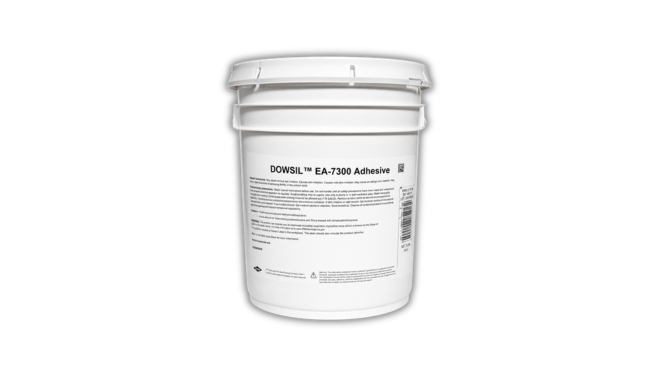
- Dual-cure system
- Fast processing
- Broad adhesion
Product Description
DOWSIL™ EA-7300 Adhesive is a one-part, gray, non-slumping silicone adhesive that cures rapidly at lower temperatures than traditional heat cure products. It utilizes a primary heat-accelerated cure followed by a secondary moisture cure to create a long-lasting, durable bond. With high elongation and low modulus, it provides excellent stress relief for moving joints subjected to CTE mismatch or other environmental conditions.
Product Key Features
- Dual-Cure System - features a heat-accelerated cure followed by a secondary moisture cure that continues to build physical properties and adhesion over 3 to 7 days.
- Fast Processing - achieves >90% of its final adhesion in 30 minutes at 105°C, or in just 5 minutes at 125°C.
- Robust Mechanical Profile - cures to deliver a Shore A hardness of 20, a tensile strength of 2.93 MPa, a low tensile modulus of 0.34 MPa, and an exceptional 600% elongation.
- Extreme Temperature Stability - stable for use from -45°C (or lower) up to long-term exposure at +150°C, and short-term exposure at +200°C or higher.
- Broad Adhesion - designed to adhere to common engineering metals and plastics, providing a tough, solvent-free bond.
Applications
This adhesive fits applications requiring reliable adhesion to common engineering plastics and metals, along with low modulus properties for stress relief.
- Automotive Electronics: Suited for control units, sensors, ADAS devices, electric power steering, and autonomous steering components, including under-hood applications[cite: 1244, 1249, 1250, 1261].
- EV Components: Ideal for assembling battery packs, EV controllers, on-board chargers, inverters/converters, and e-motors.
- Housings & Deep Sections: Effective for automotive electrical housings, electronic module assemblies, and applications requiring a deep section cure.
Technical Specifications
| General Properties | |||||
|
Color
Color
The color |
Gray | ||||
|
Specific Gravity
Specific Gravity
Specific gravity (SG) is the ratio of the density of a substance to the density of a reference substance; equivalently, it is the ratio of the mass of a substance to the mass of a reference substance for the same given volume. For liquids, the reference substance is almost always water (1), while for gases, it is air (1.18) at room temperature. Specific gravity is unitless. |
1.15 | ||||
| Physical Properties | |||||
|
Viscosity
Viscosity
Viscosity is a measurement of a fluid’s resistance to flow. Viscosity is commonly measured in centiPoise (cP). One cP is defined as the viscosity of water and all other viscosities are derived from this base. MPa is another common unit with a 1:1 conversion to cP. A product like honey would have a much higher viscosity -around 10,000 cPs- compared to water. As a result, honey would flow much slower out of a tipped glass than water would. The viscosity of a material can be decreased with an increase in temperature in order to better suit an application |
250,000 mPa.s | ||||
| Mechanical Properties | |||||
|
|||||
|
Elongation
Elongation
Elongation is the process of lengthening something. It is a percentage that measures the initial, unstressed, length compared to the length of the material right before it breaks. It is commonly referred to as Ultimate Elongation or Tensile Elongation at break. |
600 % | ||||
|
|||||
|
|||||
| Electrical Properties | |||||
|
Dielectric Strength
Dielectric Strength
Dielectric strength is measured in kV per mm and is calculated by the Breakdown voltage divided by the thickness of the tested material. Those two properties go hand in hand and while Breakdown voltage is always thickness dependent, dielectric strength is a general material property. As an example, the dielectric strength of Polyimide is 236 kV/mm. If we place 1mm of Polyimide between two electrodes, it will act as an insulator until the voltage between the electrodes reaches 236 kV. At this point it will start acting as a good conductor, causing sparks, potential punctures and current flow. |
15.7 kV/mm | ||||
|
Volume Resistivity
Volume Resistivity
Volume resistivity, also called volume resistance, bulk resistance or bulk resistivity is a thickness dependent measurement of the resistivity of a material perpendicular to the plane of the surface. |
1.1E+13 Ohms⋅cm | ||||
|
|||||
|
|||||
Additional Information
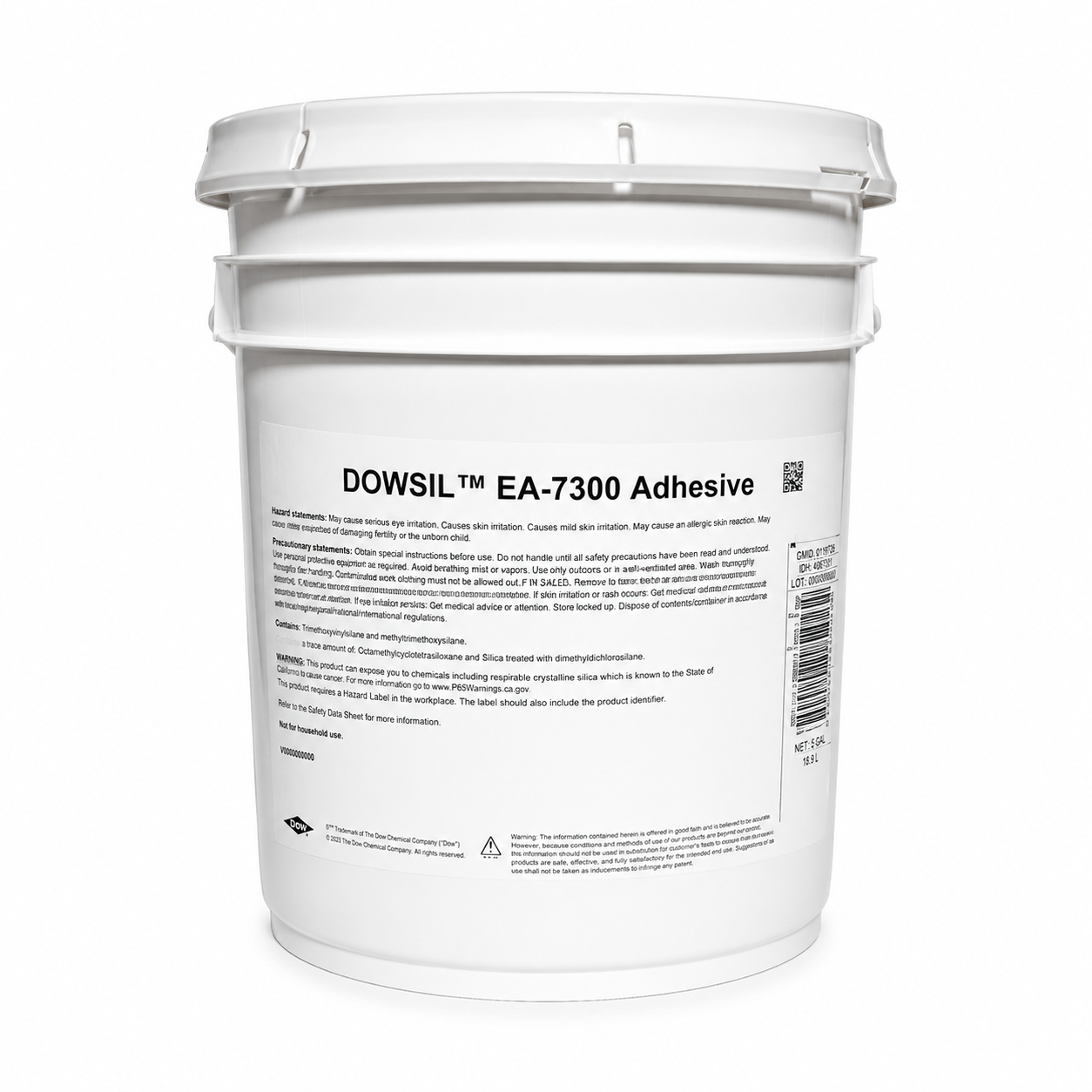
DOWSIL™ EA-7300 Adhesive
DOWSIL™ EA-7300 Adhesive is an innovative one-part silicone structural adhesive engineered to ctivated products. Formulated with a unique dual-cure matrix, its initicure rapidly at significantly lower temperatures than traditional heat-aal heat acceleration is reinforced by a secondary ambient moisture cure to develop an exceptionally long-lasting, high-strength bond. Its low modulus and remarkable high elongation parameters provide premium stress relief for component interfaces experiencing severe CTE mismatches, making it ideal for robust sealing across sensitive automotive electronic control modules and advanced ADAS assemblies.
Typical values only. Adhesion and physical mechanics continue building via a secondary moisture cross-linking mechanism post heat-exposure.
Key Features
- One-part solvent-free compound configuration streamlines manufacturing flow and reduces process footprint risks.
- Advanced thixotropic paste consistency features high flow resistance to remain non-slumping on joints.
- Low temperature accelerated heat cure cuts processing costs while safeguarding sensitive electronics components.
- Secondary moisture cure action acts over several days to build a highly durable, deep section structural cross-link.
- Very low tensile modulus (0.34 MPa) coupled with high elongation (600%) delivers superior movement stress relief.
- Robust unprimed adhesion limits develop aggressively onto common engineering metals and selected plastics.
Processing Summary
Process Notes
- Review specialized temperature conditions and "Use Before" expirations detailed directly on batch product labels.
- Keep containers securely closed in original packaging profiles to block ambient moisture contamination.
- As a single-component system, no volumetric mixing or bulk mechanical degassing loops are mandatory.
- Thoroughly clear joint paths of grease, fluid trace lines, and dust contaminants before dispensing paste.
- Degrease faces with clean solvent choices like Dow OS fluids, naphtha, mineral spirits, or MEK.
- Do not employ acetone or isopropyl alcohol (IPA) alone, as they fail to adequately clean thick oils.
- Incorporate light localized mechanical abrasion whenever possible to expand structural surface bonding area.
- Unprimed dính bám performs well over reactive metals and glass, but non-reactive boundaries like Teflon require aid.
- Introduce specialized industrial plasma exposure or chemical etching to establish a reactive bonding face.
- Apply standard Dow chemical primers in thin, uniform coatings and wipe off excess cleanly before adhesive tracking.
- Allow primers to achieve full independent cure windows before extruding the silicone elastomer bead.
Engineering Data for DOWSIL™ EA-7300
Physical & Cured Mechanical Characteristics
| Physical Property | Typical Engineering Value | Test Method Standard / Notes |
|---|---|---|
| Appearance / Color | Non-slumping thixotropic paste / Gray | CTM 0176 |
| Specific Gravity | 1.15 g/mL | CTM 0097 |
| Viscosity (High Shear - 20 rpm) | 250,000 cP | HAT 7 spindle at 25°C (CTM 0050) |
| Viscosity (Low Shear - 2 rpm) | 650,000 cP | HAT 7 spindle at 25°C (CTM 0050) |
| Durometer Hardness | 20 Shore A | CTM 0091) |
| Tensile Strength | 2.93 MPa | ASTM D412 / CTM 0137 |
| Elongation | 600 % | ASTM D412 / CTM 0137 |
| Tensile Modulus | 0.34 MPa | ASTM D412 / CTM 0137 |
| Unprimed Adhesion Strength | 1.89 MPa | AlClad (5 min @ 125°C + 7 day RT, 23 mil) |
Electrical Insulation Properties (Non-Dried)
| Electrical Parameter | Typical Engineering Value | Test Condition Spec (CTM) |
|---|---|---|
| Dielectric Strength | 15.7 kV/mm | 2.0 mm thickness, non-dried (CTM 0114) |
| Volume Resistivity | 1.1E+13 ohm-cm | Non-dried (CTM 0249) |
| Dielectric Constant (Permittivity) | 3.2 / 3.1 / 3.1 | 100 Hz / 100 kHz / 1 MHz (CTM 0543) |
| Dissipation Factor | 0.001 / 0.002 / 0.004 | 100 Hz / 100 kHz / 1 MHz (CTM 0543) |
Where DOWSIL™ EA-7300 Fits

- Sealing electronic control units, sensors, and modules.
- Optimized structural anchor for ADAS hardware devices.
- Protects sensitive boards from engine room operational stress.
.png)
- Structural adhesive sealing for electric car battery packs.
- Bonds components inside EV controllers and on-board chargers.
- Seals high-power inverter, converter, and E-motor housings.
.png)
- Bonds autonomous steering system sub-assemblies.
- Seals critical electric power steering components.
- Locks automotive electrical board enclosures fluid-tight.
Advancing the future of mobility with
DOWSIL™ EA-7300 Adhesive
DOWSIL™ EA-7300 Adhesive drives automotive innovation forward with high-performance bonding tailored for EV, ADAS, and power electronics applications.
-
Enhanced Efficiency: Supports high throughput with fast in-line processing and compatibility with both automated and manual dispensing systems.
-
Robust Durability: Utilizes dual-cure technology to create strong, long-lasting bonds that withstand extreme thermal cycling and salt spray.
- Cost-Effective Processing: Features a rapid, low-temperature cure that works seamlessly with lightweight materials to reduce manufacturing costs.
Applications requiring strong adhesion durability:
• Power electronics
• ADAS technology
• EV electronics
Standard Packaging & Technical Help
- Available across standard industrial protective vessel and cartridge line sizes.
- Supplied ready-to-use without requiring complex multi-part mixing setups.
- Logistics packages safeguard component chemistry from premature ambient moisture activation.
- Configuring low-temperature rapid heat bake schedules to balance floor energy costs and line speed.
- Evaluating complex substrate layout structures to confirm unprimed boundary adhesion values.
- Calibrating automated robotic fluid lines to track specified paste thixotropy properties.
- Coordinating lab-scale substrate evaluations to establish minimum line cure parameters.
Tips and Troubleshooting
| Issue | Recommended Action |
|---|---|
| Premature surface skinning or bead tearing during secondary adjustments |
|
| Incomplete structural cross-linking down through joint core zones |
|
| Adhesion tracking breakdown or low lap shear force values over difficult substrates |
|