
-
Home

-
Products
-
Adhesives
-
Silicone Adhesives
- DOWSIL™ SE 9168 RTV
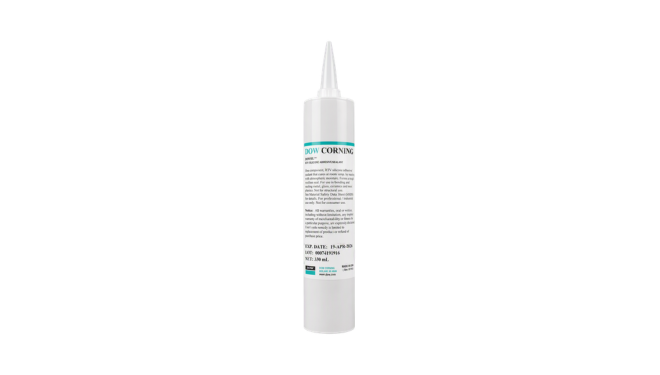
DOWSIL™ SE 9168 RTV
- Fast processing
- Flame resistance
- Controlled volatility
Product Description
DOWSIL™ SE 9168 RTV Adhesive is a one-part, gray, non-flowing polydimethylsiloxane adhesive designed to provide a fast tack-free room temperature cure. It offers controlled silicone volatility and good flame resistance, eliminating the need for curing ovens.
Product Key Features
- One-Part Room Temperature Cure - cures quickly at room temperature, requiring no additional heat or curing ovens.
- Fast Processing - features a rapid tack-free time of 6.5 minutes at 25°C to accelerate manufacturing throughput.
- Flame Resistance - achieves a UL 94 V-0 flammability classification, making it suitable for applications requiring high flame resistance.
- Controlled Volatility - maintains a low molecular siloxane (D4-D10) content of 35 ppm.
- Mechanical & Electrical Profile - cures to deliver a Shore A hardness of 44, a tensile strength of 3.69 MPa (535 psi), an elongation of 363%, and a dielectric strength of 26 kV/mm.
Applications
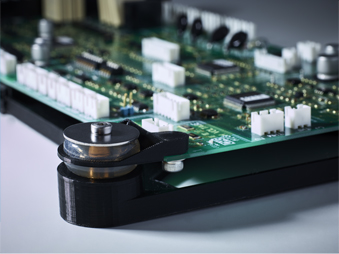
This adhesive is suitable for electronic assemblies requiring fast room temperature curing, vibration dampening, and reliable flame resistance.
- Circuit Boards & Modules: Ideal for fixing parts directly on circuit boards and within electronic modules.
- Vibration Dampening: Effectively used for the vibration dampening of fixed components in electronic assemblies.
- Flame Retardant Uses: Designed specifically for applications that demand added flame resistance and UL 94 V-0 compliance.
Technical Specifications
| General Properties | |||||
|
Color
Color
The color |
Gray | ||||
|
Specific Gravity
Specific Gravity
Specific gravity (SG) is the ratio of the density of a substance to the density of a reference substance; equivalently, it is the ratio of the mass of a substance to the mass of a reference substance for the same given volume. For liquids, the reference substance is almost always water (1), while for gases, it is air (1.18) at room temperature. Specific gravity is unitless. |
1.32 | ||||
| Physical Properties | |||||
| Tack-Free Time | 6.5 minutes | ||||
|
Viscosity
Viscosity
Viscosity is a measurement of a fluid’s resistance to flow. Viscosity is commonly measured in centiPoise (cP). One cP is defined as the viscosity of water and all other viscosities are derived from this base. MPa is another common unit with a 1:1 conversion to cP. A product like honey would have a much higher viscosity -around 10,000 cPs- compared to water. As a result, honey would flow much slower out of a tipped glass than water would. The viscosity of a material can be decreased with an increase in temperature in order to better suit an application |
non-flowing mPa.s | ||||
| Mechanical Properties | |||||
|
|||||
|
|||||
|
Elongation
Elongation
Elongation is the process of lengthening something. It is a percentage that measures the initial, unstressed, length compared to the length of the material right before it breaks. It is commonly referred to as Ultimate Elongation or Tensile Elongation at break. |
363 % | ||||
|
|||||
| Electrical Properties | |||||
|
Dielectric Strength
Dielectric Strength
Dielectric strength is measured in kV per mm and is calculated by the Breakdown voltage divided by the thickness of the tested material. Those two properties go hand in hand and while Breakdown voltage is always thickness dependent, dielectric strength is a general material property. As an example, the dielectric strength of Polyimide is 236 kV/mm. If we place 1mm of Polyimide between two electrodes, it will act as an insulator until the voltage between the electrodes reaches 236 kV. At this point it will start acting as a good conductor, causing sparks, potential punctures and current flow. |
26 kV/mm | ||||
|
Volume Resistivity
Volume Resistivity
Volume resistivity, also called volume resistance, bulk resistance or bulk resistivity is a thickness dependent measurement of the resistivity of a material perpendicular to the plane of the surface. |
8.0 E+15 Ohms⋅cm | ||||
| Thermal Properties | |||||
|
UL 94 Rating
UL 94 Rating
Flammability rating classification. It determines how fast a material burns or extinguishes once it is ignited. HB: slow burning on a horizontal specimen; burning rate less than 76 mm/min for thickness less than 3 mm or burning stops before 100 mm V-2: burning stops within 30 seconds on a vertical specimen; drips of flaming particles are allowed. V-1: burning stops within 30 seconds on a vertical specimen; drips of particles allowed as long as they are not inflamed. V-0: burning stops within 10 seconds on a vertical specimen; drips of particles allowed as long as they are not inflamed. 5VB: burning stops within 60 seconds on a vertical specimen; no drips allowed; plaque specimens may develop a hole. 5VA: burning stops within 60 seconds on a vertical specimen; no drips allowed; plaque specimens may not develop a hole |
V-0 | ||||
Additional Information
DOWSIL™ SE 9168 RTV Adhesive
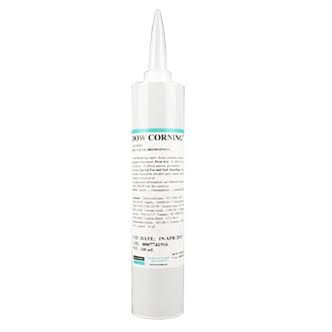
DOWSIL™ SE 9168 RTV Adhesive is a premium one-part, gray, non-flowing silicone adhesive formulated for high-reliability applications requiring fast tack-free room temperature curing. Composed of polydimethylsiloxane, this thixotropic paste is engineered with controlled silicone volatility to limit low molecular siloxane outgassing and features a UL 94 V-0 flammability rating for superior flame resistance. It eliminates the need for curing ovens, providing excellent unprimed adhesion and vital stress relief for critical electronic modules and circuit board sub-assemblies.
Typical values only. Performance profiles are measured after full atmospheric moisture activation at room temperature settings.
Key Features
- One-part moisture cure system bypasses oven operating steps and associated equipment costs.
- Thixotropic non-flowing paste profile ensures dependable bead control and component isolation.
- Fast room-temperature tack-free development (6.5 minutes) accelerates assembly throughput limits.
- Controlled silicone volatility limits low molecular siloxanes to 35 ppm to protect sensitive circuits.
- Certified UL 94 V-0 flammability rating provides superior in-service flame resistance.
- Maintains structural and electrical insulation parameters across a wide range of -45°C to 200°C.
Processing Summary
Process Notes
- Store unopened original packages at or below the temperature specified on the product label.
- Take strict precautions to prevent any atmospheric moisture contact with raw material.
- Minimize head air space and purge partially filled containers with dry nitrogen or dry air.
- Verify the formal "Use Before" validation field marked on the package label prior to lines setup.
- Clean substrate boundaries thoroughly with Dow OS fluids, naphtha, mineral spirits, or MEK.
- Avoid using pure acetone or isopropyl alcohol (IPA) alone, as they do not remove heavy oils well.
- Incorporate fine surface mechanical abrasion to maximize active bonding surface area[.
- Chemical etching or plasma treatment methods can optimize hold on non-reactive profiles like Teflon, PE, or PP.
- Cure processing advances evenly inward but is dependent on humidity levels (30% to 80% RH).
- Avoid applying paste inside highly confined or fully enclosed layout zones restricted from air exposure.
- Run lab-scale lap shear assessments to screen for 100% cohesive failure, ensuring component compatibility.
- Screen highly plasticized plastics or rubbers; mobile plasticizers can act as active bond release agents.
Engineering Data for DOWSIL™ SE 9168
Physical & Cured Mechanical Properties
| Physical Property | Typical Engineering Value | Unit |
|---|---|---|
| Appearance / Color | Non-flowing paste / Gray | - |
| Tack-free Time (25 oC) | 6.5 | minutes |
| Specific Gravity (Cured) | 1.32 | - |
| Durometer Hardness | 44 Shore A | - |
| Tensile Strength | 535 / 3.69 / 37 | |
| Elongation | 363 | % |
| Lap Shear Adhesion (Glass) | 275 / 1.9 / 189 | psi/ MPa/(N/cm²) |
| Low Molecular Siloxane Content (D4 - D10) | 35 | ppm |
Electrical & Flammability Performance Insulation
| Insulating Attribute | Typical Engineering Value | Unit |
|---|---|---|
| Dielectric Strength | 650 (26 ) | volts/mil (kV/mm) |
| Volume Resistivity | 8.0E+15 | ohm*cm |
| UL Flammability Classification | 94 V-0 | - |
Where DOWSIL™ SE 9168 Fits
.png)
- Provides safe, room temperature moisture curing loops.
- Controlled volatility safeguards complex circuit tracks from outgassing.
- Unprimed dính bám secures common electronic materials.
- Forms a tough yet highly flexible rubber structural seal.
- Absorbs thermal expansions under shifting assembly conditions.
- Resists micro-shocks without losing baseline boundary line hold.
.png)
- Certified UL 94 V-0 flammability classification rating.
- Thixotropic paste rheology prevents slumping on vertical runs.
- Intended to successfully survive splash or intermediate solvent exposure.
See One-Part Moisture-Curing RTV Silicone Dispensing Methods
Observe the high-precision processing of one-part non-flowing industrial RTV silicone adhesive sealants via automated needle dispensing setups. This practical reference highlights best practices for balancing track extrusion parameters, checking non-slump bead profiles, and verifying surface handling stability before complete room temperature cross-linking completes.
Standard Packaging & Technical Help
- Available in multiple industrial protective packaging container choices to suit your automation requirements.
- Supplied ready-to-use without requiring volatile pre-mixing setups or compound volumetric calculations.
- Logistics configurations safeguard elements, maintaining a sealed environment away from humidity activation.
- Assisting manufacturing lines with room-temperature tuning to fully eliminate capital oven operations.
- Evaluating complex component layouts to optimize unprimed over engineering plastic matrices.
- Configuring automated needle path tracking setups to maximize processing throughput.
- Guidance regarding regulatory safety data and formal UL flammability certification matching.
Tips and Troubleshooting
| Issue | Recommended Action |
|---|---|
| Premature layer skinning or surface tearing during finishing tooling steps |
|
| Incomplete structural cross-linking down through joint core zones |
|
| Adhesion tracking breakdown or low lap shear force values over difficult substrates |
|