
-
Home

-
Products
-
Coatings, powders & Resins
-
Conformal Coatings
- HumiSeal 1B31 LTX Acrylic Conformal Coating
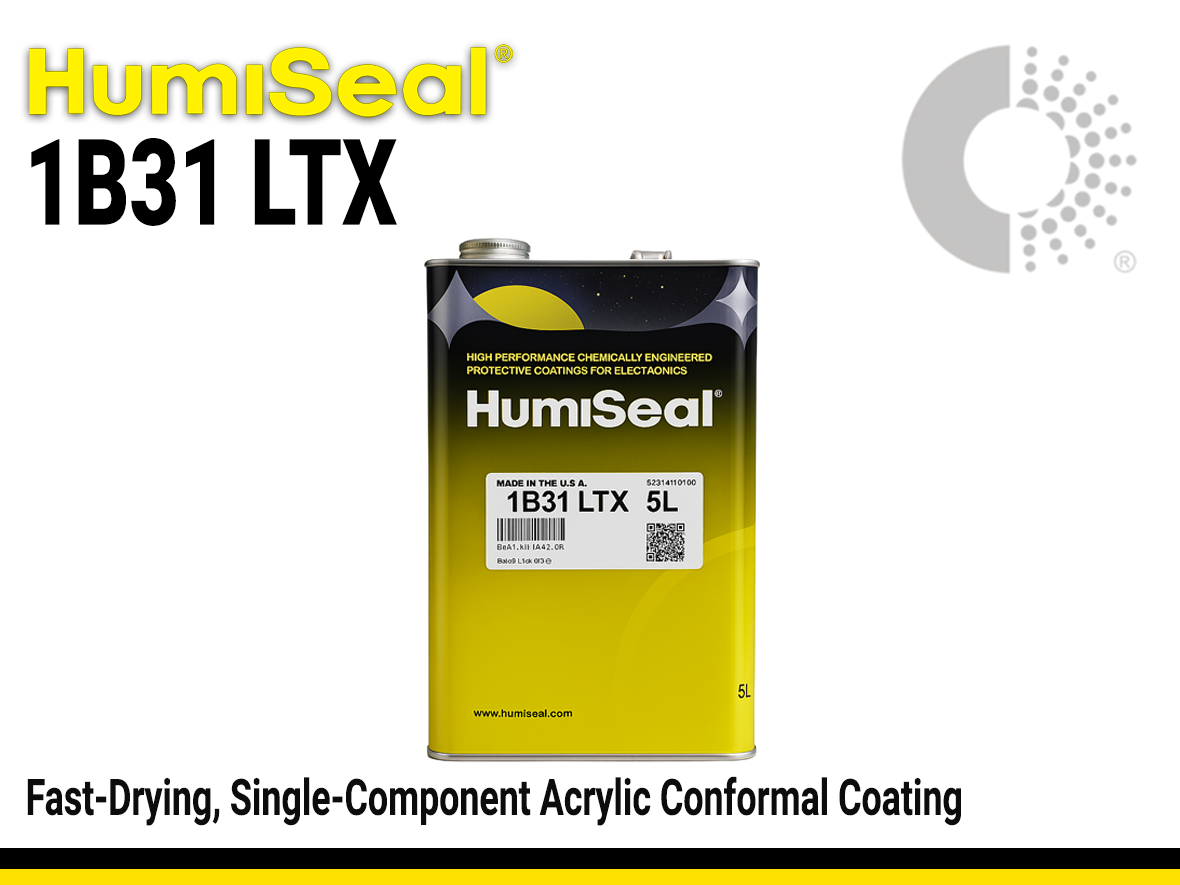
HumiSeal 1B31 LTX Acrylic Conformal Coating
- Available in multiple pre‑blends
- Reduced xylene and toluene
- Low moisture vapor permeability
Product Description
HumiSeal 1B31 LTX is a fast‑drying, single‑component acrylic conformal coating formulated to protect electronic assemblies from moisture, corrosive environments, and particulate contamination. It features a reduced xylene and toluene solvent system to ensure full compliance with GB30981‑2020, which governs VOC and solvent usage for conformal coatings. HumiSeal 1B31 LTX is available in a range of pre‑blended versions designed for use without additional dilution and optimized for various application methods.
Product Key Features
- Reduced xylene and toluene formulation for GB30981‑2020 compliance
- Low moisture vapor permeability
- Available in multiple pre‑blends, ready for use without further dilution. Contact us for more information.
- Pre-blends with Thinner 600 are ideal for enhanced spray application
- Pre-blends with Thinner 789 are ideal for film coater systems. Heated systems may be needed for 120CPS pre-blends, providing improved coating coverage
Applications
- Protection of printed circuit boards (PCBs) exposed to moisture, salt fog, corrosive atmospheres, and particulate contamination
Technical Specifications
| Physical Properties | |||||||
|
Viscosity
Viscosity
Viscosity is a measurement of a fluid’s resistance to flow. Viscosity is commonly measured in centiPoise (cP). One cP is defined as the viscosity of water and all other viscosities are derived from this base. MPa is another common unit with a 1:1 conversion to cP. A product like honey would have a much higher viscosity -around 10,000 cPs- compared to water. As a result, honey would flow much slower out of a tipped glass than water would. The viscosity of a material can be decreased with an increase in temperature in order to better suit an application |
200 mPa.s | ||||||
| General Properties | |||||||
| Density (g) | 0.91 g/cm3 | ||||||
|
Film Thickness
Film Thickness
Film thickness is the thickness of a backing film without taking into account any coatings or adhesive layers. It is measured in micron and the conversion factor to mil is 0.039. |
25 - 75 µm | ||||||
| Solids | 35 % | ||||||
| Thermal Properties | |||||||
|
Glass Transition Temperature (Tg)
Glass Transition Temperature (Tg)
The glass transition temperature for organic adhesives is a temperature region where the polymers change from glassy and brittle to soft and rubbery. Increasing the temperature further continues the softening process as the viscosity drops too. Temperatures between the glass transition temperature and below the decomposition point of the adhesive are the best region for bonding. The glass-transition temperature Tg of a material characterizes the range of temperatures over which this glass transition occurs. |
14 °C | ||||||
| Operating Temperature | -65 - 125 °C | ||||||
|
|||||||
| Electrical Properties | |||||||
|
Breakdown Voltage
Breakdown Voltage
Breakdown voltage is the minimum voltage necessary to force an insulator to conduct some amount of electricity. It is the point at which a material ceases to be an insulator and becomes a resistor that conducts electricity at some proportion of the total current. After dielectric breakdown, the material may or may not behave as an insulator any more because of the molecular structure alteration. The current flow tend to create a localised puncture that totally alters the dielectric properties of the material. This electrical property is thickness dependent and is the maximum amount of voltage that a dielectric material can withstand before breaking down. The breakdown voltage is calculated by multiplying the dielectric strength of the material times the thickness of the film. |
7500 V | ||||||
|
|||||||
|
|||||||
Additional Information
Additional Information
Conformal coatings can be successfully applied to substrates that have been cleaned prior to coating and also to substrates assembled with low residue “no clean” materials. Users should perform adequate testing to confirm compatibility between the conformal coating and their particular assembly materials, process conditions and cleanliness level. Please contact HumiSeal® for additional information.
HumiSeal® 1B31 LTX Pre-Blends are specifically diluted to a viscosity for immediate use. No additional dilution is required. Customers should establish which Pre-Blend is suitable for their equipment and application method before commercial use. HumiSeal® Technical Support should be contacted if any further advice on Pre-Blends and equipment is required.