
-
Home

-
Products
-
Coatings, powders & Resins
-
Conformal Coatings
- HumiSeal 1B31LOC Acrylic Conformal Coating
HumiSeal 1B31LOC Acrylic Conformal Coating
Harmonization Code : 3906909090 | Acrylic polymers in primary form
Others>Others
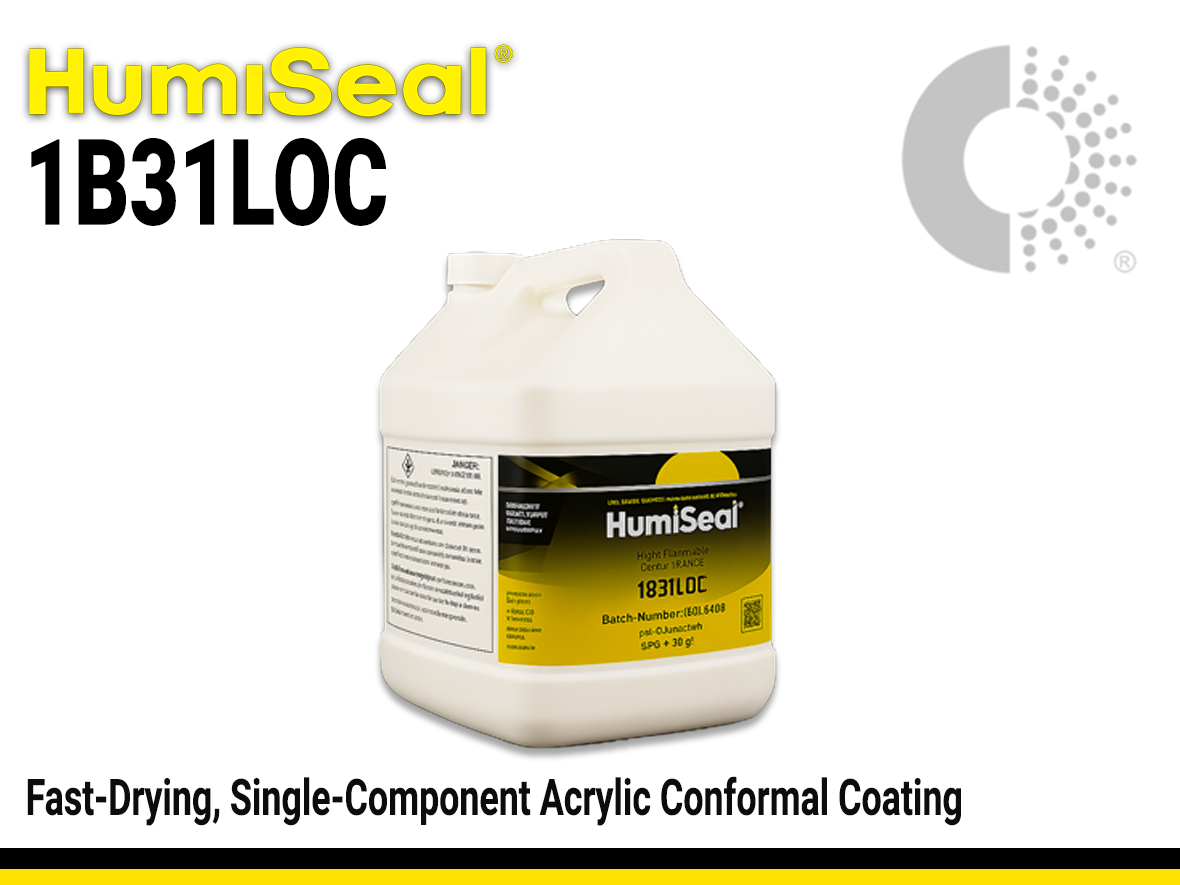
Main features
- Low VOC formulation
- Strong electrical insulation properties
- MIL‑I‑46058C qualified
Product Description
HumiSeal 1B31LOC is a low‑VOC, solvent‑based acrylic conformal coating designed to comply with most North American air‑quality regulations. It is a fast‑drying, single‑component coating that delivers excellent moisture and environmental protection for printed circuit assemblies. The cured film provides outstanding flexibility and electrical properties, fluoresces under UV light for simplified inspection, and is easily repairable. HumiSeal 1B31LOC is MIL‑I‑46058C qualified and IPC‑CC‑830 and RoHS Directive 2002/95/EC compliant.
Product Key Features
- Low VOC formulation that meets most North American air‑quality requirements
- Single‑component acrylic system
- MIL‑I‑46058C qualified
- IPC‑CC‑830 compliant
- RoHS compliant (Directive 2002/95/EC)
Applications
- Protection of printed circuit boards (PCBs) in consumer, industrial, automotive, and aerospace electronics
- Electronics manufactured in low‑VOC or regulated environments
Technical Specifications
| General Properties | |||||||
| Density (g) | 1.20 g/cm3 | ||||||
|
Film Thickness
Film Thickness
Film thickness is the thickness of a backing film without taking into account any coatings or adhesive layers. It is measured in micron and the conversion factor to mil is 0.039. |
25 - 75 µm | ||||||
| Solids | 25 % | ||||||
| Physical Properties | |||||||
|
Viscosity
Viscosity
Viscosity is a measurement of a fluid’s resistance to flow. Viscosity is commonly measured in centiPoise (cP). One cP is defined as the viscosity of water and all other viscosities are derived from this base. MPa is another common unit with a 1:1 conversion to cP. A product like honey would have a much higher viscosity -around 10,000 cPs- compared to water. As a result, honey would flow much slower out of a tipped glass than water would. The viscosity of a material can be decreased with an increase in temperature in order to better suit an application |
450 mPa.s | ||||||
| Thermal Properties | |||||||
| Operating Temperature | -65 - 125 °C | ||||||
|
|||||||
| Electrical Properties | |||||||
|
Breakdown Voltage
Breakdown Voltage
Breakdown voltage is the minimum voltage necessary to force an insulator to conduct some amount of electricity. It is the point at which a material ceases to be an insulator and becomes a resistor that conducts electricity at some proportion of the total current. After dielectric breakdown, the material may or may not behave as an insulator any more because of the molecular structure alteration. The current flow tend to create a localised puncture that totally alters the dielectric properties of the material. This electrical property is thickness dependent and is the maximum amount of voltage that a dielectric material can withstand before breaking down. The breakdown voltage is calculated by multiplying the dielectric strength of the material times the thickness of the film. |
7500 V | ||||||
|
|||||||
|
|||||||