-
Home

-
Products
-
Die Attach Materials
-
Die Attach Pastes
- LOCTITE ABLESTIK 8200T
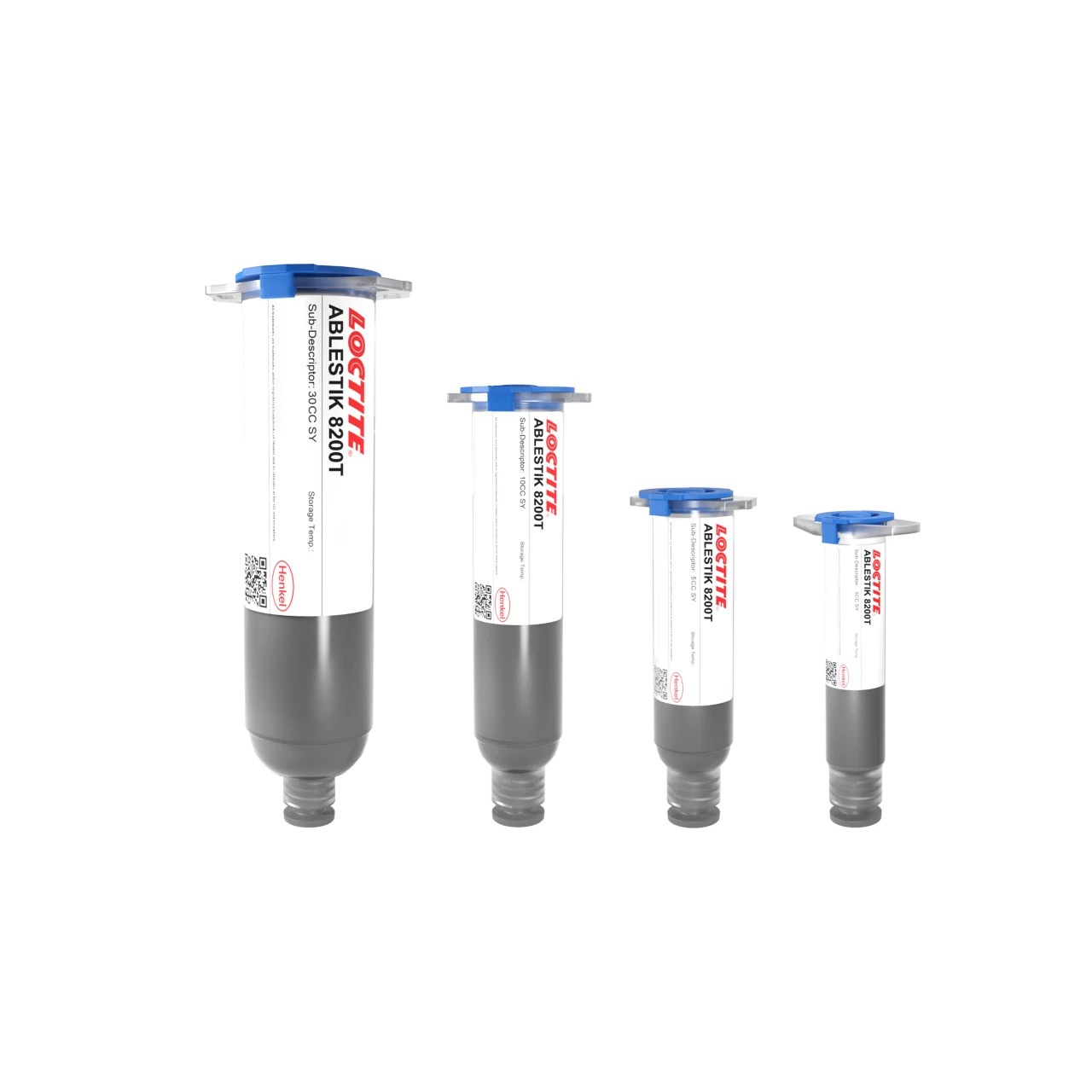
LOCTITE ABLESTIK 8200T
Harmonization Code : 3506.91.90.99 | Prepared glues and other prepared adhesives, not elsewhere specified or included; products suitable for use as glues or adhesives, put up for retail sale as glues or adhesives, not exceeding a net weight of 1 kg ; Adhesives based on polymers of headings 3901 to 3913 or on rubber; Other ; Other

Main features
- High electrical conductivity
- Snap curable
- Excellent adhesion to Ag plated LF
Product Description
LOCTITE ABLESTIK 8200T electrically conductive die attach adhesive is designed for high reliability package applications with medium thermal and electrical requirements. This material offers improved JEDEC performance on QFN type packages.
LOCTITE ABLESTIK 8200T is hybrid silver adhesive that is snap curable and has excellent adhesion to Ag plated leadframe. It is typically used on PPF and Silver substrates and exhibits very low bleed.
Cure Schedule
- 30 minute ramp to 175°C + 15 minutes @ 175°C
Technical Specifications
| General Properties | |||||||||
|
Work life @25°C
Work life @25°C
Work life is the amount of time we have to work with a material until it is no longer able to be easily worked and applied on a substrate. It is based on the change in viscosity and it can rely on the application requirements. |
24 hours | ||||||||
|
|||||||||
| Thermal Properties | |||||||||
|
Glass Transition Temperature (Tg)
Glass Transition Temperature (Tg)
The glass transition temperature for organic adhesives is a temperature region where the polymers change from glassy and brittle to soft and rubbery. Increasing the temperature further continues the softening process as the viscosity drops too. Temperatures between the glass transition temperature and below the decomposition point of the adhesive are the best region for bonding. The glass-transition temperature Tg of a material characterizes the range of temperatures over which this glass transition occurs. |
241 °C | ||||||||
|
Thermal Conductivity
Thermal Conductivity
Thermal conductivity describes the ability of a material to conduct heat. It is required by power packages in order to dissipate heat and maintain stable electrical performance. Thermal conductivity units are [W/(m K)] in the SI system and [Btu/(hr ft °F)] in the Imperial system. |
2.5 W/m.K | ||||||||
|
|||||||||
| Electrical Properties | |||||||||
|
Volume Resistivity
Volume Resistivity
Volume resistivity, also called volume resistance, bulk resistance or bulk resistivity is a thickness dependent measurement of the resistivity of a material perpendicular to the plane of the surface. |
1.0x10⁻⁴ Ohms⋅cm | ||||||||
| Mechanical Properties | |||||||||
|
|||||||||
| Chemical Properties | |||||||||
| Moisture absorption | 0.3 % | ||||||||
|
|||||||||
| Physical Properties | |||||||||
|
Viscosity
Viscosity
Viscosity is a measurement of a fluid’s resistance to flow. Viscosity is commonly measured in centiPoise (cP). One cP is defined as the viscosity of water and all other viscosities are derived from this base. MPa is another common unit with a 1:1 conversion to cP. A product like honey would have a much higher viscosity -around 10,000 cPs- compared to water. As a result, honey would flow much slower out of a tipped glass than water would. The viscosity of a material can be decreased with an increase in temperature in order to better suit an application |
9,000 mPa.s | ||||||||