
-
Home

-
Products
-
Encapsulants & Underfills
-
Liquid Encapsulants
- SYLGARD™ 160 Silicone Elastomer Kit
SYLGARD™ 160 Silicone Elastomer Kit
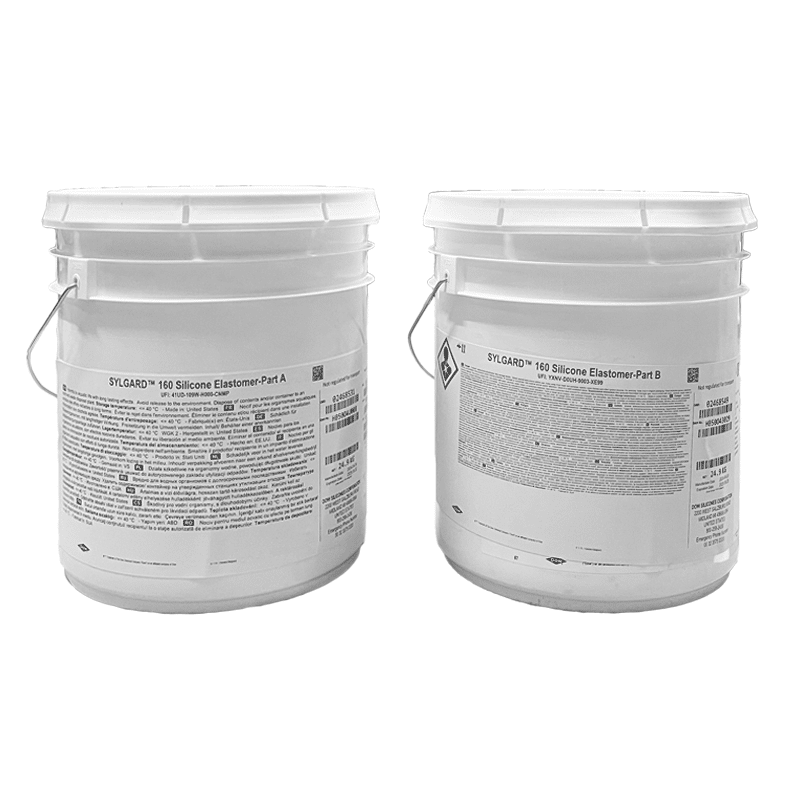
- Two-part silicone elastomer (1:1 mix ratio)
- Low shrinkage with no solvent byproducts
- Wide operating temperature range (-45°C to 200°C)
Product Description
SYLGARD™ 160 Silicone Elastomer is a two-part, 1:1 mix ratio, dark gray to black polydimethylsiloxane encapsulant designed for general potting of electrical and PCB system assemblies. It provides 4,865 cP mixed viscosity, 0.62 W/m·K thermal conductivity, and UL 94 V-0 flame rating while supporting room temperature cure or heat-accelerated cure. This makes it a candidate for power supplies, connectors, sensors, industrial controls, and transformers, subject to application-specific testing and qualification.
Key features
- Two-part silicone system - 1:1 mix ratio supports manual mixing or automated metered mixing and dispensing.
- Good flowability - 4,865 cP mixed viscosity supports potting and encapsulation of electronic assemblies.
- Flexible cure options - cures in 24 hours at 25°C or 4 minutes at 100°C for process flexibility.
- Moderate thermal conductivity - 0.62 W/m·K supports thermal transfer through the cured encapsulant.
- Electrical insulation - 19 kV/mm dielectric strength and 5.6E+14 ohm·cm volume resistivity support electrical protection review.
- Flame resistance - UL 94 V-0 rating supports evaluation for applications requiring added flame resistance.
Applications / Suitable for
SYLGARD™ 160 Silicone Elastomer is suitable for evaluation as a general potting material in electrical and PCB system assembly applications where flowability, electrical insulation, moderate thermal conductivity, and flame resistance are selection factors.
- Power supplies: May be considered where electrical insulation, flame resistance, and moderate thermal conductivity are required for potting review.
- Connectors and sensors: Suitable for evaluation where a cured silicone elastomer is needed for mechanical and environmental protection.
- Industrial controls: Supports review for PCB system assemblies requiring room temperature or heat-accelerated cure options.
- Transformers: May be evaluated as a general potting material where dielectric performance and flame resistance are important selection criteria.
Technical Specifications
| General Properties | |||||
|
Color
Color
The color |
Dark gray to black | ||||
|
Specific Gravity
Specific Gravity
Specific gravity (SG) is the ratio of the density of a substance to the density of a reference substance; equivalently, it is the ratio of the mass of a substance to the mass of a reference substance for the same given volume. For liquids, the reference substance is almost always water (1), while for gases, it is air (1.18) at room temperature. Specific gravity is unitless. |
1.61 | ||||
|
Work life @25°C
Work life @25°C
Work life is the amount of time we have to work with a material until it is no longer able to be easily worked and applied on a substrate. It is based on the change in viscosity and it can rely on the application requirements. |
0.33 hours | ||||
| Physical Properties | |||||
|
Viscosity
Viscosity
Viscosity is a measurement of a fluid’s resistance to flow. Viscosity is commonly measured in centiPoise (cP). One cP is defined as the viscosity of water and all other viscosities are derived from this base. MPa is another common unit with a 1:1 conversion to cP. A product like honey would have a much higher viscosity -around 10,000 cPs- compared to water. As a result, honey would flow much slower out of a tipped glass than water would. The viscosity of a material can be decreased with an increase in temperature in order to better suit an application |
4865 mPa.s | ||||
| Thermal Properties | |||||
|
Thermal Conductivity
Thermal Conductivity
Thermal conductivity describes the ability of a material to conduct heat. It is required by power packages in order to dissipate heat and maintain stable electrical performance. Thermal conductivity units are [W/(m K)] in the SI system and [Btu/(hr ft °F)] in the Imperial system. |
0.62 W/m.K | ||||
|
|||||
| Curing Conditions | |||||
|
|||||
| Mechanical Properties | |||||
|
|||||
| Electrical Properties | |||||
|
Dielectric Strength
Dielectric Strength
Dielectric strength is measured in kV per mm and is calculated by the Breakdown voltage divided by the thickness of the tested material. Those two properties go hand in hand and while Breakdown voltage is always thickness dependent, dielectric strength is a general material property. As an example, the dielectric strength of Polyimide is 236 kV/mm. If we place 1mm of Polyimide between two electrodes, it will act as an insulator until the voltage between the electrodes reaches 236 kV. At this point it will start acting as a good conductor, causing sparks, potential punctures and current flow. |
19 kV/mm | ||||
|
Volume Resistivity
Volume Resistivity
Volume resistivity, also called volume resistance, bulk resistance or bulk resistivity is a thickness dependent measurement of the resistivity of a material perpendicular to the plane of the surface. |
5.6x10¹⁴ Ohms⋅cm | ||||
|
|||||
|
|||||
Additional Information
SYLGARD™ 160 Silicone Elastomer
SYLGARD™ 160 Silicone Elastomer is a two-part, 1:1 mix ratio, dark gray to black silicone encapsulant designed for general potting of electrical and PCB system assemblies. It provides 4,865 cP mixed viscosity, 0.62 W/m·K thermal conductivity, Shore A 56 hardness, and UL 94 V-0 flame rating. Its room temperature or heat-accelerated cure profile can help support process flexibility, subject to application-specific testing and qualification.
Review the technical data sheet and SDS before handling, processing, or qualifying the material.
Managing heat in complex architectures
Dow’s thermally conductive silicone elastomers and gels encompass an adaptable selection of products for encapsulation and potting applications. This broad family of material technologies offers versatile thermal management solutions with a variable level of hardness or stress relief to fit your PCB system application need.
The low viscosity before cure of these products enables them to process easily and fully embed tall components, delicate wires and solder joints, making them particularly suitable for managing high heat in complicated PCB system architectures. Plus, due to their extremely low modulus after cure, these materials offer superb stress relief.
Key features
- Good flowability - 4,865 cP mixed viscosity supports potting and filling of electronic assemblies.
- Moderate thermal conductivity - 0.62 W/m·K supports heat transfer through the encapsulant.
- Electrical insulation - 19 kV/mm dielectric strength supports electrical protection review.
- Flame resistance - UL 94 V-0 rating supports applications requiring added flame resistance.
- Repairability - cured silicone elastomer can be selectively removed and repotted when repairs are needed.
Processing summary
Dow guides and brochures for application review
Use the following Dow literature to review SYLGARD™ 160 Silicone Elastomer in the broader context of silicone encapsulants, gels, elastomers, thermal management materials, and electronics protection materials.
Review Dow silicone material families for electronics protection, environmental sealing, thermal interface needs, optical materials, coatings, gels, and encapsulants used in demanding electronics applications.
Use this brochure to review Dow silicone materials for electronics reliability, including encapsulation, potting, thermal management, and stress relief in PCB system assemblies.
Review Dow protection, assembly, and thermal material options for LED lighting designs where potting, thermal interface materials, encapsulants, and coatings may be part of the assembly stack.
Review Dow material options for solar module applications, including electronics encapsulants, potting materials, junction box adhesives, frame sealing, and protective materials.
Uncured system properties
| Property | Typical value | Unit | Condition / note |
|---|---|---|---|
| One or two-part | Two | - | Two-part silicone elastomer kit |
| Color | Dark gray to black | - | Per technical data sheet |
| Viscosity, Part A | 6,000 / 6 | cP / Pa-sec | Per technical data sheet |
| Viscosity, Part B | 3,730 / 3.7 | cP / Pa-sec | Per technical data sheet |
| Viscosity, mixed | 4,865 / 4.8 | cP / Pa-sec | Per technical data sheet |
| Specific gravity, Part A | 1.61 | - | Uncured Part A |
| Specific gravity, Part B | 1.60 | - | Uncured Part B |
Cured and performance properties
Cure basis and test conditions are per technical data sheet unless otherwise stated.
| Property | Typical value | Unit | Condition / note |
|---|---|---|---|
| Thermal conductivity | 0.36 / 0.62 | BTU/hr ft °F / W/m·K | Per technical data sheet |
| Working time at 25°C | 20 | minutes | Pot life |
| Cure time at 25°C | 24 | hours | Room temperature cure |
| Heat cure time at 100°C | 4 | minutes | Heat-accelerated cure |
| Durometer | 56 | Shore A | Per technical data sheet |
| Dielectric strength | 475 / 19 | volts/mil / kV/mm | Per technical data sheet |
| Volume resistivity | 5.6E+14 | ohm·cm | Per technical data sheet |
| Dielectric constant at 100 Hz | 3.51 | - | Per technical data sheet |
| Dielectric constant at 100 kHz | 3.45 | - | Per technical data sheet |
| Dissipation factor at 100 Hz | 0.0047 | - | Per technical data sheet |
| Dissipation factor at 100 kHz | 0.00118 | - | Per technical data sheet |
| Linear CTE | 200 | µm/m-°C or ppm | By DMA |
| UL RTI rating | 150 | °C | Per technical data sheet |
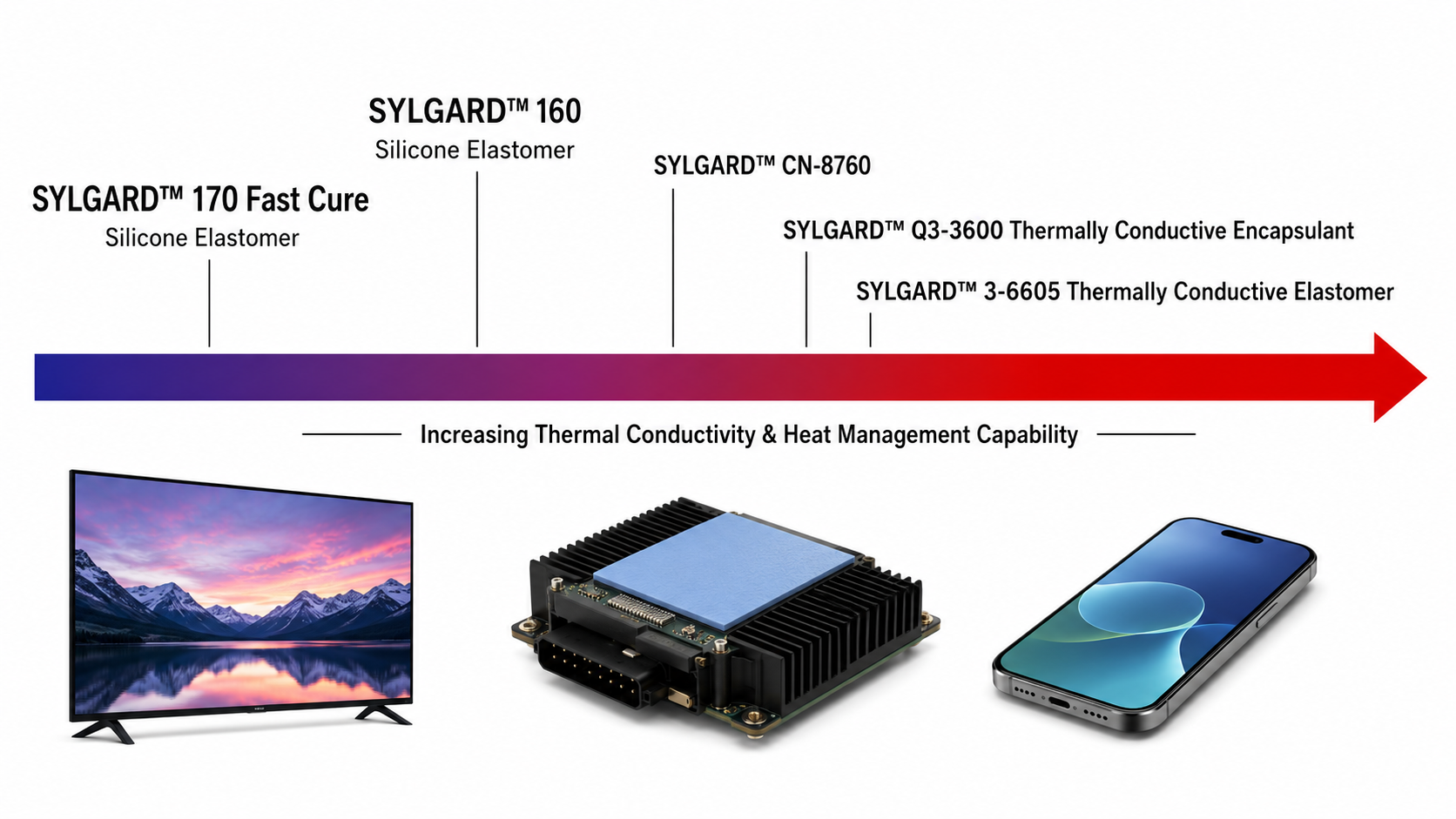
Where SYLGARD™ 160 fits
- 0.62 W/m·K thermal conductivity
- UL 94 V-0 flame rating
- 19 kV/mm dielectric strength
- Flexible elastomer after cure
- Manual or automated dispensing options
- Repairable by selective mechanical removal
- 5.6E+14 ohm·cm volume resistivity
- Shore A 56 cured hardness
- 24-hour room temperature cure or 4-minute heat cure
Documents and qualification support
- Technical data sheet
- Safety data sheet, Part A
- Safety data sheet, Part B
- Multiple packaging sizes are available per technical data sheet.
- Substrates and surface condition
- Potting volume, geometry, and void-sensitive areas
- Dispense method and planned mix equipment
- Cure temperature limits and production takt time
- Electrical, thermal, flame rating, and environmental requirements
Tips and troubleshooting
| Issue | Recommended action |
|---|---|
| Air entrapment or voids |
|
| Adhesion below target |
|
| Cure inhibition risk |
|
| Moisture exposure during storage |
|
| Repair or rework requirement |
|