-
Home

-
Products
-
Encapsulants & Underfills
-
Liquid Encapsulants
- SYLGARD™ 184 Silicone Elastomer Kit
SYLGARD™ 184 Silicone Elastomer Kit
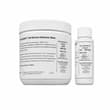
- Two-part silicone elastomer (10:1 mix ratio)
- Flexible cure options: room temperature or heat-accelerated
- Low shrinkage and minimal internal stress
Product Description
SYLGARD™ 184 Silicone Elastomer Kit is a two-part, 10:1 mix ratio, transparent polydimethylsiloxane elastomer designed for electronics encapsulation and PCB system assembly protection. It provides 3500 cP mixed viscosity, 43 Shore A durometer, 500 volts/mil dielectric strength, and UL RTI rating 150°C while supporting room-temperature cure and heat-accelerated cure processing. SYLGARD™ 184 is suitable for LED lighting encapsulation, power supplies, connectors, sensors, industrial controls, transformers, amplifiers, high voltage resistor packs, relays, and solar cell adhesive or encapsulant applications.
Key features
- Two-part 10:1 system - Supplied as a base and curing agent kit with a 10 to 1 mix ratio for electronics encapsulation processes.
- Flowable transparent elastomer - 3500 cP mixed viscosity and high transparency support encapsulation flow and easy component inspection.
- Versatile cure processing - Cures at 25°C in 48 hours or by heat acceleration at 100°C, 125°C, or 150°C.
- Electrical insulation - 500 volts/mil dielectric strength, 2.9E+14 ohm*cm volume resistivity, and good dielectric properties support PCB protection.
- Firm flexible protection - 43 Shore A durometer and 980 psi tensile strength support mechanical protection and stress relief after cure.
- Thermal use range - Suitable for most uses over -45°C to 200°C for long periods, with application testing required at temperature extremes.
Applications / Suitable for
SYLGARD™ 184 Silicone Elastomer Kit is suitable for electronics assemblies requiring transparent silicone encapsulation, electrical insulation, mechanical protection, environmental protection, and component inspection after potting.
- LED lighting encapsulation: Transparent encapsulation where high transparency and component visibility are required.
- Power supplies and industrial controls: Electrical and mechanical protection for assemblies exposed to operational stress.
- Connectors, sensors, and relays: Flowable silicone encapsulation around components and features requiring insulation and protection.
- Transformers, amplifiers, and high voltage resistor packs: Encapsulation for electrical insulation and stress relief in electronic devices.
- Solar cells and beam lead integrated circuits: Suitable as an adhesive or encapsulant for solar cells and for adhesive handling of beam lead integrated circuits during processing.
Technical Specifications
| General Properties | |||||
|
Color
Color
The color |
Colorless | ||||
|
Specific Gravity
Specific Gravity
Specific gravity (SG) is the ratio of the density of a substance to the density of a reference substance; equivalently, it is the ratio of the mass of a substance to the mass of a reference substance for the same given volume. For liquids, the reference substance is almost always water (1), while for gases, it is air (1.18) at room temperature. Specific gravity is unitless. |
1.03 | ||||
|
Work life @25°C
Work life @25°C
Work life is the amount of time we have to work with a material until it is no longer able to be easily worked and applied on a substrate. It is based on the change in viscosity and it can rely on the application requirements. |
1.5 hours | ||||
| Physical Properties | |||||
|
Viscosity
Viscosity
Viscosity is a measurement of a fluid’s resistance to flow. Viscosity is commonly measured in centiPoise (cP). One cP is defined as the viscosity of water and all other viscosities are derived from this base. MPa is another common unit with a 1:1 conversion to cP. A product like honey would have a much higher viscosity -around 10,000 cPs- compared to water. As a result, honey would flow much slower out of a tipped glass than water would. The viscosity of a material can be decreased with an increase in temperature in order to better suit an application |
3500 mPa.s | ||||
| Thermal Properties | |||||
|
Thermal Conductivity
Thermal Conductivity
Thermal conductivity describes the ability of a material to conduct heat. It is required by power packages in order to dissipate heat and maintain stable electrical performance. Thermal conductivity units are [W/(m K)] in the SI system and [Btu/(hr ft °F)] in the Imperial system. |
0.27 W/m.K | ||||
|
|||||
| Curing Conditions | |||||
|
|||||
| Mechanical Properties | |||||
|
|||||
|
|||||
| Electrical Properties | |||||
|
Dielectric Strength
Dielectric Strength
Dielectric strength is measured in kV per mm and is calculated by the Breakdown voltage divided by the thickness of the tested material. Those two properties go hand in hand and while Breakdown voltage is always thickness dependent, dielectric strength is a general material property. As an example, the dielectric strength of Polyimide is 236 kV/mm. If we place 1mm of Polyimide between two electrodes, it will act as an insulator until the voltage between the electrodes reaches 236 kV. At this point it will start acting as a good conductor, causing sparks, potential punctures and current flow. |
19 kV/mm | ||||
|
Volume Resistivity
Volume Resistivity
Volume resistivity, also called volume resistance, bulk resistance or bulk resistivity is a thickness dependent measurement of the resistivity of a material perpendicular to the plane of the surface. |
2.9x10¹⁴ Ohms⋅cm | ||||
|
|||||
|
|||||
Additional Information
SYLGARD™ 184 Silicone Elastomer Kit
SYLGARD™ 184 Silicone Elastomer Kit is a transparent, two-part polydimethylsiloxane elastomer designed for encapsulating and protecting electrical and PCB system assemblies. When the liquid components are thoroughly mixed, the material cures to a flexible elastomer suitable for electrical insulation, mechanical protection, stress relief, and environmental protection.
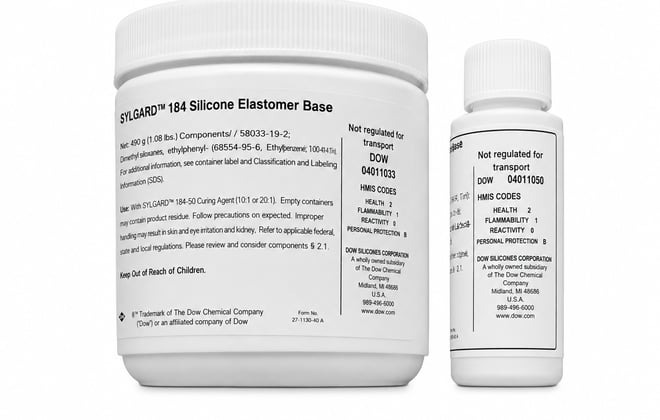
SYLGARD™ 184 is positioned as a transparent, two-part silicone encapsulant with good flame resistance. The table below places SYLGARD™ 184 within a broader optically clear material set and highlights its use as a transparent encapsulant.
| Product | Cure system | Features and benefits | Agency listing |
|---|---|---|---|
| DOWSIL™ EG-1200 Gel | Two-part addition | High transparency • Rapid, versatile-cure flowable gel • High tackiness for coupling a variety of surfaces • Can be used as liquid optically clear coupling agent for displays and lighting applications | Not listed |
| DOWSIL™ MS-1002 Moldable Silicone | Two-part addition | Optically clear moldable silicone • Suitable for producing fine-detail optical parts • Good resistance to environmental aging | UL 94 (f1) |
| DOWSIL™ VE-XXXX | UV | Transparent • Low modulus • Low shrinkage • UV-curable resin for liquid-based bonding technology • Designed to bond display cover glass/plastic and touch panel to LCD/OLED display modules | Not listed |
| SYLGARD™ 184 Silicone Elastomer | Two-part addition | Transparent, two-part encapsulant • Good flame resistance | UL 94 V-1 (f1) |
Processing, mechanical, and electrical data
The values below are typical values from the technical data sheet and are not intended for preparing specifications. They are useful screening anchors for electronics encapsulation, potting, and protective silicone applications.
| Property | Typical value |
|---|---|
| Composition | Polydimethylsiloxane elastomer |
| Mix ratio | 10 to 1 |
| Color | Colorless |
| Viscosity, base | 5100 cP, 5.1 Pa-sec |
| Viscosity, mixed | 3500 cP, 3.5 Pa-sec |
| Thermal conductivity | 0.27 W/mK |
| Pot life at 25°C | 1.5 hours |
| Cure schedule | 48 hr at 25°C, 35 min at 100°C, 20 min at 125°C, 10 min at 150°C |
| Durometer | 43 Shore A |
| Dielectric strength | 500 volts/mil, 19 kV/mm |
| Volume resistivity | 2.9E+14 ohm*cm |
| Dielectric constant | 2.72 at 100 Hz, 2.68 at 100 kHz |
| Tensile strength | 980 psi, 6.7 MPa |
| Refractive index | 1.4118 at 589 nm, 1.4225 at 632.8 nm |
| UL RTI rating | 150°C |
Mixing, de-airing, cure, and repairability
Application methods
SYLGARD™ 184 is designed for automated metered mixing and dispensing or manual mixing. Thoroughly mixed encapsulant can be poured or dispensed directly into the container in which it is to be cured.
De-airing and void control
In most cases, de-airing is not required. Where the component being potted or encapsulated has many small voids, dispensing under vacuum or evacuating the unit after dispensing is recommended by the TDS.
Cure behavior
Dow silicone encapsulants cure without exotherm at a constant rate regardless of sectional thickness or degree of confinement. SYLGARD™ 184 requires no post cure and can be placed in service immediately after the cure schedule is complete.
Repairability
Cured Dow silicone encapsulants can be selectively removed depending on the removal method and technique. Damaged or defective units can be repaired, and the repaired area can be repotted with additional product.
Electronics protection and transparent encapsulation uses
SYLGARD™ 184 Silicone Elastomer is suitable for the following applications listed in the technical data sheet.
Transparent encapsulation where high transparency allows easy inspection of components.
Protection for electrical assemblies requiring flexible silicone encapsulation.
Flowable encapsulation for component geometries requiring insulation and protection.
Electrical protection for assemblies requiring dielectric performance and stress relief.
Encapsulation and protection for relay assemblies listed in the technical data sheet.
Suitable as an adhesive or encapsulant for solar cells and for adhesive handling of beam lead integrated circuits during processing.
Technical and safety documents
Review the technical data sheet and safety data sheets before handling, processing, or specifying SYLGARD™ 184 Silicone Elastomer Kit. These documents support property review, processing setup, safe handling, storage, exposure controls, and disposal review.
Review typical properties, cure schedules, application methods, processing guidance, applications, limitations, and product stewardship information.
Review safe handling, storage, exposure controls, physical and health hazard information, transport, and disposal information for Part A.
Review safe handling, storage, exposure controls, physical and health hazard information, transport, and disposal information for Part B.
Need help evaluating SYLGARD™ 184 for your electronics application?
Share your assembly design, substrate materials, dispensing process, cure limits, and reliability requirements so CAPLINQ can support product evaluation and application review.