
-
Home

-
Products
-
Molding Compounds
-
Optoelectronic Epoxy Mold Compounds
- WMC-G279 | White Epoxy Molding Compound
WMC-G279 | White Epoxy Molding Compound
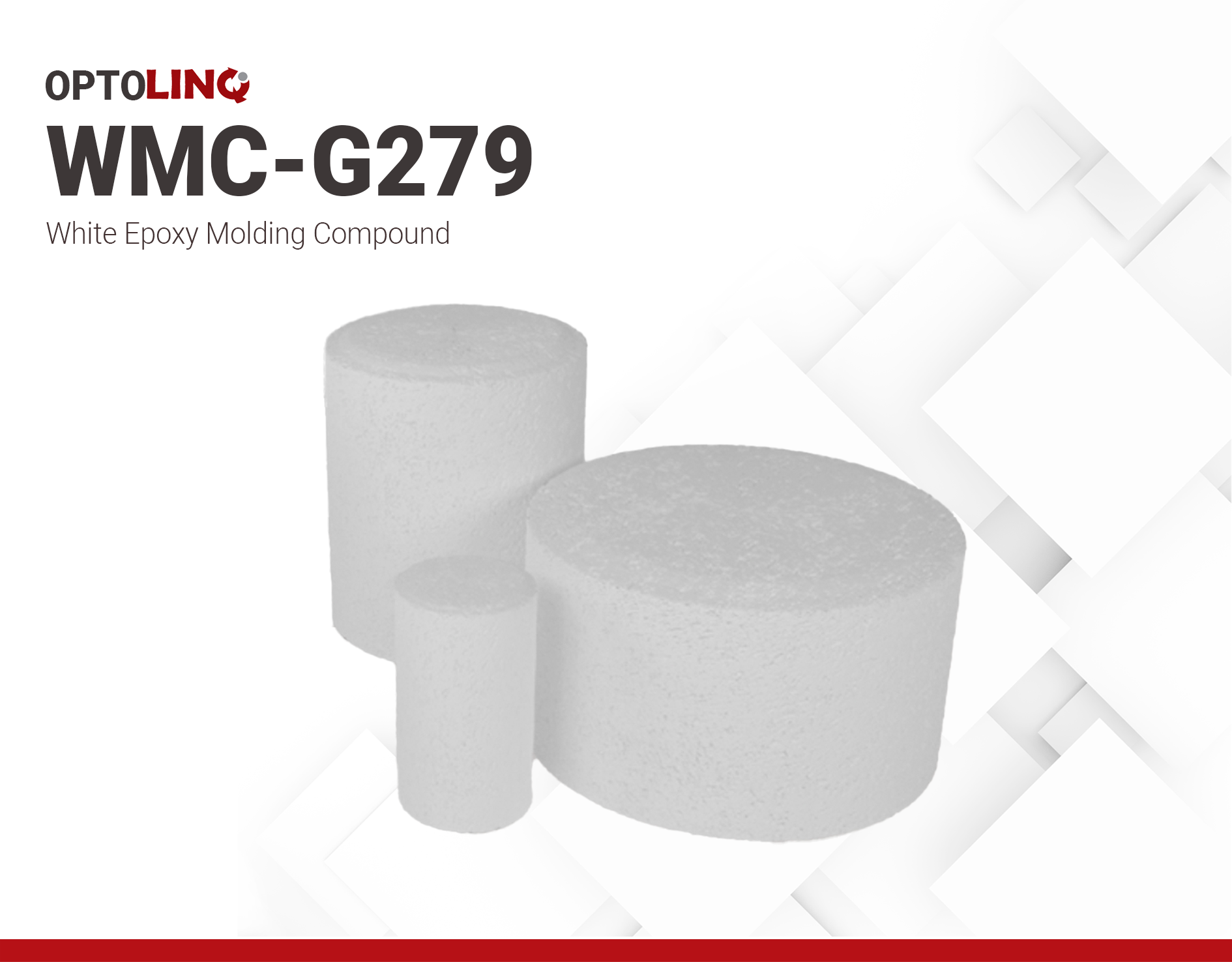

- White transmitting EMC for optocouplers
- Balanced moldability and cycle efficiency
- Low stress
Product Description
OPTOLINQ™ WMC-G279 is a white, halogen-free, light-transmitting epoxy molding compound developed for photocoupler and optocoupler packages. It is formulated for good moldability and low-stress encapsulation, with a spiral flow of 85 cm and gel time of 22 s at 175 °C. The cured compound provides a glass transition temperature of 180 °C, flexural strength of 155 MPa, and flexural modulus of 16.6 GPa at 25 °C, supporting package integrity during molding, post-cure, and downstream thermal exposure.
For electrical and environmental reliability, WMC-G279 combines low ionic contamination, 0.5% water absorption after PCT 24 h, extract pH of 6.7, and extract conductivity of 40 µS/cm. It also provides volume resistivity of 5.0 × 10¹⁵ Ω·cm at 25 °C, CTI of 300 V, and UL 94 V-0 flammability. Optical performance is defined by 20% transmittance at 2 mm thickness at 940 nm, making it suitable for optocoupler designs that depend on controlled light transmission rather than reflective cavity behavior. For similar optical isolation molding applications, OPTOLINQ™ WMC-G279 can be positioned as a close functional alternative to Hysol GR180T.
Key Features
- White transmitting formulation: Supports optical transmission in photocoupler and optocoupler package designs.
- Good moldability: 85 cm spiral flow at 175 °C supports practical transfer molding behavior.
- Fast gel time: 22 s at 175 °C supports efficient molding cycles.
- High thermal stability: Tg of 180 °C supports reflow and thermal cycling robustness.
- Low moisture uptake: 0.5% water absorption after PCT 24 h helps limit moisture-driven reliability risk.
- Low ionic contamination: Low chloride and sodium levels support long-term electrical reliability.
- Electrical insulation capability: Volume resistivity of 5.0 × 10¹⁵ Ω·cm and CTI of 300 V support isolation-focused packages.
- UL 94 V-0 flame rating: Meets a common flammability requirement for electronic package materials.
Applications / Suitable For
- Photocouplers
- Optocouplers
- Optical isolators / opto-isolators
- Transfer-molded optoelectronic isolation packages
- Packages requiring white transmitting EMC behavior
- Applications requiring halogen-free EMC and UL 94 V-0 performance
OPTOLINQ WMC-G279 is available in custom pellet dimensions. Contact us for detailed specifications.
Technical Specifications
| General Properties | |||||||
|
Specific Gravity
Specific Gravity
Specific gravity (SG) is the ratio of the density of a substance to the density of a reference substance; equivalently, it is the ratio of the mass of a substance to the mass of a reference substance for the same given volume. For liquids, the reference substance is almost always water (1), while for gases, it is air (1.18) at room temperature. Specific gravity is unitless. |
1.88 | ||||||
| Thermal Properties | |||||||
|
Glass Transition Temperature (Tg)
Glass Transition Temperature (Tg)
The glass transition temperature for organic adhesives is a temperature region where the polymers change from glassy and brittle to soft and rubbery. Increasing the temperature further continues the softening process as the viscosity drops too. Temperatures between the glass transition temperature and below the decomposition point of the adhesive are the best region for bonding. The glass-transition temperature Tg of a material characterizes the range of temperatures over which this glass transition occurs. |
180 °C | ||||||
|
UL 94 Rating
UL 94 Rating
Flammability rating classification. It determines how fast a material burns or extinguishes once it is ignited. HB: slow burning on a horizontal specimen; burning rate less than 76 mm/min for thickness less than 3 mm or burning stops before 100 mm V-2: burning stops within 30 seconds on a vertical specimen; drips of flaming particles are allowed. V-1: burning stops within 30 seconds on a vertical specimen; drips of particles allowed as long as they are not inflamed. V-0: burning stops within 10 seconds on a vertical specimen; drips of particles allowed as long as they are not inflamed. 5VB: burning stops within 60 seconds on a vertical specimen; no drips allowed; plaque specimens may develop a hole. 5VA: burning stops within 60 seconds on a vertical specimen; no drips allowed; plaque specimens may not develop a hole |
V-0 | ||||||
|
|||||||
|
|||||||
| Electrical Properties | |||||||
|
Volume Resistivity
Volume Resistivity
Volume resistivity, also called volume resistance, bulk resistance or bulk resistivity is a thickness dependent measurement of the resistivity of a material perpendicular to the plane of the surface. |
5e 15 Ohms⋅cm | ||||||
|
|||||||
| Mechanical Properties | |||||||
|
|||||||
|
|||||||
|
|||||||
| Chemical Properties | |||||||
| Water Absorption | 0.5 % | ||||||
|
|||||||
| Curing Conditions | |||||||
| Transfer Pressure | 40-70 kg/cm2 | ||||||
| Transfer Time | 10-20 s | ||||||
|
|||||||
|
|||||||
| Physical Properties | |||||||
| Spiral Flow @ 175°C | 85 cm | ||||||