
-
Home

-
Products
-
Encapsulants & Underfills
-
Optically Clear Materials
- ABchimie R12230 Optically Clear Encapsulation Gel
ABchimie R12230 Optically Clear Encapsulation Gel
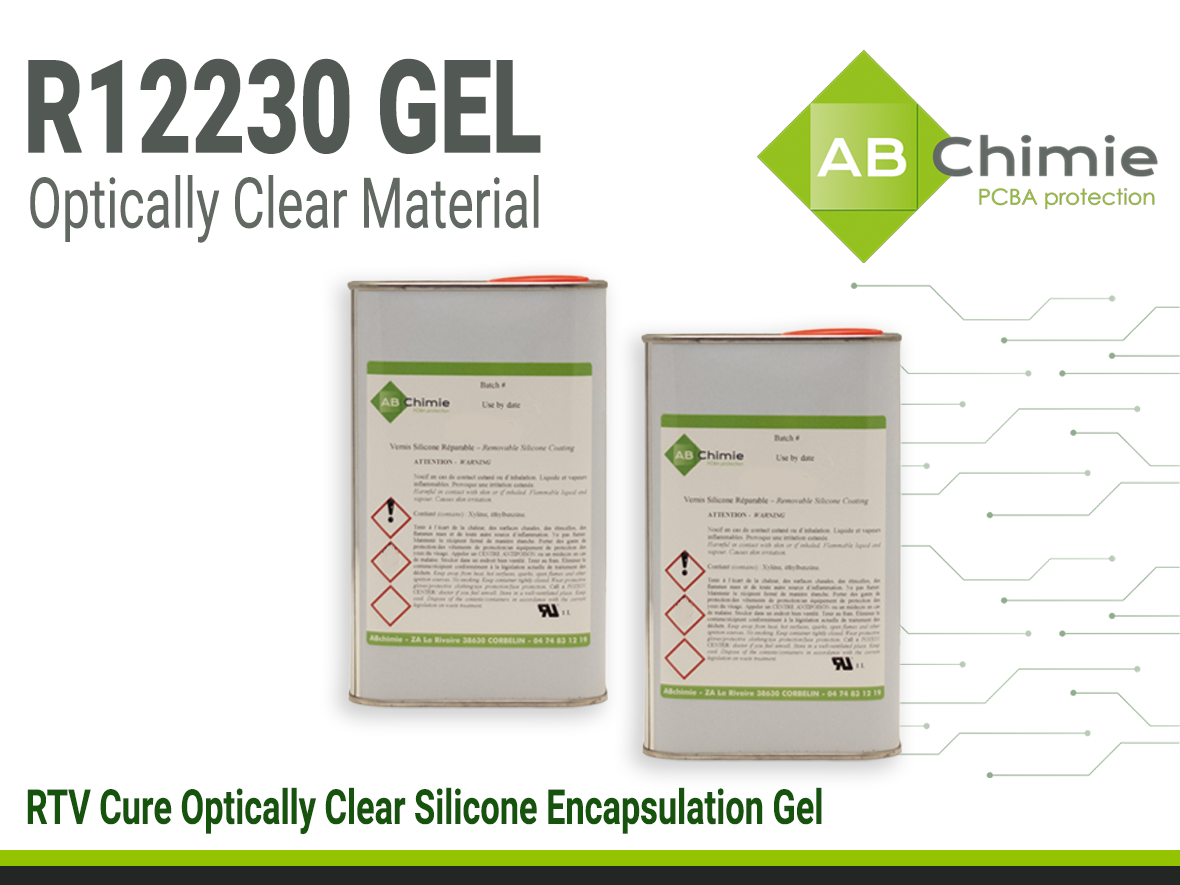

- Optically clear
- Quick setting
- Good heat stability
Product Description
ABchimie R12230 GEL is a pourable, two‑component silicone rubber that cures at room temperature through a polyaddition reaction to form a very soft, optically clear silicone gel. Designed for high‑transparency applications, it provides excellent protection for sensitive electronic components while maintaining exceptional clarity and long‑term stability.
Its softness, transparency, and ability to flow into complex geometries make R12230 GEL ideal for encapsulating sensors, delicate electronic assemblies, and components requiring vibration damping. A fast‑curing version, R12230 GEL ACC, is also available for applications requiring shorter processing times
Product Key Features
- Excellent transparency for optical or sensor‑based applications
- Easy‑flowing formulation suitable for potting complex shapes
- Provides vibration damping and mechanical stress relief
Applications
- Encapsulation of optical or light‑sensitive electronic components
- Damping systems and vibration‑sensitive assemblies
Technical Specifications
| General Properties | |
|
Appearance
Appearance
Appearance at room temperature. |
Liquid |
|
Color
Color
The color |
Transparent |
|
Mix Ratio
Mix Ratio
The amount of a constituent divided by the total amount of all other constituents in a mixture |
1:1 |
|
Specific Gravity
Specific Gravity
Specific gravity (SG) is the ratio of the density of a substance to the density of a reference substance; equivalently, it is the ratio of the mass of a substance to the mass of a reference substance for the same given volume. For liquids, the reference substance is almost always water (1), while for gases, it is air (1.18) at room temperature. Specific gravity is unitless. |
0.98 |
|
Work life @25°C
Work life @25°C
Work life is the amount of time we have to work with a material until it is no longer able to be easily worked and applied on a substrate. It is based on the change in viscosity and it can rely on the application requirements. |
0.83 hours |
| Physical Properties | |
|
Viscosity
Viscosity
Viscosity is a measurement of a fluid’s resistance to flow. Viscosity is commonly measured in centiPoise (cP). One cP is defined as the viscosity of water and all other viscosities are derived from this base. MPa is another common unit with a 1:1 conversion to cP. A product like honey would have a much higher viscosity -around 10,000 cPs- compared to water. As a result, honey would flow much slower out of a tipped glass than water would. The viscosity of a material can be decreased with an increase in temperature in order to better suit an application |
1200 mPa.s |
| Curing Conditions | |
| Cure Time | 120 - 180 min |
| Electrical Properties | |
| Dielectric Constant @ 1000 kHz | 2.8 |
|
Dielectric Strength
Dielectric Strength
Dielectric strength is measured in kV per mm and is calculated by the Breakdown voltage divided by the thickness of the tested material. Those two properties go hand in hand and while Breakdown voltage is always thickness dependent, dielectric strength is a general material property. As an example, the dielectric strength of Polyimide is 236 kV/mm. If we place 1mm of Polyimide between two electrodes, it will act as an insulator until the voltage between the electrodes reaches 236 kV. At this point it will start acting as a good conductor, causing sparks, potential punctures and current flow. |
23 kV/mm |
| Dissipation Factor @ 23°C /1 kHz | 0.001 |
|
Volume Resistivity
Volume Resistivity
Volume resistivity, also called volume resistance, bulk resistance or bulk resistivity is a thickness dependent measurement of the resistivity of a material perpendicular to the plane of the surface. |
1.1x10¹⁵ Ohms⋅cm |
Additional Information
Instructions for Use
Mixing of the Two Components
Hand mixing
The two components are thoroughly mixed using an electrical or pneumatic mixer, on a low speed setting so as to limit the inclusion of air in the mixture. A dispensing machine can also be used. After mixing A and B parts, it is preferable to degas the product to eliminate the air bubbles that would be visible in the finished part and which would reduce the mechanical and dielectric properties. Degassing is generally carried out with a vacuum of 30 to 50 mbar releasing the vacuum several times during the operation. A recipient with a high diameter/height ratio is better suited to quick degassing; however the height must be sufficient to contain the swelling of the elastomer under vacuum conditions.
Automatic mixing (to be preferred when using R12230 GEL ACC as the pot life is too short to hand-mix and efficiently degas the material).
In order to avoid any air bubbles that may affect the mechanical and dielectric properties, it is recommended to degas separately A and B part, prior to pour it slowly and regularly into the tanks of the dosing machine. The A and B Parts should be dosed and mixed with a static mixer with a standard commercial equipment (A special care is recommended in pumping the product from the tanks to avoid any air entry before dosing and mixing).
After Mixing
R12230 GEL (A+B) or R12230 GEL ACC (A+B) is poured slowly and regularly. In the case of a high thickness coating operation, the casting must be made at the lowest point in the volume to be filled; this avoids forming and including air bubbles in the volume. It should not be filled totally to allow expansion of the gel at service temperatures. Certain materials that R12230 GEL or R12230 GEL ACC may be in contact with when curing could inhibit the reaction. Especially troublesome materials are: Sulphur- containing cured natural and synthetic rubber compounds (neoprene, latex, SBR), tin catalyzed silicone rubbers, amine catalyzed epoxies, PVC stabilized with tin salts and some polyurethane elastomers.