-
Home

-
Products
-
Adhesives
-
Silicone Adhesives
- DOWSIL™ TC-5550 Thermal Conductive Compound
DOWSIL™ TC-5550 Thermal Conductive Compound
- Good pump-out resistance for bare die application
- High thixotropy
- Low thermal resistance
Product Description
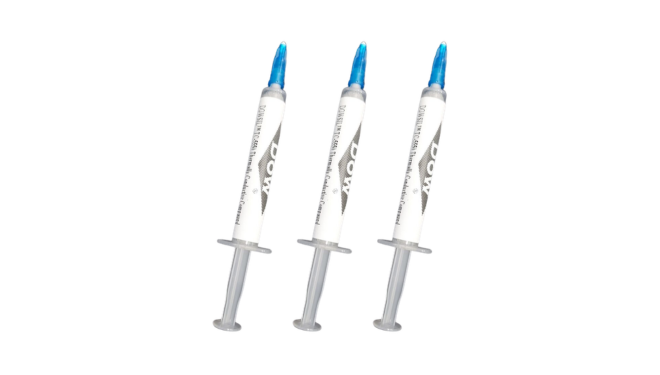
DOWSIL™ TC-5550 Thermally Conductive Compound is a high-performance, one-part, non-curing silicone thermal interface material designed to provide efficient heat transfer in electronic modules, processors, and bare die applications where long-term thermal reliability is critical. Delivering 5.0 W/m·K thermal conductivity, excellent pump-out resistance, and an ultra-thin bondline thickness of approximately 20 μm, TC-5550 minimizes thermal resistance while maintaining stable thermal performance under demanding operating conditions. Its highly thixotropic, solvent-free formulation enables consistent screen printing, stencil printing, or dispensing without viscosity drift over time, making it ideal for automated manufacturing environments. The grease-like silicone matrix creates an effective thermal bridge between heat-generating devices and heat sinks, helping improve cooling efficiency, system performance, and long-term reliability in compact electronic designs.
Key Features
-
5.0 W/m·K thermal conductivity for efficient heat transfer.
-
Excellent pump-out resistance for bare die and high-power semiconductor applications.
-
Ultra-thin bondline capability of approximately 20 μm (0.02 mm).
-
Low thermal resistance of 0.05 °C·cm²/W at 40 psi.
-
One-part, non-curing formulation eliminates cure processing.
-
High thixotropy (~8) for controlled placement and print definition.
-
Screen printable, stencil printable, and dispensable for flexible manufacturing.
-
Solvent-free formulation provides long-term viscosity stability.
-
99.96% non-volatile content for consistent thermal performance.
-
Easy reworkability compared with cured thermal interface materials.
-
Maintains a positive heat sink seal for improved thermal transfer.
-
Suitable for bare die cooling, ASICs, CPUs, GPUs, AI accelerators, power modules, networking equipment, HPC servers, telecom systems, and advanced electronic modules.
Technical Specifications
| General Properties | |
|
Color
Color
The color |
Gray |
|
Component System
Component System
Describes the number of components that must be supplied, mixed, or activated before application or cure. |
One Part |
|
Specific Gravity
Specific Gravity
Specific gravity (SG) is the ratio of the density of a substance to the density of a reference substance; equivalently, it is the ratio of the mass of a substance to the mass of a reference substance for the same given volume. For liquids, the reference substance is almost always water (1), while for gases, it is air (1.18) at room temperature. Specific gravity is unitless. |
2.6 |
| Physical Properties | |
|
Thixotropic index
Thixotropic index
Thixotropic Index is a ratio of a material s viscosity at two different speeds in Ambient temperature, generally different by a factor of ten. A thixotropic material s viscosity will decrease as agitation or pressure is increased. It indicates the capability of a material to hold its shape. Mayonnaise is a great example of this. It holds its shape very well, but when a shear stress is applied, the material easily spreads. It helps in choosing a material in accordance to the application, dispense method and viscosity of a material. |
~8 |
|
Viscosity
Viscosity
Viscosity is a measurement of a fluid’s resistance to flow. Viscosity is commonly measured in centiPoise (cP). One cP is defined as the viscosity of water and all other viscosities are derived from this base. MPa is another common unit with a 1:1 conversion to cP. A product like honey would have a much higher viscosity -around 10,000 cPs- compared to water. As a result, honey would flow much slower out of a tipped glass than water would. The viscosity of a material can be decreased with an increase in temperature in order to better suit an application |
120000-170000 mPa.s |
| Other Properties | |
|
VOC-Free (100% solids content)
VOC-Free (100% solids content)
VOC means Volatile Organic compound. VOCs are evaporating molecules and are literally everywhere around us. Our scents are volatile organic compounds, most of the things that we smell are VOC etc. So what do we mean when we state that a product is VOC free? A VOC free product, according to the FTC is one where: 1)VOCs have not been intentionally added to the product. 2)The presence of VOCs at that level does not cause material harm that consumers typically associate with VOCs, including but not limited to, harm to the environment or human health. 3)The presence of VOCs at that level does not result in concentrations higher than would be found at background levels in the ambient air. |
99.96 |
| Thermal Properties | |
|
Thermal Conductivity
Thermal Conductivity
Thermal conductivity describes the ability of a material to conduct heat. It is required by power packages in order to dissipate heat and maintain stable electrical performance. Thermal conductivity units are [W/(m K)] in the SI system and [Btu/(hr ft °F)] in the Imperial system. |
5.0 W/m.K |
| Thermal Impedance | 0.05 °C·cm²/W |
Additional Information
DOWSIL™ TC-5550: Printable Thermally Conductive Compound for Bare Die Cooling
DOWSIL™ TC-5550 Thermally Conductive Compound is a gray, thixotropic, non-curing silicone thermal compound designed for efficient heat transfer in electronic modules, especially bare die applications requiring good pump-out resistance. With 5.0 W/m·K thermal conductivity, high thixotropy, low thermal resistance, and thin bondline capability, TC-5550 helps improve thermal transfer from electronic devices or PCB assemblies to heat sinks or chassis while supporting screen printing, stencil printing, and dispensing processes.
High-conductivity TIM with pump-out resistance — TC-5550 delivers 5.0 W/m·K thermal conductivity, high thixotropy, and reliable printability for compact electronic module cooling.
Its solvent-free, one-part formulation requires no cure, remains stable after opening, and enables consistent screen or stencil printing for high-performance thermal interface applications.
Designed for bare die and compact electronics cooling — suitable for thermal transfer between semiconductor devices, electronic modules, heat sinks, and chassis.
The grease-like silicone compound maintains a positive heat sink seal while offering ease of application, reworkability, and strong resistance to pump-out during operation.
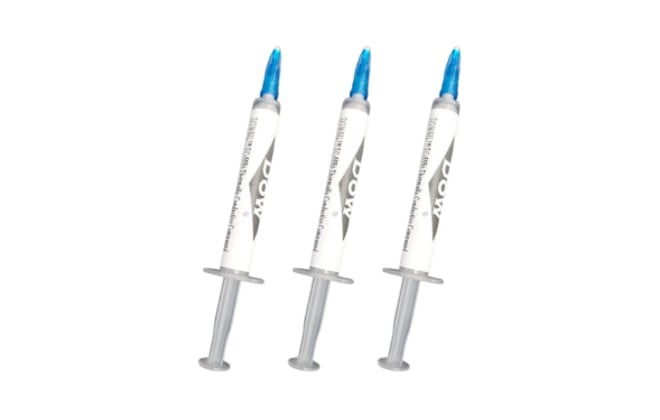
5.0 W/m·K Thermal Conductivity • Non-Curing • Pump-Out Resistant • Screen & Stencil Printable
Features & Benefits
- 5.0 W/m·K thermal conductivity — supports high-performance heat transfer.
- Good pump-out resistance — designed especially for bare die applications.
- One-part material — no mixing and no cure required.
- Solvent-free formulation — provides material stability after opening.
- High thixotropy — supports controlled placement and print definition.
- Screen and stencil printable — suitable for patterned TIM application.
- Thin BLT capability — supports lower thermal resistance.
- Easy rework — non-curing grease-like compound enables serviceability.
Typical Applications
- Bare die thermal interface applications.
- Electronic module cooling.
- Processor-to-heat-sink interfaces.
- PCB assembly thermal management.
- Heat sink or chassis thermal coupling.
- Screen printed TIM patterns.
- Stencil printed thermal compound applications.
Thermal Challenges in Compact Electronic Modules
Bare die and compact electronic modules require thermal interface materials that can provide high conductivity, thin bondlines, stable placement, and resistance to pump-out under thermal cycling. DOWSIL™ TC-5550 helps address these challenges with a highly thixotropic, non-curing silicone compound that can be screen printed, stencil printed, or dispensed onto heat sinks and electronic assemblies.
Engineering Data for DOWSIL™ TC-5550
| Property | DOWSIL™ TC-5550 | Condition / Note |
|---|---|---|
| Type | One-part compound | Non-curing thermal compound |
| Color | Gray | Typical appearance |
| Viscosity at High Strain | 120–170 Pa·s | ASTM D4440 |
| Thixotropic Index | ~8 | High thixotropy |
| Specific Gravity | 2.6 g/ml | ASTM D1298 |
| Non-Volatile Content | 99.96% | 48 h at 125 °C |
| Thermal Conductivity | 5.0 W/m·K | Hot Disk, ISO 22007-2 |
| Thermal Resistance | 0.05 °C·cm²/W | At 40 psi / ~25 N/cm² |
| Bondline Thickness | 0.02 mm / 0.0008 inch | At 40 psi / ~25 N/cm² |
*Typical properties are not intended for specification writing. Verify performance under actual application, assembly pressure, bondline thickness, printing process, and reliability conditions.
Where DOWSIL™ TC-5550 Fits
- Bare die TIM
- Semiconductor packages
- High-power chips
- PCB assemblies
- Control modules
- Heat sink interfaces
- Screen printing
- Stencil printing
- Dispensing
Printing, Dispensing & Application
Screen Printing
High thixotropy supports controlled screen printing for patterned TIM placement on heat sinks or modules.
Stencil Printing
Stencil printing can be used to define repeatable thermal compound patterns and target bondline control.
Dispensing
The one-part, non-curing compound is also suitable for dispense processes where reworkability and no-cure assembly are required.
How TC-5550 Supports High-Performance Thermal Design
| Design Challenge | DOWSIL™ TC-5550 Benefit |
|---|---|
| Bare die interfaces can experience pump-out over time. | Good pump-out resistance helps maintain the thermal interface during operation. |
| High-power devices require efficient heat transfer. | 5.0 W/m·K thermal conductivity supports effective heat dissipation. |
| Thermal compounds must print consistently in production. | Solvent-free formulation helps maintain stable viscosity after container opening. |
| Manufacturers may need serviceable, no-cure interfaces. | One-part, non-curing format supports easy application and rework. |
Ready to Evaluate DOWSIL™ TC-5550?
```