
-
Home

-
Products
-
Coatings, powders & Resins
-
Conformal Coatings
- HumiSeal 1B73LOC Acrylic Conformal Coating
HumiSeal 1B73LOC Acrylic Conformal Coating
Harmonization Code : 3906909090 | Acrylic polymers in primary form
Others>Others
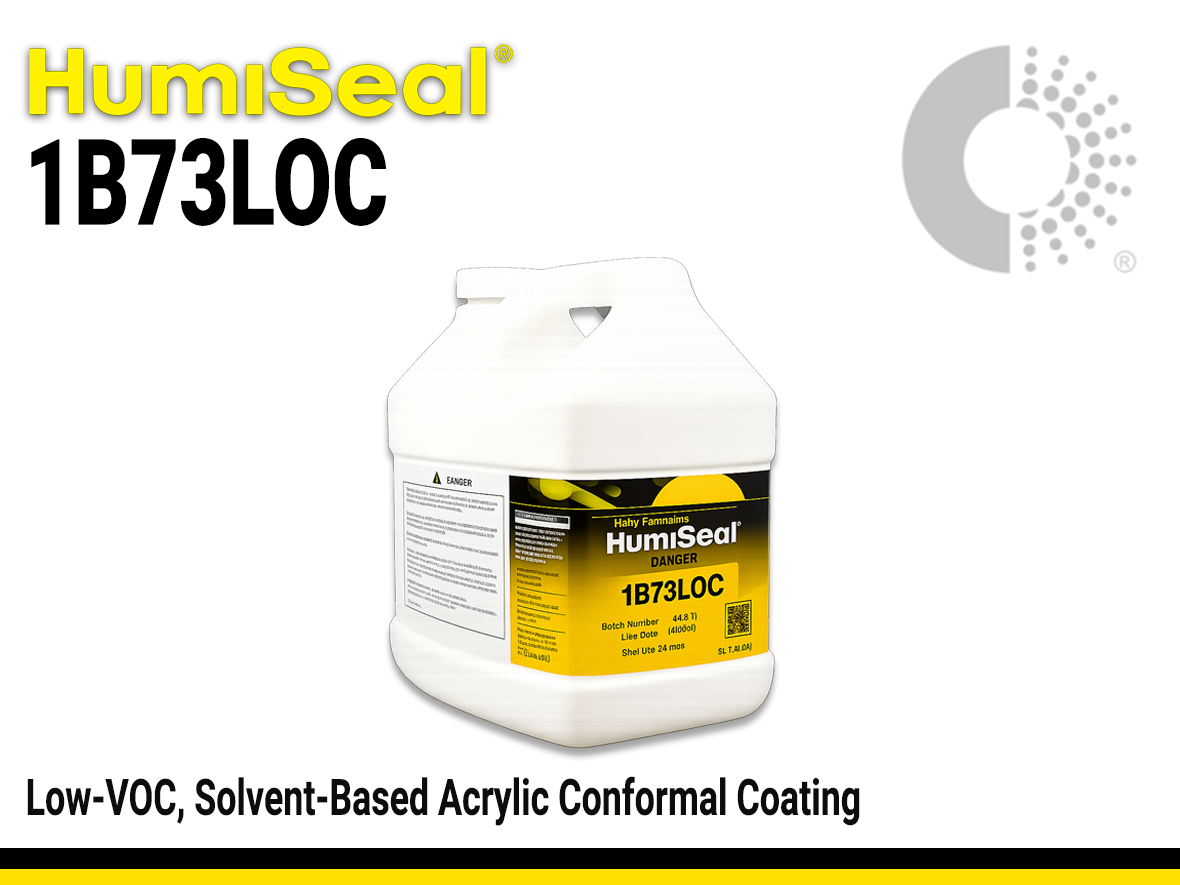
Main features
- MIL‑I‑46058C qualified
- RoHS Directive 2011/65/EU compliant
- UL recognized (File Number E105698)
Product Description
HumiSeal 1B73LOC is a low‑VOC, solvent‑based acrylic conformal coating formulated to comply with most North American air‑quality regulations. 1B73LOC is designed for printed circuit assemblies and offers strong performance along with easy inspection—thanks to its UV fluorescence once cured. The coating is easily repairable and meets multiple industry standards, including MIL‑I‑46058C, IPC‑CC‑830, RoHS Directive 2011/65/EU, and UL File Number E105698.
Product Key Features
- Low VOC formulation
- MIL‑I‑46058C qualified
- IPC‑CC‑830 compliant
- RoHS Directive 2011/65/EU compliant
- UL recognized (File Number E105698)
Applications
- Printed circuit boards (PCBs) used in consumer, commercial, and industrial electronics
- Electronic assemblies in regions requiring low‑VOC compliant manufacturing processes
Technical Specifications
| General Properties | |||||
| Density (g) | 1.23 g/cm3 | ||||
|
Film Thickness
Film Thickness
Film thickness is the thickness of a backing film without taking into account any coatings or adhesive layers. It is measured in micron and the conversion factor to mil is 0.039. |
25-75 µm | ||||
| Solids | 26 % | ||||
| Physical Properties | |||||
|
Viscosity
Viscosity
Viscosity is a measurement of a fluid’s resistance to flow. Viscosity is commonly measured in centiPoise (cP). One cP is defined as the viscosity of water and all other viscosities are derived from this base. MPa is another common unit with a 1:1 conversion to cP. A product like honey would have a much higher viscosity -around 10,000 cPs- compared to water. As a result, honey would flow much slower out of a tipped glass than water would. The viscosity of a material can be decreased with an increase in temperature in order to better suit an application |
445 mPa.s | ||||
| Thermal Properties | |||||
|
Glass Transition Temperature (Tg)
Glass Transition Temperature (Tg)
The glass transition temperature for organic adhesives is a temperature region where the polymers change from glassy and brittle to soft and rubbery. Increasing the temperature further continues the softening process as the viscosity drops too. Temperatures between the glass transition temperature and below the decomposition point of the adhesive are the best region for bonding. The glass-transition temperature Tg of a material characterizes the range of temperatures over which this glass transition occurs. |
42 °C | ||||
| Operating Temperature | -65 - 125 °C | ||||
|
UL 94 Rating
UL 94 Rating
Flammability rating classification. It determines how fast a material burns or extinguishes once it is ignited. HB: slow burning on a horizontal specimen; burning rate less than 76 mm/min for thickness less than 3 mm or burning stops before 100 mm V-2: burning stops within 30 seconds on a vertical specimen; drips of flaming particles are allowed. V-1: burning stops within 30 seconds on a vertical specimen; drips of particles allowed as long as they are not inflamed. V-0: burning stops within 10 seconds on a vertical specimen; drips of particles allowed as long as they are not inflamed. 5VB: burning stops within 60 seconds on a vertical specimen; no drips allowed; plaque specimens may develop a hole. 5VA: burning stops within 60 seconds on a vertical specimen; no drips allowed; plaque specimens may not develop a hole |
V-0 | ||||
|
|||||
| Electrical Properties | |||||
|
Breakdown Voltage
Breakdown Voltage
Breakdown voltage is the minimum voltage necessary to force an insulator to conduct some amount of electricity. It is the point at which a material ceases to be an insulator and becomes a resistor that conducts electricity at some proportion of the total current. After dielectric breakdown, the material may or may not behave as an insulator any more because of the molecular structure alteration. The current flow tend to create a localised puncture that totally alters the dielectric properties of the material. This electrical property is thickness dependent and is the maximum amount of voltage that a dielectric material can withstand before breaking down. The breakdown voltage is calculated by multiplying the dielectric strength of the material times the thickness of the film. |
6300 V | ||||
|
|||||
|
|||||