-
Home

-
Products
-
Molding Compounds
-
Semiconductor Epoxy Mold Compounds
- LINQSOL EMC-G374
LINQSOL EMC-G374
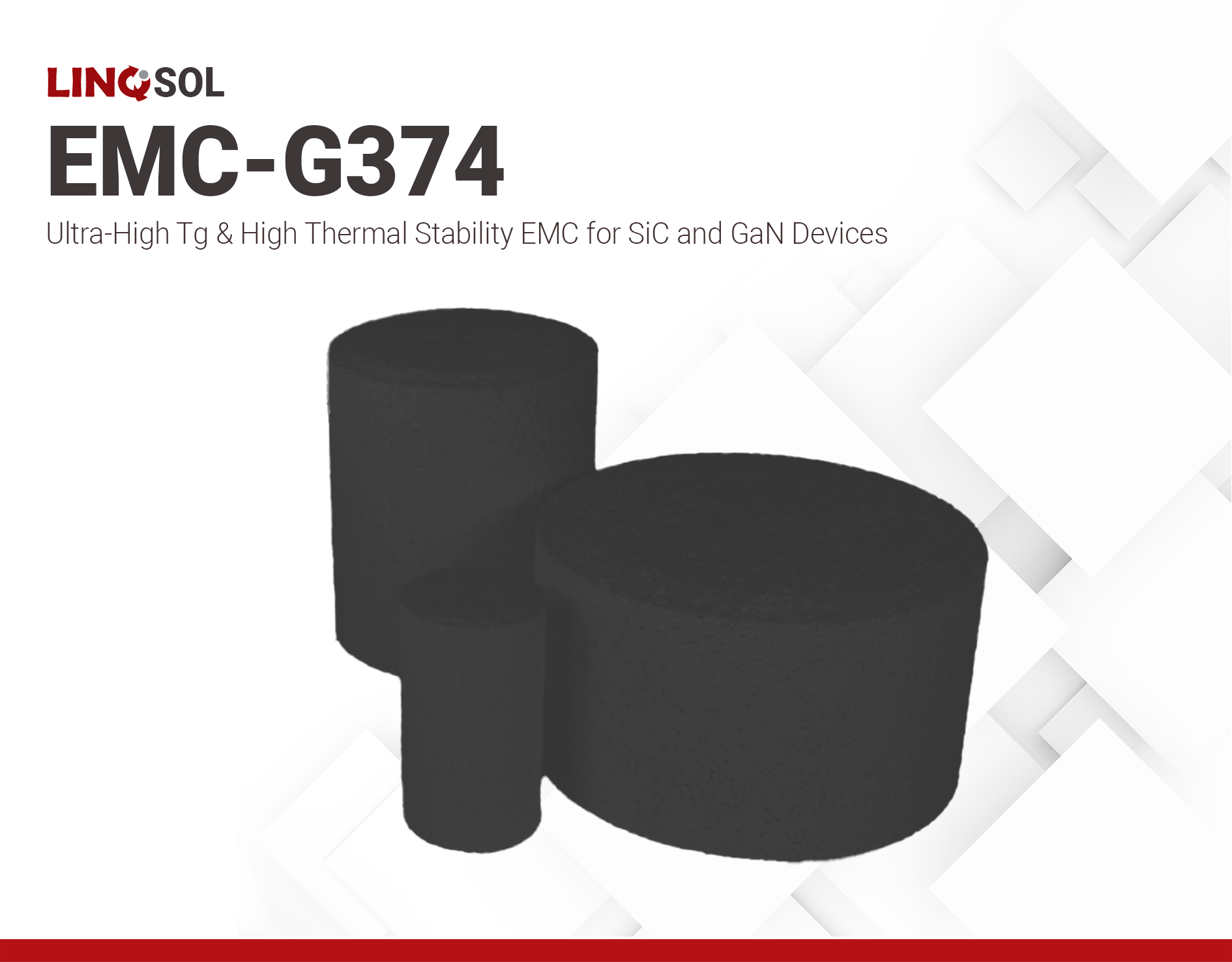

- Ultra-high glass transition temperature (272 °C)
- Designed for high-power SiC and GaN devices
- High degradation temperature, and excellent thermal stability
Product Description
LINQSOL™ EMC-G374 is a next-generation, epoxy molding compound engineered specifically for high-power, high-voltage SiC and GaN packages. Its ultra-high Tg (272 °C), high degradation temperature (460 °C) provide exceptional thermal stability through assembly and operation, and a UL 94 V-0 flammability rating highlighting its adherence to stringent safety standards for high-power semiconductor applications. EMC-G374 guarantees strong performance and outstanding reliability in demanding automotive, industrial, and energy systems.
With very low ionic content, low dissipation factor (0.0013), moderate dielectric constant (3.5), and very high volume resistivity (6.0×10¹⁶ Ω·cm), EMC-G374 safeguards creepage/clearance and partial-discharge performance in high-voltage modules. Fast gel (28 s @ 175 °C), spiral flow (100 cm), and short cure (2.5–4 min @ 175 °C) enable efficient molding cycles.
Overall, LINQSOL EMC-G374 seamlessly integrates advanced material properties, safety compliance, and superior performance, precisely meeting the stringent demands of high-power semiconductor components such as TO packages LINQSOL EMC-G374 finds its niche in high-voltage and high-power discrete packages and power modules, including but not limited to IGBT, TO220, TO247, and other surface mount devices.
Key Features
- Ultra-High Tg (272 °C): Withstands high junction temps and aggressive reflow and sintering profiles.
- High Degradation Temp (460 °C): Extra thermal safety margin vs. conventional EMCs.
- Low CTE (12/52 ppm/°C): Mitigates die/package stress and warpage in large-area power chips.
- High Modulus Retention: 21/9.5 GPa (25/260 °C) supports mechanical stability at heat.
- Excellent Moldability: Spiral flow 100 cm, viscosity 42,000 cP @ 175 °C, gel 28 s for fast, complete fill.
- Electrical Insulation Integrity: 6.0×10¹⁶ Ω·cm volume resistivity for HV isolation.
- Low Loss Dielectric: Df 0.0013, Dk 3.512 to reduce heating and leakage under AC stress.
- Clean Chemistry: Cl ≤2.1 ppm / Na ≤1.3 ppm / SO₄²⁻ <1.0 ppm lowers corrosion/ionic migration risk.
- Moisture Control: 0.8% PCT (96 h) aids reliability in humid/condensing environments.
- Safety: UL94 V-0 flammability rating for compliance-driven markets.
Applications suitable for:
- SiC MOSFET / Schottky diode modules and GaN HEMT (Gallium Nitride High-Electron-Mobility Transistor) power packages
- Automotive traction inverters, on-board chargers (OBC), DC/DC converters
- Industrial drives, servo inverters, robotics, welding power supplies
- Renewable/ESS inverters (PV, wind, battery), UPS and server/telecom PSUs
- High-temperature, high-voltage power modules and transfer-molded packages
Technical Specifications
| General Properties | |
|
Color
Color
The color |
Black |
| Filler Content | 82 % |
|
Specific Gravity
Specific Gravity
Specific gravity (SG) is the ratio of the density of a substance to the density of a reference substance; equivalently, it is the ratio of the mass of a substance to the mass of a reference substance for the same given volume. For liquids, the reference substance is almost always water (1), while for gases, it is air (1.18) at room temperature. Specific gravity is unitless. |
1.92 |
| Physical Properties | |
| Spiral Flow @ 175°C | 100 cm |
|
Viscosity
Viscosity
Viscosity is a measurement of a fluid’s resistance to flow. Viscosity is commonly measured in centiPoise (cP). One cP is defined as the viscosity of water and all other viscosities are derived from this base. MPa is another common unit with a 1:1 conversion to cP. A product like honey would have a much higher viscosity -around 10,000 cPs- compared to water. As a result, honey would flow much slower out of a tipped glass than water would. The viscosity of a material can be decreased with an increase in temperature in order to better suit an application |
42000 mPa.s |
| Chemical Properties | |
|
Chloride (Cl-)
Chloride (Cl-)
The amount of Chloride (Cl-) ion extracted from the product in parts per million (ppm) |
2.1 ppm |
|
Sodium (Na+)
Sodium (Na+)
The amount of Sodium (Na+) ion extracted from the product in parts per million (ppm) |
1.3 ppm |
| Water Extract Conductivity | 11.8 Ohm |
| Mechanical Properties | |
|
Adhesion Strength
Adhesion Strength
Adhesion is the bond strength measurement of a coating to a substrate. When an adhesive is bonded to an item or surface, numerous physical, mechanical and chemical forces come into play, which may have an effect on each other. |
13227.5 Oz/in |
| Flexural Modulus @ 25°C | 21 N/mm2 |
|
Flexural Strength @ 25°C
Flexural Strength @ 25°C
Flexural strength, also known as modulus of rupture, or bend strength, or transverse rupture strength is a material property, defined as the stress in a material just before it yields in a flexure test. This is the flexural strength tested at Room Temperature, 25°C |
144 N/mm2 |
| Molded Shrinkage | 0.12 % |
| Storage (DMA) Modulus @ 25°C | 17.5 N/mm2 |
| pH of extract | 5-7 |
| Thermal Properties | |
|
Coefficient of Thermal Expansion (CTE), α1
Coefficient of Thermal Expansion (CTE), α1
CTE α1 (alpha 1) is the slope of the Coefficient of thermal expansion in a temperature range below the Glass transition temperature (Tg). It explains how much a material will expand until it reaches Tg. |
12 ppm/°C |
|
Coefficient of Thermal Expansion (CTE), α2
Coefficient of Thermal Expansion (CTE), α2
CTE α2 (alpha 2) is the slope of the Coefficient of thermal expansion in a temperature range above the Glass transition temperature (Tg). It explains the extent to which a material will expand after it passes Tg. |
52 ppm/°C |
|
Degradation temperature
Degradation temperature
The temperature at which the materials start losing their properties |
460 °C |
| Gel Time @ 175°C / 347°F | 28 s |
|
Glass Transition Temperature (Tg)
Glass Transition Temperature (Tg)
The glass transition temperature for organic adhesives is a temperature region where the polymers change from glassy and brittle to soft and rubbery. Increasing the temperature further continues the softening process as the viscosity drops too. Temperatures between the glass transition temperature and below the decomposition point of the adhesive are the best region for bonding. The glass-transition temperature Tg of a material characterizes the range of temperatures over which this glass transition occurs. |
272 °C |
|
UL 94 Rating
UL 94 Rating
Flammability rating classification. It determines how fast a material burns or extinguishes once it is ignited. HB: slow burning on a horizontal specimen; burning rate less than 76 mm/min for thickness less than 3 mm or burning stops before 100 mm V-2: burning stops within 30 seconds on a vertical specimen; drips of flaming particles are allowed. V-1: burning stops within 30 seconds on a vertical specimen; drips of particles allowed as long as they are not inflamed. V-0: burning stops within 10 seconds on a vertical specimen; drips of particles allowed as long as they are not inflamed. 5VB: burning stops within 60 seconds on a vertical specimen; no drips allowed; plaque specimens may develop a hole. 5VA: burning stops within 60 seconds on a vertical specimen; no drips allowed; plaque specimens may not develop a hole |
V-0 |
| Electrical Properties | |
| Dielectric Constant @ 1000 kHz | 3.512 |
| Dissipation Factor @ 25°C /1000 kHz | 0.0013 |
|
Volume Resistivity
Volume Resistivity
Volume resistivity, also called volume resistance, bulk resistance or bulk resistivity is a thickness dependent measurement of the resistivity of a material perpendicular to the plane of the surface. |
6.0x10¹⁶ Ohms⋅cm |