
-
Home

-
Products
-
Encapsulants & Underfills
-
Potting materials
- SYLGARD™ 527 A&B Silicone Dielectric Gel
SYLGARD™ 527 A&B Silicone Dielectric Gel
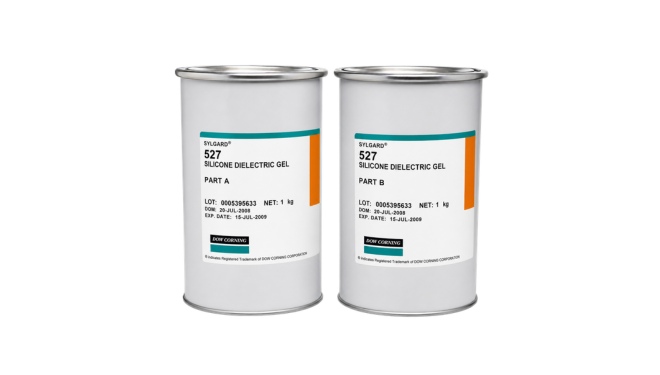
- 465 cP mixed viscosity for good flow under components
- Very soft, low-stress dielectric protection
- 425 V/mil dielectric strength and 2.75E+15 ohm*cm volume resistivity for electrical insulation
Product Description
SYLGARD™ 527 A&B Silicone Dielectric Gel is a two-part, 1:1 mix ratio polydimethylsiloxane dielectric gel designed for sealing, protecting, coating, encapsulating, and potting PCB system assemblies. It provides 465 cP mixed viscosity, 113 g gel hardness, and 425 V/mil dielectric strength while supporting room-temperature cure or heat-accelerated cure for process flexibility. This makes it a candidate for assemblies with delicate components that require low-stress dielectric protection, subject to application-specific testing and qualification.
Key features
- Two-part gel format - 1:1 mix ratio supports meter-mix dispensing or manual mixing for lower-volume application work.
- Low mixed viscosity - 465 cP mixed viscosity allows good flow under components.
- Very soft cured gel - 113 g gel hardness helps provide stress relief for delicate components and interconnections.
- Dielectric protection - 425 V/mil dielectric strength and 2.75E+15 ohm*cm volume resistivity support electrical insulation needs.
- Flexible cure options - room-temperature cure or heat-accelerated cure, with T90 heat cure times of 210 min at 100°C, 75 min at 125°C, and 35 min at 150°C.
- Color options - available in clear or red, with transparent clear material supporting visual inspection where applicable.
Applications / Suitable for
SYLGARD™ 527 A&B Silicone Dielectric Gel is suitable for sealing and protecting PCB system assemblies and electronic devices, especially assemblies with delicate components.
- PCB system assemblies: Suitable for potting and encapsulating boards and assemblies that require soft dielectric protection.
- Delicate components: Suitable for low-stress protection where very soft cured gel behavior is required.
- Electrical insulation: Suitable for assemblies requiring silicone gel insulation from moisture, contaminants, and electrical exposure.
- Stress relief: Suitable for protecting circuits and interconnections from thermal and mechanical stresses.
Further Information
Technical Specifications
Additional Information
Low-viscosity silicone gel for delicate PCB assembly protection
SYLGARD™ 527 A&B Silicone Dielectric Gel is a two-part, 1:1 mix ratio polydimethylsiloxane gel designed for sealing and protecting PCB system assemblies. Its 465 cP mixed viscosity, 113 g gel hardness, and room-temperature or heat-accelerated cure options support practical processing for electronics that require soft dielectric protection, subject to application-specific qualification.

Soft gel protection for stress-sensitive electronic assemblies
Silicone dielectric gels cure in place to form a cushioning, resilient material that retains much of the stress relief and self-healing qualities of a liquid while providing the dimensional stability of an elastomer. SYLGARD™ 527 A&B is suitable for sealing and protecting PCB system assemblies, especially those with delicate components.
Flow under components
465 cP mixed viscosity supports good flow under components during potting, coating, encapsulation, and sealing processes.
Low-stress gel behavior
113 g gel hardness provides a very soft cured material profile for assemblies where mechanical cushioning and stress relief are important.
Electrical insulation
425 V/mil dielectric strength, 17 kV/mm dielectric strength, and 2.75E+15 ohm*cm volume resistivity support dielectric protection needs.
Process flexibility
Room-temperature cure or heat-accelerated cure gives manufacturers options for process development and cycle-time review.
Suitable for PCB sealing, protection, potting, and encapsulation
SYLGARD™ 527 A&B Silicone Dielectric Gel is suitable for coating, encapsulating, potting, and sealing electronic devices and PCB system assemblies where soft dielectric protection and stress relief are required.
PCB system assemblies
Suitable for sealing and protecting PCB assemblies with delicate components.
Electronic devices
Suitable for coating, encapsulating, potting, and sealing electronic devices.
Stress-sensitive components
Suitable for applications requiring mechanical cushioning and stress relief around circuits and interconnections.
Electrical insulation
Suitable for dielectric protection from moisture, contaminants, and electrical exposure.
Key product data for application review
The values below are typical properties and are not intended for use in preparing specifications. Final material selection should be validated using the actual part design, process conditions, substrates, and reliability requirements.
| Property | Typical value | Unit |
|---|---|---|
| Number of parts | Two | Part A and Part B |
| Mix ratio | 1:1 | By component format |
| Color | Clear or red | Visual |
| Viscosity, Part A | 470 | cP |
| Viscosity, Part B | 454 | cP |
| Viscosity, mixed | 465 | cP |
| Specific gravity, uncured | 0.95 | - |
| Working time at 25°C | 1.98 | hr |
| Gel hardness | 113 | g |
| Penetration, 1/4 cone | 55 | mm/10 |
| Linear CTE by TMA | 335 | ppm/°C |
| Thermal conductivity | 0.20 | W/m*K |
Dielectric data for insulation review
SYLGARD™ 527 A&B Silicone Dielectric Gel combines high volume resistivity with low dissipation factor values for PCB assembly applications requiring dielectric protection.
| Electrical property | Typical value | Unit |
|---|---|---|
| Dielectric strength | 425 | V/mil |
| Dielectric strength | 17 | kV/mm |
| Dielectric constant at 100 Hz | 2.85 | - |
| Dielectric constant at 100 kHz | 2.85 | - |
| Volume resistivity | 2.75E+15 | ohm*cm |
| Dissipation factor at 100 Hz | 0.002 | - |
| Dissipation factor at 100 kHz | 0.0001 | - |
Room-temperature cure option with heat acceleration for faster processing
The cure reaction begins when Part A and Part B are mixed. Working time is defined as the time required for the initial mixed viscosity to double at room temperature. Adding heat accelerates the cure reaction, and cure schedules should be verified in each new application.
Heat cure schedule, T90
| Temperature | Time |
|---|---|
| 100°C | 210 min |
| 125°C | 75 min |
| 150°C | 35 min |
Mixing, dispensing, and de-airing
- Matched viscosities support static or dynamic mixing.
- Automated meter-mix equipment is commonly used for high-volume processes.
- Manual weighing and hand mixing may be appropriate for low-volume applications.
- Degassing at > 28 inches Hg vacuum may be necessary to support a void-free protective layer.
Qualification points for substrates, cure, and service conditions
Useful temperature range
For most uses, silicone gels should be operational over -45°C to 150°C for long periods. Performance should be verified for the parts or assemblies.
Cure inhibition screening
Organotin compounds, sulfur-containing materials, unsaturated hydrocarbon plasticizers, and some solder flux residues can inhibit addition-cure gels.
Repair and rework
Dow dielectric gel removal for repair can be assisted using Dow OS fluids. Repaired areas can be cleaned, dried, and patched with additional silicone gel.
Storage handling
Containers should be kept tightly closed with headspace minimized. Partially filled containers should be purged with dry air or nitrogen.
Technical documents for application review
Review the technical data sheet, safety data sheets, and Dow product selection guide before handling, processing, or qualifying SYLGARD™ 527 A&B Silicone Dielectric Gel.
Product-specific TDS for typical properties, cure schedule, mixing, de-airing, compatibility, repairability, storage, and handling guidance.
Dow selection guide covering gels and related protection, assembly, and optical material options for application comparison.
Safety data sheet for SYLGARD™ 527 A&B Silicone Dielectric Gel. Review before handling, storage, dispensing, or disposal.
Safety data sheet for SYLGARD™ 527 B Silicone Dielectric Gel. Review together with Part A documentation before processing.
Need help reviewing SYLGARD™ 527 for your PCB assembly?
Share your assembly geometry, substrates, dispensing method, cure window, service temperature, and reliability requirements so the application fit can be reviewed before qualification.
Review SDS and application limits before use
Product safety information required for safe use is not included in the product overview. Read the product and safety data sheets and container labels before handling. This product is neither tested nor represented as suitable for medical or pharmaceutical uses.