
-
Home

-
Products
-
Encapsulants & Underfills
-
Potting materials
- DOWSIL™ 3-4150 Dielectric Gel Kit
DOWSIL™ 3-4150 Dielectric Gel Kit
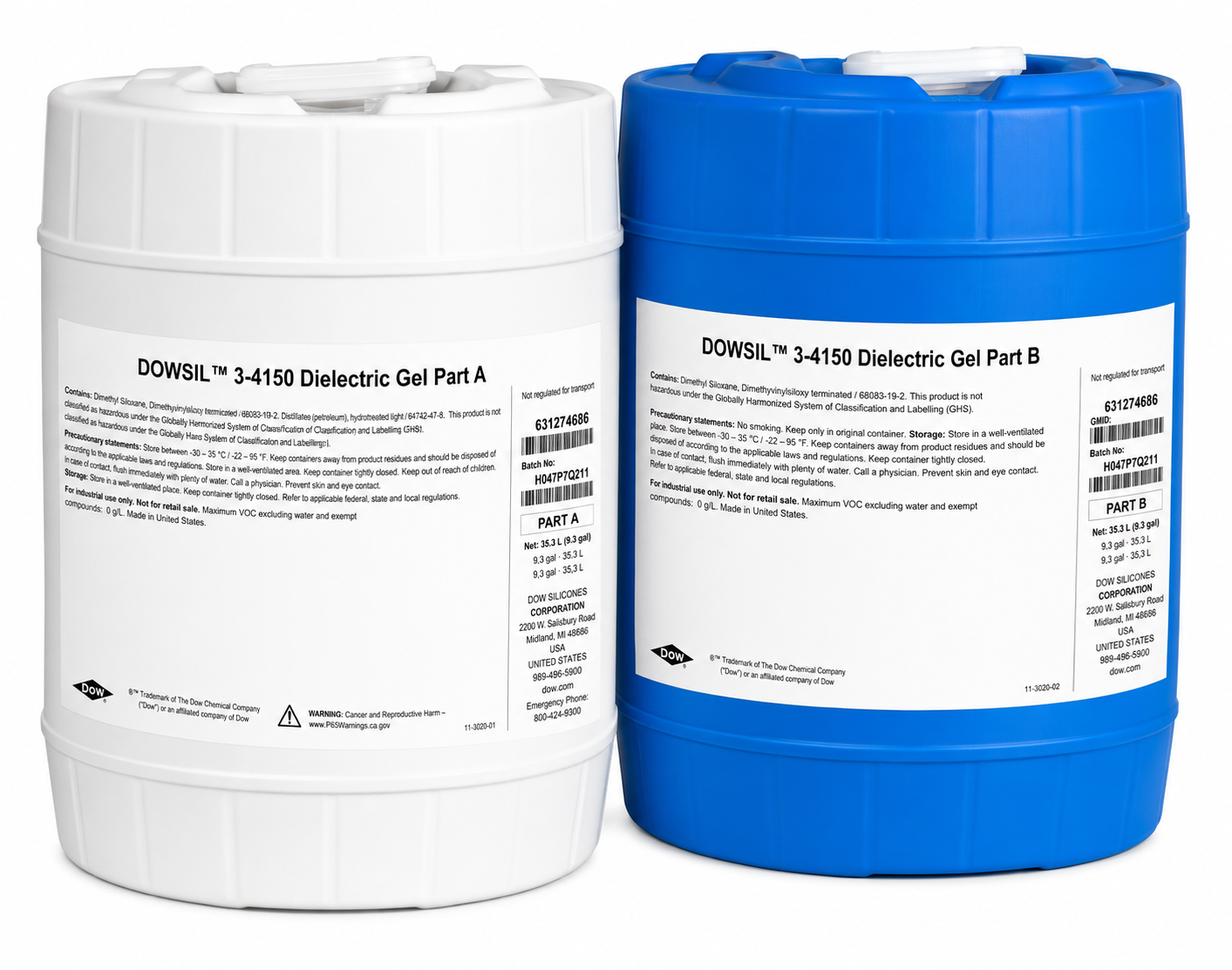

- Low viscosity and room temperature cure gel
- Low stress
- Excellent dielectric performance
Product Description
DOWSIL™ 3-4150 Dielectric Gel Kit is a two-part, 1:1 mix ratio, transparent green silicone dielectric gel designed for potting printed circuit board system assemblies. It provides 475 cP mixed viscosity, 7 minutes working time at 25°C, and 1.5 hours cure time at 25°C while supporting room temperature processing and soft gel encapsulation. This makes it a candidate for PCB assemblies requiring stress relief, mechanical protection, electrical insulation, and environmental protection, subject to application-specific testing and qualification.
Key features
- Two-part 1:1 mix ratio - supports straightforward metering and mixing for manual or automated dispensing.
- Fast room temperature cure - cures in 1.5 hours at 25°C without requiring an oven.
- Low mixed viscosity - 475 cP supports flow into PCB assemblies and potted geometries.
- Soft gel hardness - 115 grams gel hardness helps provide stress relief for delicate components.
- Electrical insulation - 375 volts/mil dielectric strength supports review for dielectric protection.
- Mix verification color - blue and yellow parts turn green when properly mixed.
Applications / Suitable for
DOWSIL™ 3-4150 Dielectric Gel Kit may be considered for electronics assemblies that require soft encapsulation, room temperature cure, and dielectric protection.
- PCB system assemblies: Designed for coating, encapsulating, or potting PCB assemblies with delicate components.
- Stress relief applications: May be considered where a very soft gel is needed to cushion components and interconnections.
- Electrical insulation review: Supports evaluation where dielectric strength and volume resistivity are part of qualification.
- Environmental protection: May be considered for assemblies requiring isolation from moisture and contaminants.
Technical Specifications
| General Properties | |||||||||
| Chemistry Type | Silicone | ||||||||
|
Mix Ratio
Mix Ratio
The amount of a constituent divided by the total amount of all other constituents in a mixture |
1:1 | ||||||||
|
Product Type
Product Type
Material category or functional product class. |
Dielectric gel | ||||||||
|
Specific Gravity
Specific Gravity
Specific gravity (SG) is the ratio of the density of a substance to the density of a reference substance; equivalently, it is the ratio of the mass of a substance to the mass of a reference substance for the same given volume. For liquids, the reference substance is almost always water (1), while for gases, it is air (1.18) at room temperature. Specific gravity is unitless. |
0.97 | ||||||||
|
Work life @25°C
Work life @25°C
Work life is the amount of time we have to work with a material until it is no longer able to be easily worked and applied on a substrate. It is based on the change in viscosity and it can rely on the application requirements. |
7/60 hours | ||||||||
|
|||||||||
| Physical Properties | |||||||||
|
|||||||||
|
|||||||||
| Curing Conditions | |||||||||
|
|||||||||
| Mechanical Properties | |||||||||
|
Hardness (Bloom Strength)
Hardness (Bloom Strength)
Softness or firmness of the cured gel. |
115 | ||||||||
| Electrical Properties | |||||||||
|
Dielectric Strength
Dielectric Strength
Dielectric strength is measured in kV per mm and is calculated by the Breakdown voltage divided by the thickness of the tested material. Those two properties go hand in hand and while Breakdown voltage is always thickness dependent, dielectric strength is a general material property. As an example, the dielectric strength of Polyimide is 236 kV/mm. If we place 1mm of Polyimide between two electrodes, it will act as an insulator until the voltage between the electrodes reaches 236 kV. At this point it will start acting as a good conductor, causing sparks, potential punctures and current flow. |
15 kV/mm | ||||||||
|
Volume Resistivity
Volume Resistivity
Volume resistivity, also called volume resistance, bulk resistance or bulk resistivity is a thickness dependent measurement of the resistivity of a material perpendicular to the plane of the surface. |
7.0x10¹⁵ Ohms⋅cm | ||||||||
|
|||||||||
|
|||||||||
Additional Information
DOWSIL™ 3-4150 Dielectric Gel Kit
DOWSIL™ 3-4150 Dielectric Gel Kit is a two-part, transparent green silicone dielectric gel designed for potting printed circuit board system assemblies. It provides 475 cP mixed viscosity, 7 minutes working time at 25°C, and 1.5 hours cure time at 25°C. Its soft cured gel form can help support stress relief, mechanical protection, electrical insulation, and environmental protection, subject to application-specific testing and qualification.
Typical values are not intended for specification writing. Review source documents before qualification.
Key features
- Transparent green mixed gel: blue and yellow parts turn green when properly mixed.
- Fast room temperature cure: 1.5 hours cure at 25°C supports room temperature processing.
- Low viscosity: 475 cP mixed viscosity supports flow during potting and encapsulation.
- Soft cured gel: 115 grams gel hardness can help cushion delicate components.
- Electrical insulation: dielectric strength and volume resistivity support dielectric protection review.
Processing summary
Mixing, deaering, and cure control
- Use accurate 1:1 proportioning to support consistent cure and final gel properties.
- Confirm the mixed material turns green as a visual check for proper mixing.
- Use static or dynamic mixers for automated meter-mix processes.
- For low-volume work, manual weighing and hand mixing may be appropriate.
- Consider gas entrapment during part design, mixing, and dispensing setup.
- Use bladder packs where applicable to reduce direct air contact and contamination risk.
- Do not apply air pressure directly to the liquid gel surface without a bladder pack.
- Degassing at more than 28 inches Hg vacuum may be needed for a void-free protective layer.
- Run small-scale compatibility testing when a substrate may inhibit addition-cure chemistry.
- Review exposure to organotin compounds, sulfur-containing materials, plasticizers, and flux residues.
- Check for liquid or uncured product at the substrate interface after cure.
- Validate cure schedules in each new assembly design and production process.
Uncured system properties, per technical data sheet
| Property | Part A or Base | Part B or Catalyst | Mixed |
|---|---|---|---|
| Viscosity, cP | 475 | 450 | 475 |
| Viscosity, mPa-sec | 475 | 450 | 475 |
| Viscosity, Pa-sec | 0.5 | 0.5 | 0.5 |
| Working time at 25°C | 7 minutes | ||
| Gel time at 25°C | 28 minutes | ||
| Cure time at 25°C | 1.5 hrs | ||
Cured properties, typ.
Cure basis: 1.5 hrs at 25°C. Cure is defined as the time required to reach 90% of final properties.
| Property | Typical value | Unit | Test method / condition |
|---|---|---|---|
| Specific gravity, cured | 0.97 | - | Per technical data sheet |
| Gel hardness | 115 | grams | Per technical data sheet |
| Dielectric strength | 375 / 15 | volts/mil; kV/mm | Per technical data sheet |
| Dielectric constant at 100 Hz | 2.85 | - | Per technical data sheet |
| Dielectric constant at 100 kHz | 2.85 | - | Per technical data sheet |
| Volume resistivity | 7.0 E+15 | ohm*cm | Per technical data sheet |
Where DOWSIL™ 3-4150 fits
- 475 cP mixed viscosity supports flow during potting.
- 375 volts/mil dielectric strength supports insulation review.
- 1.5 hours cure at 25°C supports room temperature processing.
- 115 grams gel hardness supports low-stress cushioning.
- Soft gel behavior can help relieve mechanical and thermal stress.
- Green mixed color supports visual review during processing.
- Volume resistivity is listed at 7.0 E+15 ohm*cm.
- Dielectric constant is listed as 2.85 at 100 Hz and 100 kHz.
- Void control and compatibility testing should be included in qualification.
Use the encapsulants and gels selection guide
Use the selection guide to compare Dow silicone encapsulants and gels by application need, processing window, and key material properties. Start with the assembly requirement, then review viscosity, cure behavior, hardness, dielectric properties, and handling notes before shortlisting materials for qualification.
- Review whether the application requires a gel, elastomer, encapsulant, or potting material.
- Compare processing needs such as mix ratio, working time, and cure schedule.
- Check dielectric, mechanical, and environmental protection requirements.
- Use DOWSIL™ 3-4150 as a candidate when soft gel stress relief and fast room temperature cure are important.
- Confirm final fit through application-specific testing and qualification.
Packaging and qualification support
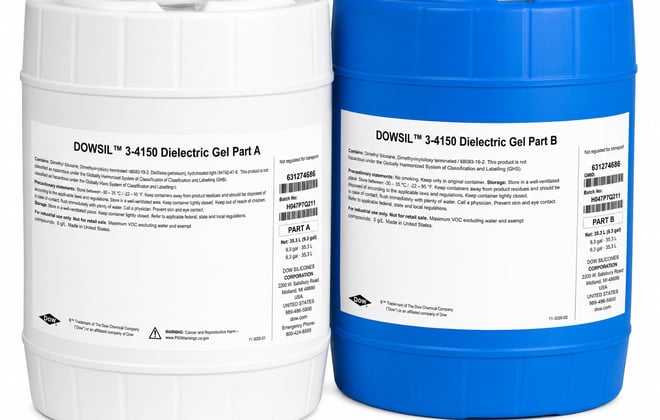
- Available in batch-matched kits containing Part A and Part B.
- Typical package options include 210 mL dual cartridges.
- Other listed options include one gallon pails, five gallon pails, and 55 gallon drums.
- Not all package sizes may be available for all gels or all locations.
- Share PCB layout, component height, potting volume, and dispense method.
- Identify cure constraints, room temperature process needs, and heat-acceleration limits.
- Define dielectric targets, environmental exposure, and expected service temperature range.
- Flag substrates, flux residues, or materials that may affect addition-cure compatibility.
Tips and troubleshooting
| Issue | Recommended action |
|---|---|
| Voids or air entrapment |
|
| Incomplete cure or cure variation |
|
| Potential cure inhibition |
|
| Repair or rework need |
|
| Storage or shelf-life deviation |
|