
Engineered for Orbit
Space-Qualified Coatings and Adhesives
-
Home

-
Aerospace
-
Space Systems
- Spacecraft Structural Bonding
Spacecraft Structural Bonding
Spacecraft Structural Bonding
Satellite bus panels, brackets, and substructure are frequently bonded rather than mechanically fastened, since bonded joints distribute load more evenly and avoid the stress risers and mass penalty of fasteners. The adhesive has to cure reliably in a cleanroom environment, survive launch vibration and shock, and hold up through years of thermal cycling in vacuum with no opportunity for repair.
This page covers structural and fast-curing adhesives used to bond glass, metal, and composite components on the spacecraft bus.
Where This Bonding Is Used
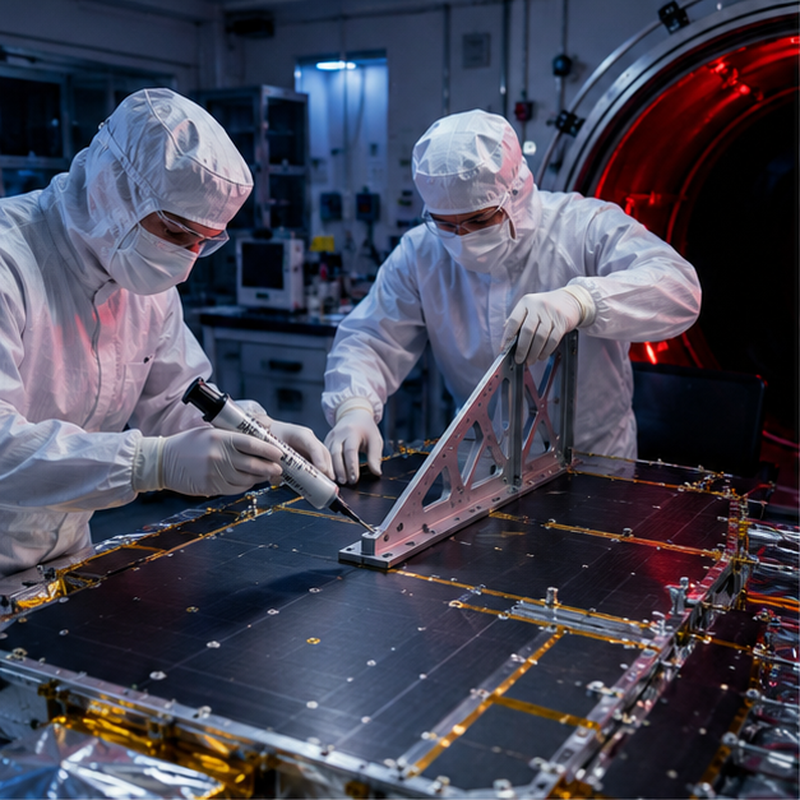
Structural adhesives bonding composite and metallic bus panels to brackets and substructure without the mass penalty of fasteners.
Fast-curing, low-outgassing adhesives bonding glass and metal components near optics and sensors, where contamination risk drives material choice.
Bonding of solar cells to substrates, OSR mirrors to substrates, and cover glasses to solar cells using space-qualified encapsulant/adhesive systems.
Selection Factors
Low TML/CVCM per ASTM E595 wherever the bond is near optics, sensors, or thermal control surfaces.
Whether the substrate needs a primer for reliable adhesion, or whether a primer-free system is preferred to simplify the cleanroom process.
Fast cure supports production throughput; longer working time supports precision alignment on optical and sensor assemblies.
Bond integrity through the vibration and shock loads of launch before the mission environment even begins.
Retained adhesion through repeated extreme temperature swings over an orbit, without a service atmosphere to moderate the range.
Proven adhesion across the specific mix of glass, metal, composite, and cured silicone commonly found on a satellite bus.
Frequently Asked Questions
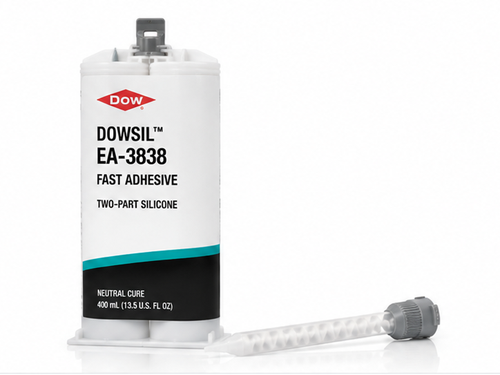
Why choose a primer-free adhesive like EA-3838 over a primed system?
A primer-free adhesive removes a process step, a cure/flash-off wait, and a source of batch-to-batch variability from a cleanroom production line, which can matter on programs with tight schedules or high part counts. A primed system may still be preferred where the substrate combination or long-term reliability data specifically calls for it, so the choice should be checked against the actual substrate and program requirements rather than assumed.
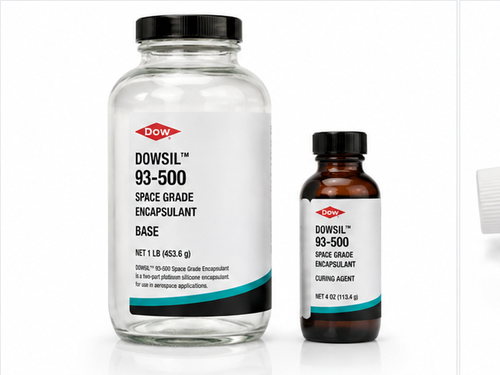
Is DOWSIL 93-500 an adhesive or an encapsulant?
Both, depending on how it's used. The same two-component silicone elastomer is documented for potting and encapsulating electronic components as well as for bonding solar cells, OSR mirrors, and cover glasses to their substrates. Which role it's playing on a given assembly determines how it should be specified and inspected, even though the material itself doesn't change.
Do all structural bonds on a satellite bus need to be low-outgassing?
Not universally, but it's the safer default assumption on most programs, since contamination-sensitive surfaces like optics, sensors, and thermal control coatings can be located elsewhere on the same bus. A bond far from any sensitive surface may tolerate a less stringent material, but that determination should be made deliberately rather than by default.
Are these products qualified to a specific space agency standard?
Qualification varies by product and grade. Dow documents several DOWSIL products, including 93-500, against NASA low-outgassing requirements per ASTM E595, but current certification status and any additional agency-specific approvals should be confirmed for the specific product and grade in question. Contact the technical team for documentation.
Do you provide support for spacecraft bonding material selection?
Yes. The Krayden technical team works directly with engineers on adhesive selection, datasheets, and application support for new satellite program qualification or production work.
Need Help Selecting a Spacecraft Bonding Adhesive?
Selection depends on the substrate, outgassing requirements, cure speed, and thermal cycling range. The Krayden technical team provides material selection support, datasheets, and application guidance across structural and fast-curing bonding systems.
Spacecraft Structural Bonding – Quick Reference