
Engineered for Orbit
Space-Qualified Coatings and Adhesives
-
Home

-
Aerospace
-
Space Systems
- Thermal Fluids & Management
Thermal Fluids & Management
Thermal Fluids & Management
Without an atmosphere for convective cooling, spacecraft electronics rely entirely on conduction and radiation to move heat away from components and reject it to space. Thermal adhesives, gels, and gap fillers bridge the physical gap between a heat-generating component and a radiator or heat pipe, and every one of them has to do that job without contaminating nearby optics or sensors.
This page covers low-outgassing thermal materials used to bond, fill gaps, and manage heat on spacecraft electronics and structures.

Where This Is Used
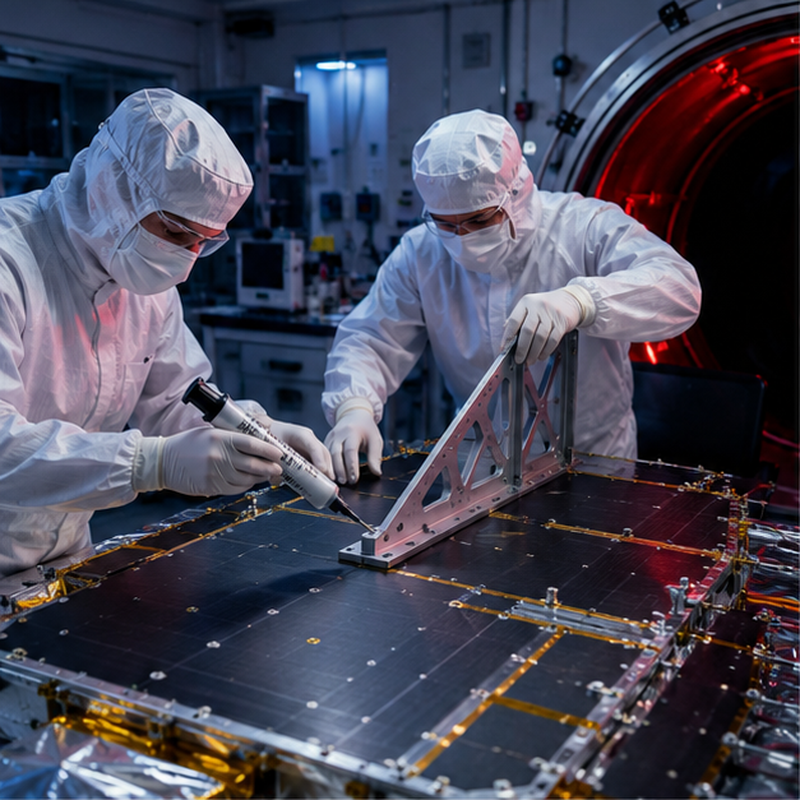
Thermal adhesives that bond and thermally couple heat-generating components directly to spacecraft radiator panels.
Gap fillers used where components sit at varying heights above a cold plate or heat sink and a solid bonded joint isn't practical.
Soft, low-modulus thermal gels used where mechanical stress on a delicate component or interconnect must stay minimal.
Selection Factors
Whether the interface needs mechanical bonding (adhesive) or should remain reworkable for component replacement (gel or gap filler).
Thermal performance at the actual installed thickness and contact pressure, not bulk conductivity figures alone.
Low TML/CVCM performance, since thermal materials are frequently located close to sensitive electronics and structures.
Softness or gap-filling range needed to accommodate component height variation without stressing solder joints or leads.
Retained thermal and mechanical performance through the repeated hot/cold swings of an orbit over the mission life.
Whether room-temperature or heat cure fits the assembly sequence and any heat-sensitive components nearby.


Frequently Asked Questions
Why not just bond every component to the radiator with a thermal adhesive?
A bonded joint gives good thermal performance but removes the ability to rework or replace that component without damaging it or the radiator surface. Gels and gap fillers trade some thermal performance for reworkability and tolerance to height variation across multiple components, which is often the better fit during integration and test when components may still need replacement.
How is spacecraft thermal management different from avionics thermal management?
Avionics thermal materials (covered on the Thermal Control application page) generally assume some airflow or a pressurized environment is available as a heat-rejection path. Spacecraft thermal materials work entirely by conduction to a radiator that rejects heat by radiation to space, with no convective assist, which changes both the thermal design approach and the outgassing requirements on the materials involved.
Does a softer thermal gel always mean worse thermal performance?
Not necessarily. A softer material can conform better to surface irregularities and achieve a thinner effective bondline at low pressure, which can offset a lower bulk conductivity number. Installed thermal resistance at the actual assembly pressure is a more reliable comparison point than bulk conductivity alone.
Are these thermal materials qualified to NASA outgassing standards?
Dow documents the TC-2035, TC-4060, and TC-5533 products alongside its Space Grade silicone line, but current certification status and specific test data should be confirmed for the exact grade in question before specifying it on a program. Contact the technical team for documentation.
Do you provide support for spacecraft thermal material selection?
Yes. The Krayden technical team works directly with engineers on thermal material selection, datasheets, and application support for new satellite program qualification or production work.
Need Help Selecting a Spacecraft Thermal Material?
Selection depends on whether the joint needs to be bonded or reworkable, the installed bondline, and outgassing requirements. The Krayden technical team provides material selection support, datasheets, and application guidance across thermal adhesives, gels, and gap fillers.
Thermal Fluids & Management – Quick Reference